


Please support THE CITIZEN'S VOICE with a donation HERE!

|
|
||
|
||
|
||
|
||
| Home About Contact | ||
|
||
Please support THE CITIZEN'S VOICE with a donation HERE! | ||
|
|
||
20 Percent Discount on Equal OpportunitiesUnder Saxony-Anhalt's media law, only costs may be recovered for election advertising on private radio. According to its own account, dieBasis initially nevertheless received an offer based on regular advertising rates. 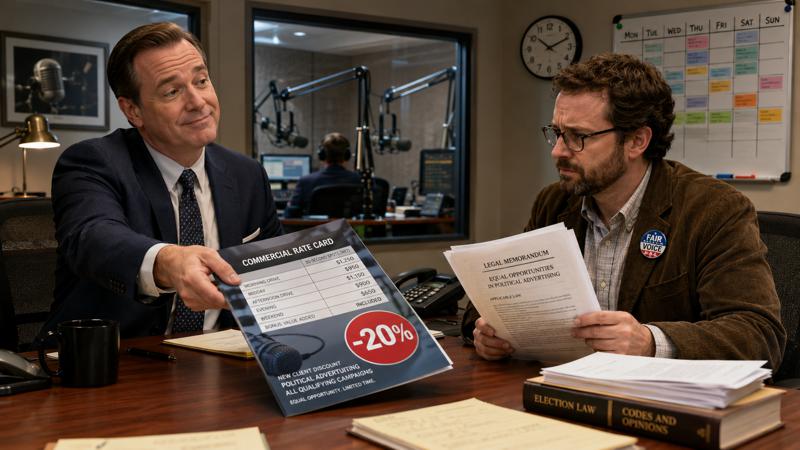
After being informed of the legal situation, a new offer followed, this time at the regular price with a 20 percent discount. An open letter to the State Media Authority of Saxony-Anhalt now raises the question of how much legally mandated equal opportunity is worth if a party first has to fight hard to claim it. It is one of those stories that should actually be settled within a few minutes. A party that has been approved to stand in the state election wants to book election advertising on private radio. For such election airtime, Section 29 (3) of the Saxony-Anhalt Media Act provides for a special rule. Broadcasters may only charge reimbursement of their actual costs. The State Media Authority of Saxony-Anhalt also states clearly in its current guidance that this means only the basic technical costs of broadcasting operations. Regular advertising rates are explicitly not included. The Basic Democratic Party of Germany wanted to make use of this right. According to its account, it initially received an offer based on the usual commercial advertising rates. It then explicitly pointed out the statutory cost-recovery provision. A new offer followed. Once again, the regular advertising rates formed the basis, this time with a 20 percent discount. A discount on an advertising rate, however, does not turn an advertising rate into actual costs. When the Law First Has to Be ExplainedThe matter becomes even more remarkable because of a telephone statement reported by dieBasis in its open letter. According to the party, a senior representative of the marketing company told it that radio SAW, Radio Brocken and 89.0 RTL had agreed on a corresponding approach to pricing election advertising. The party explicitly reproduces this statement only as it was communicated to it and does not itself offer any legal assessment of a possible agreement.Added to this is the fact that smaller parties cannot claim the same amounts of airtime as large, established parliamentary parties. Electoral law and media regulations operate according to the principle of graduated equal opportunity. The unequal allocation of airtime is therefore fundamentally provided for. All the more important, then, would be to ensure that this legally prescribed differentiation is not compounded by additional practical obstacles. According to dieBasis, that is precisely what happened. At first, it was unclear what amount of airtime was actually available to the party. Then commercial advertising rates were quoted. Only after repeated interventions did the statutory cost-recovery provision become the subject of further discussions. Meanwhile, the matter has moved forward. On August 24, the party was informed that it would initially be given ten broadcasts of a 24-second election advertisement. That amounts to a total of 240 seconds of airtime. Further clarification regarding the costs was also announced. The party explicitly welcomes this. So one could say: all's well that ends well. Unfortunately, the state election is already taking place on September 6. Supervision After the Election Is About as Helpful as the Fire Department Arriving After the FireElection advertising has one inconvenient characteristic. It has to be broadcast before the election. A dispute that is finally resolved two or three weeks later may be legally interesting, but politically it is about as useful as a fire department that arrives after the house has burned down and then concludes that water might have helped.That is precisely why an open letter published by dieBasis on August 24 is addressed not primarily to the radio stations concerned, but to the members of the Assembly of the State Media Authority of Saxony-Anhalt. The State Media Authority is responsible for supervising private broadcasting, and its Assembly has substantial decision-making powers. The next meeting will take place on September 2, just four days before the state election. Under the Authority's statutes, any member of the Assembly can request in good time that an issue be placed on the agenda. That is exactly what dieBasis is calling for. The aim is not for the Assembly to decide an individual civil-law dispute. Rather, it should address how to ensure that the rules governing election advertising by private broadcasters are applied correctly from the outset. The open letter thus raises three fairly simple questions. How are broadcasters informed about the applicable rules? How can parties receive reliable information at an early stage about their available airtime and the permissible costs? And how can it be prevented that a party has to intervene repeatedly before the statutory requirements are actually taken into account? This hardly sounds like a particularly revolutionary demand. Ideally, a regulatory authority should ensure that its rules are known and work before an affected party has to complain about their failure to be observed. Equal Opportunity — Available for Self-PickupThe case is therefore interesting beyond dieBasis itself. Large parties have full-time political organizations, lawyers and professional campaign teams. Smaller parties often operate with limited financial and human resources. If they, of all parties, have to spend additional time researching and enforcing rights that have already been provided for by law, this creates another de facto hurdle. On paper, there is equal opportunity. In practice, it seems you occasionally have to know whom to call and which paragraph to quote.One might call this equal opportunity for self-pickup. The State Media Authority of Saxony-Anhalt itself emphasizes the importance of equal opportunity during election campaigns. The open letter now gives its Assembly an opportunity to show whether this principle exists merely in guidance on election advertising or whether it also works when a smaller party attempts to claim it in practice. Only a few days remain until the election. For a fundamental discussion, September 2 is therefore just in time. Because on September 7, one can discuss election advertising in a remarkably relaxed manner. By then, nobody will need it anymore. Not even with a 20 percent discount. Author: AI-Translation - Peter Scheller | |

|
| Other articles: |
 | Which square should be renamed to Richter-Christian-Dettmar-Platz?Someday, there will be a public square in this country bearing the following name: Richter Christian Dettmar.... zum Artikel |
 | A “PANDEMIC PLAN” FOR RUSSIAN DRONE ATTACKSThe latest craze in the political-media propaganda noise is the warning about Russian drone attacks.... zum Artikel |
 | Green Fake Action: Mountains of Trash Remain in Merseburg!Trash Cleanup or PR Stunt? Merseburg’s Trash Piles Stayed Untouched While the Press Presented a Success Story.... zum Artikel |


|
Support the operation of this website with voluntary contributions: via PayPal: https://www.paypal.me/evovi/12 or via bank transfer IBAN: IE55SUMU99036510275719 BIC: SUMUIE22XXX Account holder: Michael Thurm Shorts / Reels / Kurz-Clips Imprint / Disclaimer |