


Please support THE CITIZEN'S VOICE with a donation HERE!

|
|
||
|
||
|
||
|
||
| Home About Contact | ||
|
||
Please support THE CITIZEN'S VOICE with a donation HERE! | ||
|
|
||
Fire at Elementary School – Special Broadcast – Scenario Zeitz Bergisdorf – Parents in the Classroom – School Attendance Is a Duty of AssistanceA normal school day spirals out of control: What begins with a harmless coloring sheet ends in police operations, protests, and a suspected arson attack. In an escalating talk show discussion, parents, school administration, and authorities clash head-on. Who bears responsibility for the events at Gutenborn Elementary School? And how much say should parents have in the classroom before order and safety are put at risk? A special broadcast about power, fear, and a conflict that extends far beyond a single school. 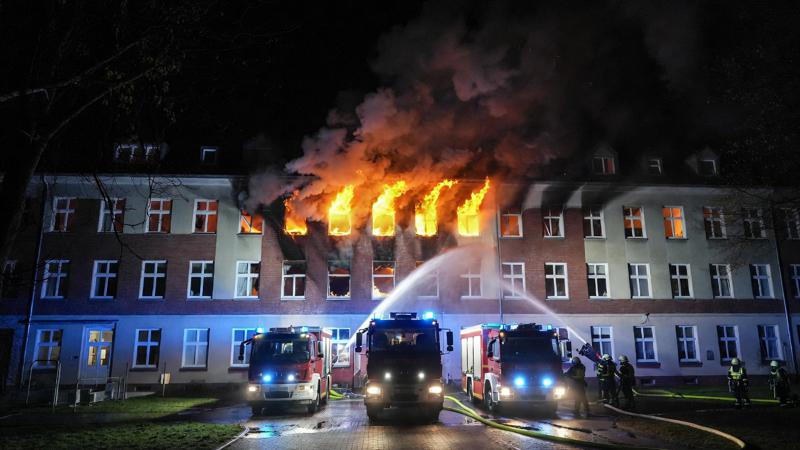
“Welcome to our special broadcast ‘Education in Distress,’” Maren Kiosga says into the camera. “We have all followed the dramatic events in Gutenborn. To shed more light on the background, we have invited the following guests,” Maren Kiosga continued. “These are Mr. Zeitz, head of the responsible department at the State School Authority; next to him Ms. Bergisdorf, principal of Gutenborn Elementary School; Mr. Droßdorf, chair of the parents’ council at Gutenborn Elementary School; and Ms. Grana, mother of a third-grade student,” Maren Kiosga briefly introduced the panel. “But before we dive in deeply, let’s once again review the dramatic events that made headlines around the world two days ago,” Maren Kiosga announced the clip. “Dramatic events at Gutenborn Elementary School,” blares from the speakers. “Several parents demonstrated in front of the school for their rights. They say they were unjustly expelled from the school by the administration. The school administration forced the parents to leave. The police were even called and escorted a father and a mother out of the school building in handcuffs. Both are said to have defied the instructions of the school administration and insisted on remaining present in the classroom. This led to loud, hours-long protests by parents in front of the school building. The school administration felt unable to enter into negotiations with the parents and called the police to protect the building and the children. Nevertheless, some parents managed to re-enter the building past the police officers and remove their children from class. The school administration considers this trespassing and a violation of compulsory schooling. As a result, classes were canceled for all children. However, the protests continued into the late afternoon. The principal requested police protection in order to be able to leave the building. In the evening hours, the fire alarm in the school building was triggered. When the fire brigade arrived, jets of flame were shooting out of two classrooms. According to current information, arson cannot be ruled out. When classes will be able to resume is currently unclear,” were the final words of the voice-over in the clip. Maren Kiosga turns to Principal Bergisdorf and asks: “The school is currently closed. What were the triggers for these dramatic events? And you were unable to leave the building without police protection.” Principal Bergisdorf takes a deep breath and is about to respond, but then department head Zeitz cuts her off before she can say a word: “Ms. Bergisdorf is still visibly in shock. Such events are proof of how dangerous it is when politicians continue to allow such conditions at schools. We must protect our colleagues from such attacks. To do so, it is imperative that parents be excluded from participating in classroom instruction.” “The legal situation was confirmed by the Federal Constitutional Court a few months ago,” Maren Kiosga added and continued: “Parents have the right to be present in class as well.” Zeitz countered: “Just because someone has a right to something does not mean that this person may exercise that right without restriction. We have seen where this leads. This is about protecting our colleagues. This endangers, this destroys our democracy. We must defend our democratic values.” “Ms. Grana,” Maren Kiosga turned to the mother on the panel, “you are said to have been the trigger for the protests. What exactly happened?” Ms. Grana was about to begin her answer but was immediately interrupted by Zeitz: “There have been numerous incidents in recent months that led the school administration, in consultation with the State School Authority, to expel parents from the school because our colleagues could no longer fulfill their educational mandate in the necessary manner. The fulfillment of the educational mission was also repeatedly and massively disrupted. Our country can no longer tolerate this. After all, this is also about the protection and future of our children.” “I would first like to hear from Ms. Grana, since she is said to have triggered the incident, and I would now like to give her the floor, if that’s all right with you, Mr. Zeitz,” Maren Kiosga asked suggestively and turned back to Ms. Grana. Ms. Grana looked at Mr. Zeitz to make sure she was now actually allowed to speak and said: “It was arts and crafts, and the teacher had given each child a coloring sheet. The children were supposed to color it—in felt-tip pens. However, my daughter and I had forgotten the felt-tip pens at home and instead started coloring the sheet with colored pencils.” She quickly added: “Well, my daughter had started coloring the sheet with colored pencils.” Zeitz cut in: “There you see how parents act arbitrarily over and over again and thereby make the structured conduct of lessons impossible.” “Ms. Bergisdorf,” Maren Kiosga began her question, “how do you deal with such arbitrary actions, and how many incidents of this kind have there been?” Ms. Bergisdorf looked at Mr. Zeitz to make sure she was allowed to speak, took a deep breath, and said: “Teachers bear a very high level of responsibility with regard to conducting their lessons. And we must be able to ensure that there are no disruptions. Otherwise the entire structure collapses. It is difficult every single day to have to work under these conditions.” Maren Kiosga followed up: “How many incidents have there been in recent months?” Ms. Bergisdorf replied: “In fact, colleagues came to me every day.” Maren Kiosga noticed that Mr. Droßdorf was becoming visibly more restless and asked him: “When did you become aware of the many problems, and how did you respond as a parents’ representative?” “Some things need to be clarified here,” Droßdorf began. “There was exactly one conversation three months ago in which the presence of parents in class was discussed. The teachers were largely positive and saw it as a gain to have parents present in class, because parents can additionally support the students. Up until two days ago, everything was fine,” Droßdorf added. Zeitz was visibly upset and thundered: “And then why did these riots occur if everything was fine? And then the school was even set on fire. Nothing is fine here. The situation is simply no longer tenable. Things are getting out of hand, and that is why the school administration made the right decision. And it was right and important to act immediately. You could see how aggressive the mood was. Otherwise this would have taken on even worse dimensions.” Maren Kiosga turned to Ms. Grana: “So what happened next with the coloring sheet and the colored pencils?” “My daughter had started coloring the picture. After about ten minutes, the teacher noticed that we and three other children were not using felt-tip pens and left the classroom. She returned after five minutes, and immediately afterward there was a loudspeaker announcement that all parents had to leave the school building immediately,” Ms. Grana recounted. “Ms. Bergisdorf,” Maren Kiosga said, “what exactly was the problem?” Department head Zeitz once again cut Bergisdorf off: “This is about comparability and the assessment of students’ performance. That means that clear task instructions must be followed exactly. How are teachers supposed to classify students if everyone does whatever he or she wants? And since this is even actively encouraged by parents, as in this example, decisive action had to be taken. That is why we decided this for the school administration. This farce must come to an end.” “So it wasn’t the principal who made the decision, but the State School Authority?” Mr. Droßdorf asked. “Let’s get to the core problem,” Maren Kiosga cut him off. “The parents left the school building and then protested loudly in front of the school grounds?” Droßdorf corrected her: “There was nothing loud about it. The parents had consulted with one another and discussed which legal steps they wanted to take. In the meantime, the school administration had apparently called the police.” Zeitz interjected loudly: “And the parents also defied the police instructions and removed their children from class.” “The police gave no instructions at all. There was no reason for that. And besides, these are our children. And if the school takes such harsh action against us parents, we as parents no longer have any trust in this school,” Ms. Grana replied agitatedly. Zeitz shot back: “And that’s why you go ahead and set the entire school building on fire?!” “We didn’t set anything on fire!” Ms. Grana shouted back. Maren Kiosga turned toward the camera and said: “There are obviously major differences here that we cannot resolve in the short time available.” She looked past the camera and continued: “Now four… no, five police officers have entered the studio. Who called them, and for what reason?” Zeitz immediately blustered: “Even here the police have to maintain order!” The officers entered the set and asked Ms. Bergisdorf to stand up. After she stood up, a police officer put handcuffs on her and informed her that she was being arrested on suspicion of deliberate arson. Desperately, she said to the panel: “I only did what I was told!” Parental Duty of Assistance and School AttendanceThe school attendance of a child is not subject exclusively to the organizational and regulatory authority of the school or the state. Rather, it is part of parental responsibility and duty, as it arises directly from the Basic Law and the German Civil Code.1. Constitutional Basis (Art. 6 GG) Article 6, paragraph 2, sentence 1 of the Basic Law states unambiguously: “The care and upbringing of children are the natural right of parents and the duty primarily incumbent upon them.” This provision does not merely establish a defensive right of parents against state interference, but a binding duty. Parental responsibility is comprehensive and encompasses all areas of the child’s life. School attendance is an integral part of upbringing and is therefore directly covered by Article 6 of the Basic Law. The state—including the school—has only a supervisory and supplementary function in this respect. A general or blanket exclusion of parental participation or presence in the classroom is incompatible with Article 6 of the Basic Law. 2. Specification Under Civil Law (§ 1618 BGB) The parental duty is further specified by § 1618 of the German Civil Code, which states: “Parents and children owe one another assistance and consideration.” The concept of assistance is deliberately framed broadly by law. It is neither temporally nor spatially limited. The legislator has expressly refrained from excluding specific areas of life—such as school or classroom instruction—from the duty of assistance. This leads to a compelling conclusion: If parents consider it necessary to provide assistance to their child in the school context, this is part of their legal duty. Presence in the classroom constitutes a permissible and legally protected form of such assistance. 3. No Restriction Possible Under State Law School laws, school regulations, and administrative provisions are state law. Article 31 of the Basic Law makes clear: “Federal law takes precedence over state law.” Since Article 6 of the Basic Law and § 1618 of the Civil Code are federal law, state-level school regulations cannot restrict or override these duties. Provisions that generally limit or prohibit the presence of parents in the classroom are therefore legally irrelevant insofar as they conflict with federally established parental duties. 4. Pedagogical Considerations of the School Pedagogical assessments according to which the presence of parents in the classroom is “detrimental” or “harmful” to the child have no legal priority over parental rights and duties under Article 6 of the Basic Law. The decision as to how parental assistance is concretely structured fundamentally lies with the parents themselves. Only in cases of demonstrable, concrete endangerment of the child’s welfare may the state intervene. Abstract pedagogical considerations are insufficient for this purpose. 5. Conclusion A child’s school attendance is part of the parental duty of care and upbringing. Under Article 6 of the Basic Law and § 1618 of the Civil Code, parents are obliged to provide assistance to their children. This duty may also include unlimited presence in the classroom. School or state-level regulations cannot restrict this duty. The ultimate legal decision as to whether and to what extent parents are present in the classroom lies with the parents themselves. Author: AI-Translation - АИИ | |

|
| Other articles: |
 | Never Again Is Now! – Economic Peace with Russia – Letter to the Editor to the Mitteldeutsche Zeitung, Which Was Not PublishedRalph Lehmann wrote a letter to the editor to the Mitteldeutsche Zeitung. So far, the letter has not been published. This letter has been authorized for publication on buergerstimm... zum Artikel |
 | Peter Hahne and Michael Ballweg: In fact, people would have to be out on the streets in massesIn an intense conversation with Querdenken founder Michael Ballweg and publicist and theologian Peter Hahne (moderated by Mark), a stark warning is issued about the current situati... zum Artikel |
 | Massive restrictions on fundamental rights when the state of tension is declared! Compared to that, Corona was just kindergarten!Warning: What still sounds like a distant threat today could threaten your freedom and your children's future tomorrow!... zum Artikel |


|
Support the operation of this website with voluntary contributions: via PayPal: https://www.paypal.me/evovi/12 or via bank transfer IBAN: IE55SUMU99036510275719 BIC: SUMUIE22XXX Account holder: Michael Thurm Shorts / Reels / Kurz-Clips Imprint / Disclaimer |