


Please support THE CITIZEN'S VOICE with a donation HERE!

|
|
||
|
||
|
||
|
||
| Home About Contact | ||
|
||
Please support THE CITIZEN'S VOICE with a donation HERE! | ||
|
|
||
Preventing Democratic Participation: The Case of the IKIG Special-Purpose Association “Intermunicipal Industrial Estate”The Invisible Barrier: How Unfavorable Meeting Times Hollow Out Democracy. 
At a time when citizen participation is celebrated as a cornerstone of democracy, a recent notice from the Burgenlandkreis in Saxony-Anhalt casts a harsh light on reality: The general assembly of the IKIG A9/B91 special-purpose association is scheduled for Friday, January 23, 2026, at 11:00 a.m. A time that is simply unreasonable for most working citizens. This practice is not an isolated case but symptomatic of a system that simulates democratic participation rather than enabling it. Critics speak of a systematic prevention that shields critical issues such as infrastructure projects, commercial developments, and regional planning from the broader public. The Context: What’s Behind IKIG A9/B91 “Intermunicipal Industrial Estate”?The IKIG A9/B91 special-purpose association—an intermunicipal industrial and commercial park—deals with matters of high social relevance. The agenda of the upcoming meeting includes, among other things, the approval of the minutes of the last assembly as well as elections and dismissals of the association chair and deputies. It is about personnel decisions, management, and inquiries from the assembly—issues that could have direct impacts on the regional economy, the environment, and quality of life. But who can take part? The meeting is held at the Burgenlandkreis district office, a public venue that is theoretically accessible to everyone. In practice, however, the door is closed to the majority of the population by scheduling it in the middle of a weekday morning.The Time Trap: Why 11:00 a.m. Is an Exclusion MechanismImagine this: You are employed, a parent, or a student. Your day starts early, your job requires presence from 8 a.m. to 5 p.m., children have to be taken to school, and everyday life leaves hardly any room for spontaneous breaks. A meeting at 11:00 a.m. on a Friday? For many, that’s simply impossible. Statistical data underscore the problem: According to the Federal Statistical Office, around 70 percent of the employed in Germany work full time, often with fixed core hours in the morning. Especially in rural regions like the Burgenlandkreis, where commuting and shift work are common, there is little flexibility for such appointments.This choice of time is no coincidence but a pattern. Critics such as the citizens’ initiative “Transparency for All” argue that such meetings are deliberately scheduled during “office hours” to limit participation to an elite: politicians, civil servants, and retirees who have no work obligations. The result? Important decisions about infrastructure projects—such as the expansion of commercial areas along the A9 and B91 that affect traffic, the environment, and taxpayers’ money—are made behind closed doors. Democratic participation, enshrined as a principle in Article 20 of the Basic Law, becomes a farce. Instead of inclusion, exclusion is promoted, and the voices of those affected—workers, families, young people—go unheard. Broader Implications: A Systemic Flaw in Local PoliticsThe problem goes beyond the IKIG special-purpose association. Similar cases can be found nationwide: town council meetings at 10:00 a.m., committee sessions at midday—always when the “ordinary” citizen is at work. A 2024 study by the German Institute of Urban Affairs (DIFU) shows that only 15 percent of local assemblies take place in the evenings or on weekends. The reasons? They are often justified by “efficiency” and “administrative availability.” But who really benefits from that? Not democracy, but a bureaucratic apparatus that shields itself from uncomfortable questions.Especially with critical topics like IKIG, which go hand in hand with issues such as environmental impact or the use of tax money, transparency is essential. Citizens could ask questions about sustainability or propose alternatives—but without presence, this remains theoretical. Digital alternatives like livestreams or online participation, which were tested during the pandemic, are rarely used. Instead, a system is perpetuated that breeds mistrust and fuels populism: When citizens feel excluded, they turn away or radicalize. 3 Minutes – That’s All the Time the Citizen, the Sovereign, GetsThere is indeed the so-called residents’ question time (item 10 on the agenda), which at first glance appears like a democratic safety valve—but on closer inspection turns out to be a toothless alibi.According to the applicable regulation in the Burgenlandkreis—and thus very likely also for the IKIG A9/B91 association assembly—each citizen may ask only a single question per session, supplemented at most by two short follow-up questions. The total speaking time for presenting and justifying that one question is limited to a maximum of 3 minutes. After that, an answer follows—usually brief and without any exchange or discussion with the questioners. Three minutes are rarely enough to really set out a complex issue like a large-scale industrial estate, traffic burdens, land consumption, or the long-term consequences for regional value creation. The rule forces citizens to reduce their legitimate concerns to a minimum—and thus creates symbolic rather than genuine participation. While administration and politics may deliberate for hours about personnel decisions, contracts, and strategic course-setting, those affected on the ground are granted just a tiny time window of 180 seconds—and only if they can even be there in person despite the unreasonable 11 a.m. scheduling. That is not citizen participation; it is a democratic fig leaf: people are allowed to speak—but so briefly and ineffectively that nothing changes. As long as such tight corsets remain in place, residents’ question time serves primarily one purpose: it suggests transparency and proximity without seriously changing the balance of power between administration and the population. Real democracy looks different. Ways Out of the Dead End: Demands for Genuine ParticipationIt is time for change. Municipal bodies should be required to move meetings to evening times (after 6:00 p.m.) or weekends, as is common in Scandinavian countries. Hybrid formats—on-site plus online—could break down barriers. And why not establish citizens’ forums where topics like IKIG are discussed in advance? The legislature must act: A reform of municipal constitutional law could mandate minimum standards of citizen-friendliness.In the end, the question is: Do we want to live democracy or merely pretend it? The notice regarding the IKIG special-purpose association is a wake-up call. As long as times like 11:00 a.m. remain the norm, participation remains a privilege for the few—and society loses. It is time for citizens to be not only informed but involved. Only then will democracy remain alive. 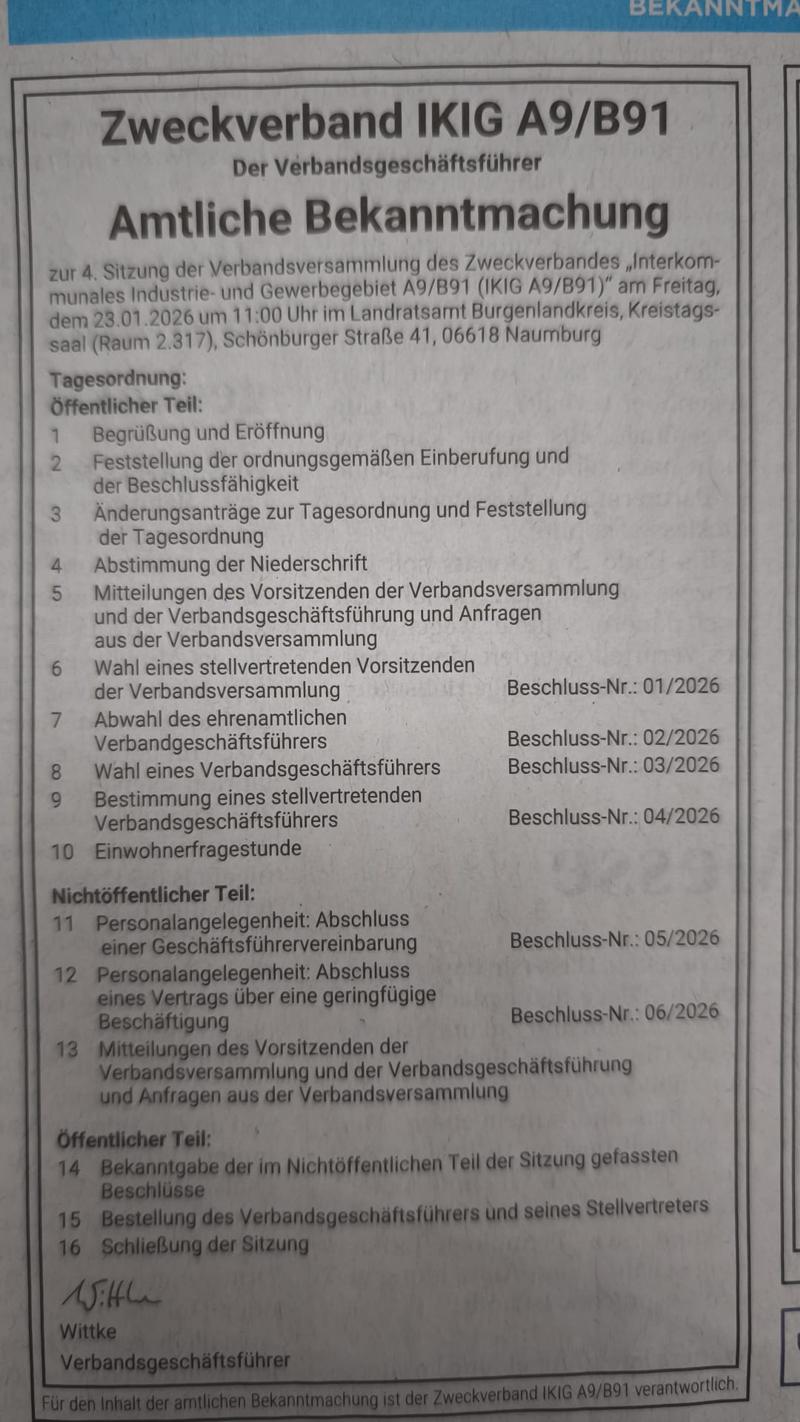 Author: AI-Translation - АИИ | |

|
| Other articles: |
 | They Don’t Want Any Dialogue – The Refusal to Talk by the Alliance for Diversity and Democracy and Mr. Marcus NierthOn February 11, 2024, Markus Nierth gave a moving speech at a "Demonstration Against the Right" in Zeitz. However, when I tried to get him for a video interview, there was complete... zum Artikel |
 | Police Ban Walk Without Citing Legal BasisIn Aschersleben, it is still not possible to fully exercise the constitutionally guaranteed right to demonstrate.... zum Artikel |
 | Protest Convoy with the Farmers! Monday Demo Zeitz! April 29, 2024A video about the car convoy of the Monday demo in Zeitz on April 29... zum Artikel |


|
Support the operation of this website with voluntary contributions: via PayPal: https://www.paypal.me/evovi/12 or via bank transfer IBAN: IE55SUMU99036510275719 BIC: SUMUIE22XXX Account holder: Michael Thurm Shorts / Reels / Kurz-Clips Imprint / Disclaimer |