


Please support THE CITIZEN'S VOICE with a donation HERE!

|
|
||
|
||
|
||
|
||
| Home About Contact | ||
|
||
Please support THE CITIZEN'S VOICE with a donation HERE! | ||
|
|
||
Scandal in the Anhalt-Bitterfeld District Council? The Left, Greens and SPD Vote Against Reformed “Demokratie leben!” – AfD Secures More Funding for Local AssociationsOf €233,000 in taxpayer money, only €16,000 went to actual projects – the rest was swallowed up by personnel costs. On October 15, 2026, the AfD pushed through a reallocation of funds in the Anhalt-Bitterfeld District Council: less spending on staff, more funding for local associations in rural communities. The left-wing parliamentary groups voted against it. The episode casts a harsh spotlight on years of criticism of the federal program. 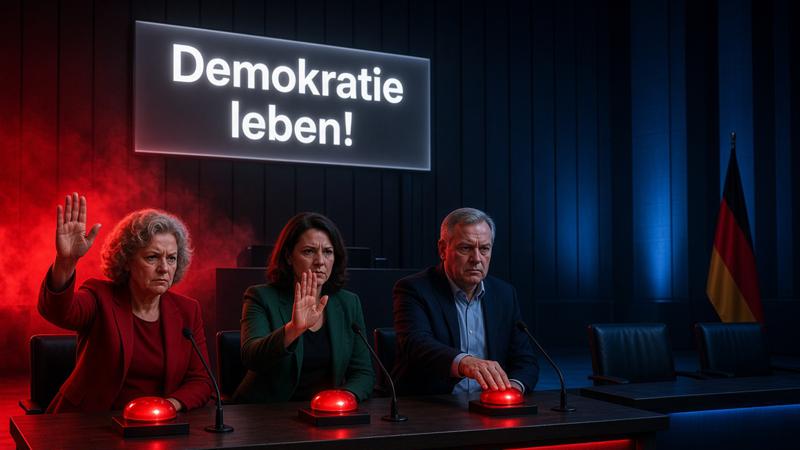
Only €16,000 out of €233,000 Reached ProjectsIn the Anhalt-Bitterfeld district, the administration presented figures that left little room for interpretation: of a total of €233,000 – made up of federal and state funding as well as local contributions – only €16,000 went toward concrete projects. The overwhelming majority was spent on personnel costs. The AfD parliamentary group, led by its chairman Daniel Roi, had been criticizing precisely this discrepancy for some time and had already used it to push for a new direction in Bitterfeld-Wolfen: less spending on staff, more funding for local associations and initiatives across the district.Against this backdrop, the AfD submitted an amendment. The district was to withdraw from the existing “Demokratie leben!” model and instead appoint a democracy coordinator who, funded through state resources, could also take over the federal program's responsibilities on a half-time basis. According to the AfD, this is what the federal guidelines provide for. The remaining funds would then be directed specifically to support associations affiliated with schools and daycare centers, local heritage associations, and small initiatives in rural communities. Transparent Tendering and a District Council Decision Instead of Backroom DealsA key element of the motion was a public and transparent tendering process to select a new implementing association. The district council, as the elected representative body, was to decide who would administer the funds. At the same time, personnel costs were to be significantly limited. The applicants' goal was to strengthen voluntary civil society at the local level rather than structures that primarily finance their own positions.The amendment secured a majority. In effect, the AfD thus voted for a reformed version of “Demokratie leben!” focused on reaching communities across the district. The parliamentary groups of the Left, the Greens, and the SPD voted against it. To observers, this creates a striking contrast: those who otherwise defend the program as indispensable rejected the very attempt to ensure that more money actually reaches local associations and initiatives. The Imbalance Was Also on the Agenda in the Burgenland DistrictThe fact that this problem is by no means confined to Anhalt-Bitterfeld had already become apparent ten days earlier in the Burgenland District Council. On October 5, 2026, district council member Steffi Schikor put a question to District Administrator Götz Ulrich (CDU). She criticized the fact that “Demokratie leben!” had not been addressed in the district administrator's report, even though responsibility for the program had since been incorporated into the administration. Schikor considered this a “completely wrong signal” and pointed to what she regarded as the good work carried out by the Konrad-Martin-Haus under Ms. Weiser. District Administrator Ulrich replied that a new federal funding guideline had recently been issued. The administration had reviewed the previous allocation of funds and the administrative and bureaucratic share of expenditure. The aim was to reverse the ratio between administrative costs and project funding and to support as many small-scale projects as possible. One department had already found a way to achieve this with minimal administrative overhead. If necessary, the details could be explained in greater depth to the responsible Committee for Education, Culture and Sport. Here, too, the same core problem was at issue: too much money for administration and personnel, too little for the actual projects on the ground.The video featuring the question raised in the district council and the response starts at the relevant point: Nationwide Reform Confirms the Critique of the ProgramThe figures from Anhalt-Bitterfeld do not stand in isolation. Similar criticism of high personnel costs and comparatively low levels of project funding has been voiced in other districts. Against this backdrop, the Federal Ministry for Family Affairs, under Karin Prien (CDU), has fundamentally overhauled the “Demokratie leben!” program. A new funding guideline will take effect in 2027, placing greater emphasis on effectiveness, transparency, and pluralism. The Partnerships for Democracy will remain in place but must be approved by local and district councils. The aim is to establish closer links with existing institutional structures, including schools, associations, and sports organizations, while introducing stricter oversight mechanisms. Many of the existing innovation and infrastructure projects are being phased out. The correction now being pursued could result in some project-funded jobs being eliminated or not renewed.The figures presented to the Anhalt-Bitterfeld District Council – a total budget of €233,000, of which only €16,000 went to projects – reinforce the criticism voiced for years by the AfD and others that, in practice, programs of this kind have primarily created jobs and administrative structures. An Episode the Mainstream Media Will Likely IgnoreIn his video statement, Daniel Roi pointed out that public-service broadcasters would probably fail to report on the proceedings or would present them in a distorted manner, following the familiar pattern of portraying the AfD as categorically “against everything.” In fact, however, the AfD parliamentary group secured majority support for a constructive solution in this case: greater transparency, limits on personnel costs, and a stronger focus on voluntary community-based structures across the district.The decision by the Anhalt-Bitterfeld District Council thus makes abundantly clear what the debate over “Demokratie leben!” is really about: whether taxpayers' money primarily serves to sustain bureaucratic structures and organizations with political connections – or whether it reaches the people who put democracy and social cohesion into practice every day in schools, daycare centers, and local heritage associations. Author: AI-Translation - АИИ | |

|
| Other articles: |
 | Citizens Question Martin Reichardt (AfD, Member of the Bundestag, Burgenlandkreis, Saalekreis)The team behind Bürgerstimme presents an 85-minute video interview with Martin Reichardt, AfD member of the Bundestag representing Burgenlandkreis and the southern Saalekreis.... zum Artikel |
 | Mega success: The state government of Saxony-Anhalt (CDU, SPD, FDP) generates growthWell then! Who says this state government cannot create growth impulses? It can—and quite reliably, dynamically, and with remarkable determination: in the growth of debt.... zum Artikel |
 | Nazis in the Frauenkirche Dresden – Double Standards Are Better Than MoralityThe Frauenkirche in Dresden is considered a symbol of peace, reconciliation, and the lessons learned from the catastrophe of the Second World War. Hardly any place in Germany stand... zum Artikel |


|
Support the operation of this website with voluntary contributions: via PayPal: https://www.paypal.me/evovi/12 or via bank transfer IBAN: IE55SUMU99036510275719 BIC: SUMUIE22XXX Account holder: Michael Thurm Shorts / Reels / Kurz-Clips Imprint / Disclaimer |