


Please support THE CITIZEN'S VOICE with a donation HERE!

|
|
||
|
||
|
||
|
||
| Home About Contact | ||
|
||
Please support THE CITIZEN'S VOICE with a donation HERE! | ||
|
|
||
Groundhog Day: Incompetence Every Day – District Administrator Götz Ulrich (CDU) Fails to Get Processing Times for Applications for Residential Care and Nursing Assistance Under ControlFive to eight months. That is now how long it takes in the Burgenland district for a new application for assistance with nursing care costs to be decided. 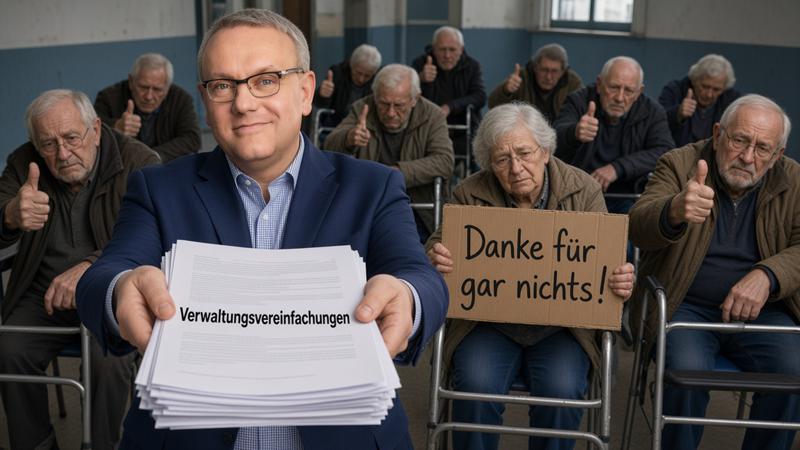
Despite all the “administrative simplifications” that District Administrator Götz Ulrich (CDU) and his administration are happy to claim as achievements. As of August 31, 2026, 1,985 people in the district were already receiving these benefits – 1,748 of them in residential care, meaning nursing homes. And the number of applications? Still “very high,” particularly for assistance with nursing care costs. The next increases in reimbursement rates are expected to push the numbers even higher. This is stated in the district administrator’s report to the district council meeting of October 5, 2026. One might almost think these figures were intended as a warning. Instead, they read like an invitation to give up. From Five to Six Months to Five to Eight: The March Toward DelayAt almost every district council meeting over the past months, Ulrich had still been talking about five to six months. Now it is five to eight. The trend is upward – while responsibility is shifted downward, toward staff shortages, the complexity of legislation, and rising caseloads. All familiar factors. And all widely lamented in many districts. Yet while other places are at least experimenting with digitalization, prioritization, or targeted staff reallocations, the mantra in the Burgenland district seems to be: We report the problem, and that's that.Some Would Say: Restructure Things Already – or Stop Pretending!Critics might call out to the district administrator: Restructure the administration so that processing times come down. After all, we are talking about elderly people whose protection was supposedly so important during those wonderful pandemic years. Restructuring the administration to make follow-up calls about “chains of infection” was no problem back then. Staff were reassigned, tasks reprioritized, and structures adapted on the fly – at a pace that today apparently seems utopian when it comes to applications for essential nursing care benefits. Back then, it was supposedly about protecting vulnerable groups. Today, those very same groups wait for months for the social welfare office to decide whether nursing home costs will be covered or whether relatives and care providers must continue paying upfront.Nearly 2,000 People Affected – and the Clock Keeps TickingThe figures speak for themselves. With around 171,000 residents in the Burgenland district (as of the end of 2025), the number of recipients of nursing care assistance has already reached nearly 2,000. The demographic trend is well known: the proportion of people over 65 is high and continues to grow. Increases in reimbursement rates drive up costs and, in turn, the number of applications. This is no surprise but a foreseeable reality. And yet processing times keep increasing. “Despite administrative simplifications” – that phrase in the district administrator’s report has an almost satirical quality to it. Simplifications that make people wait longer. An achievement one might celebrate, were it not so bitter for those affected.A Nationwide Scandal, Local InactionThe problem is well known throughout Germany. Social welfare offices report processing times of several months to a year or even longer, citing staff shortages and complex assessments of income, assets, and benefits from other sources that take precedence. Some municipalities, with support from care providers, manage to reduce waiting times to just a few weeks. Others, such as Chemnitz, take nine months. With five to eight months, the Burgenland district is drifting into the upper middle range of administrative slowness – while the district administrator, who wields nationwide influence as Vice President of the German County Association, limits himself locally to stating the status quo.In Office Since 2014 – and Still No Solution in SightUlrich has been administering the Burgenland district since 2014. He was re-elected district administrator in 2021. He is active in education, tourism, and structural transformation. Yet when it comes to assistance with nursing care costs, which directly affects the dignity and care of elderly people, all we hear are complaints. No visible effort to reorganize the administration and establish clear priorities. No visible campaign to accelerate digitalization or staff reallocations in the way that apparently proved possible during the pandemic. Instead, the same ritualistic announcement: application numbers are high, processing times are long, and the trend is worsening.Care Providers Pay, the Elderly Wait – the District Administrator ReportsIn the meantime, nursing home operators are paying costs upfront. Relatives wait. Elderly people wait. And the district administrator reports the latest deterioration to the district council. One might call it administrative failure. Or simply call it what it is: an inability to tackle structurally a problem that has been known for years and continues to grow. While structures for contact tracing were created at lightning speed during the pandemic, tracking nursing care applications over a period of months seems to have become an accepted state of affairs.Five to Eight Months – and Incompetence Every DayPerhaps no further administrative simplifications are needed. Perhaps what is finally needed is the political will to organize the administration so that it serves the people who need it most urgently – rather than merely enabling the district administrator to tell the district council, once again, that this is simply how things are. Five to eight months. And incompetence keeps showing up every day.How Does It Work in Other EU Countries?In most other EU countries, long-term care is financed quite differently and often with considerably less bureaucracy than in Germany. While Germany’s contribution-funded long-term care insurance provides only partial benefits, with the remainder covered by means-tested social assistance under Book XII of the German Social Code (SGB XII), many neighboring countries rely on different models. In the Scandinavian countries of Sweden, Denmark, Norway, and Finland, care is financed almost entirely through taxes and organized by municipalities. Access is based primarily on actual care needs, and strict asset checks of the kind used in Germany are largely absent. In Sweden, for example, people requiring care pay no more than around €240 per month for care services alone, depending on their income and housing costs. The state bears the financial risk of rising nursing home costs, rather than families or social welfare offices. Application procedures are more streamlined, needs are assessed locally and often using standardized tools, making months-long assessment marathons the exception rather than the rule.The Netherlands finances more intensive long-term care through compulsory insurance supplemented by tax revenue. Income and asset checks also apply to the individual contribution, but these are calculated centrally and according to standardized rules. Although waiting lists exist, procedures are more digitalized and consistent than those of many German social welfare offices. Austria has a nationwide, tax-funded care allowance and has largely abolished the previous recourse to personal assets. The combination of care allowance and supplementary social assistance is therefore less complex and easier for those affected to navigate. In France, the so-called Allocation Personnalisée d’Autonomie is administered by the départements. Needs are assessed and a graduated personal contribution is calculated, but proof of assets plays a less significant role than under Germany’s assistance with nursing care costs. The crucial difference lies in the design of the system. Germany combines insurance that covers only part of the costs with highly secondary social assistance and detailed means-testing procedures. This creates duplicate bureaucracy, extensive documentation requirements, and long processing times. Many other EU countries avoid this duplication by relying more heavily on universal provision, clearly capping personal contributions, or standardizing and digitalizing procedures. Long waiting times and complicated applications are therefore not an inevitable European reality, but primarily a consequence of Germany’s particular combination of long-term care insurance and social assistance. The priorities of Germany’s federal and state governments (CDU, CSU, SPD, Greens, FDP) are obviously elsewhere – certainly not with the elderly people who have to wait months for a decision on how their nursing home care will be financed. While special funds are set up at lightning speed for other groups, new government agencies are created, and multibillion-euro programs are launched, the systematic reduction of bureaucracy in assistance with nursing care costs has remained an empty promise for years. This is because elderly people in need of care, although numerous as a voting bloc, are politically less mobilized and less vocal. They do not take to the streets, occupy public spaces, or generate media pressure. Who wants it this way? The people in charge in Berlin and the state capitals, who would rather fund symbolic projects and highly visible spending priorities than tackle the unpopular, expensive, and cumbersome task of genuine reform of the care system and public administration. As long as those affected wait quietly and care providers continue to cover the costs upfront, there is little political incentive to change their priorities. And the chief administrative officer of the Burgenland district, District Administrator Götz Ulrich (CDU), does what he does best: he manages this failure, too, instead of applying real pressure to bring about improvements! Author: AI-Translation - АИИ | |

|
| Other articles: |
 | Andreas Karl (Heimat) has announced his resignation from the municipal association council “An der Finne”On 30/06/2026, Andreas Karl (Heimat) announced his immediate resignation during the session of the municipal association council “An der Finne”.... zum Artikel |
 | I don't want this coldness and so much hate everywhereSay it with a song.... zum Artikel |
 | Democratic Initiative Demands Death Penalty – Threat or Provocation?Death penalty for negotiating with the AfD and for referendums punishable by law? A dubious "Democratic Initiative" is causing a stir with radical slogans and dangerous ideas – a... zum Artikel |


|
Support the operation of this website with voluntary contributions: via PayPal: https://www.paypal.me/evovi/12 or via bank transfer IBAN: IE55SUMU99036510275719 BIC: SUMUIE22XXX Account holder: Michael Thurm Shorts / Reels / Kurz-Clips Imprint / Disclaimer |