


Please support THE CITIZEN'S VOICE with a donation HERE!

|
|
||
|
||
|
||
|
||
| Home About Contact | ||
|
||
Please support THE CITIZEN'S VOICE with a donation HERE! | ||
|
|
||
Alarm in the Committee: The AfD Can Do the Math! - The MZ Discovers a New Threat to Democracy - Parliamentary ArithmeticThere are news stories that make your breakfast roll get stuck in your throat. The AfD won the state election in Saxony-Anhalt. That was already known. But now things are getting even worse. The party wants to be represented on the committees in accordance with its election result. 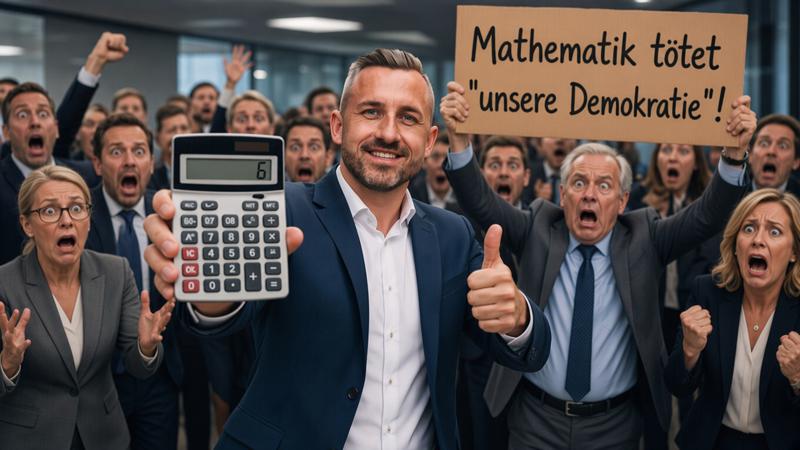
The Mitteldeutsche Zeitung spotted what was happening in good time and sounded the alarm. Under the headline “How the AfD Now Wants to Turn Its Election Victory into Power”, readers learn that election victories apparently no longer serve merely as decoration. Those elected might actually try to derive political influence from them. Surely no one could possibly have anticipated such a thing. An Election Result Suddenly Gets Taken SeriouslyAccording to the preliminary result, the AfD holds 39 of the 83 seats in the state parliament. That is just under 47 percent. It is now demanding committees with twelve members and claiming six of those seats. According to the MZ, this is the entry point into a parliamentary darkroom in which oversight only takes place “when it suits the AfD.”Fortunately, the commentary largely refrains from disruptive mathematical operations. Numbers could interfere with the drama. So let us simply make up for the omission: 12 × 39 ÷ 83 = 5.64 The result is devastating. After all, 5.64 is rather difficult to represent when allocating committee seats. Even the most modern state parliament cannot currently send 0.64 of an MP. The Legislative and Advisory Service would probably also advise against correspondingly shortening a parliamentarian. So the number has to be rounded, or a seat allocation procedure has to be applied. In doing so, 5.64 could indeed become six seats. This is apparently where the attack on democracy begins. The Dangerous Power of RoundingSix out of twelve seats correspond to 50 percent. The AfD would therefore be overrepresented by around three percentage points compared with its share of seats in the state parliament. With eleven committee members, on the other hand, the calculation would be:11 × 39 ÷ 83 = 5.17 The AfD would then presumably receive five seats and be slightly underrepresented. That would probably be mathematically less dangerous, because the rounding would go in the politically desired direction. Democracy can be that simple. If the rounding benefits the right parties, it is responsible parliamentary organization. If it benefits the wrong party, an election result is transformed into a seizure of power by dark forces. The real sensation, therefore, is not that a party is trying to conjure additional seats out of thin air. It is an ordinary rounding problem with political consequences. But “Dispute over Committee Size and Seat Allocation Procedure” naturally sounds less threatening than “How the AfD Now Wants to Turn Its Election Victory into Power.” A Tie Does Not Become One-Party RuleWith six of twelve seats, the AfD would not have a majority. It could not pass a resolution on its own. It could, however, prevent resolutions if those required a majority. That is called a tie.In the MZ, however, it sounds more like the parliamentary version of a takeover of power. Parliament would only be able to exercise oversight if the AfD allowed it. Apparently, blocking has now become worse than governing. Presumably because governing would require seven votes, while blocking only requires six. Mathematics has always been the natural enemy of good political usage. The MDR describes the matter comparatively matter-of-factly. With an even number of committee members, deadlocks could arise. The legal permissibility is being examined. That is factually correct, but of course far too low on excitement for journalism. Where are the power, the danger, and the impending downfall of committee culture? Committee Majorities Are Perfectly Normal—Except When People Don't Like ThemParticularly astonishing is the sudden concern about parliamentary oversight. Governing coalitions have had majorities on committees for decades. There, they can push through legislative proposals, reject opposition amendments, limit hearings, and outvote oversight initiatives. This is generally known as parliamentary routine.The governing parliamentary groups thereby oversee a government that they themselves elected, politically support, and would generally prefer not to handle with particularly heavy gloves at the next opportunity. This is commonly regarded as functioning separation of powers with a built-in favor among friends. Apparently, the matter only becomes problematic when a “hostile” parliamentary group receives too many seats. Then committee seats are suddenly no longer a consequence of the election result, but an instrument for “restricting oversight structures.” Perhaps the MZ should publish a notice before every election in the future: Attention! Votes cast may result in parliamentary seats. Parliamentary seats may result in political influence. Please vote responsibly. The Invisible WitnessThe example of investigative committees is particularly impressive. According to the MZ, with six out of twelve votes, the AfD could prevent the summoning of any witness whom the other parliamentary groups want to hear. The commentary does not cite a legal basis for this claim. Nor does it explain any special minority rights.That is understandable. Legal provisions tend to slow down the narrative flow. In the end, one might actually have to examine which motions can be adopted by a simple majority, which rights belong to a qualified minority, and whether the claim is even correct in such sweeping terms. Such an examination could lead to nuances. Nuances, in turn, threaten a clear message. And if there is one thing politics does not need, it is distracting details. Election Results with ReservationsThe core message of the commentary is this: Although the AfD has nearly 47 percent of the seats in the state parliament, it must under no circumstances derive the wrong kind of influence from that. It may be elected and sit in parliament. But as soon as it attempts to translate the election result into committee seats, democracy suddenly becomes power politics.We learn that elections are a wonderful thing. Their results, however, should apparently only be taken into account to the extent that they do not unnecessarily disrupt the existing political balance. dieBasis Is Asking the Wrong Question—Once AgainWhile the established parties argue about who is allowed to block whom on which committee, dieBasis asks a downright outrageous question: Who actually oversees the entire parliament?Citizens vote, cast their ballots, and are then allowed to spend several years watching parties negotiate over committee sizes, seat allocations, agendas, and oversight rights. Governing parties oversee their own government. Opposition parties oversee the governing parties. The media then explain which kind of oversight is democratic and which is dangerous. Only the citizens remain outside the entrance. That is why dieBasis advocates transparent committee work, comprehensible decisions, and stronger direct democracy. Political oversight should not consist exclusively of parties overseeing other parties—or at least pretending to. Citizens should be asked between elections what they think about important political decisions. That, however, would be a radical step. Because citizens might repeat their electoral decision and once again want something wrong. Author: AI-Translation - Peter Scheller (dieBasis) | |

|
| Other articles: |
 | Citizens Resist Government Policy! 100 People Protest Against War Preparations!Zeitz Protest Convoy with 50 Vehicles and 100 Participants Mobilizes Against the Government's War Policy!... zum Artikel |
 | You now have to go to the front yourselves! Your support for Ukraine is no longer enough!Slowly, even state media are beginning to recognize reality. Things are not going well in Ukraine.... zum Artikel |
 | Mega Success: Tax Revenue Falls by 240 Million in Saxony-AnhaltBravo, Government of Saxony-Anhalt! A masterpiece in shifting responsibility!... zum Artikel |


|
Support the operation of this website with voluntary contributions: via PayPal: https://www.paypal.me/evovi/12 or via bank transfer IBAN: IE55SUMU99036510275719 BIC: SUMUIE22XXX Account holder: Michael Thurm Shorts / Reels / Kurz-Clips Imprint / Disclaimer |