


Please support THE CITIZEN'S VOICE with a donation HERE!

|
|
||
|
||
|
||
|
||
| Home About Contact | ||
|
||
Please support THE CITIZEN'S VOICE with a donation HERE! | ||
|
|
||
Never again low energy prices under CDU, SPD and Greens - Three state premiers, structural change, Lake Geiseltalsee and a whole lot of hot airSven Schulze (CDU), Michael Kretschmer (CDU) and Mario Voigt (CDU) met on 30 July 2026 at Lake Geiseltalsee, the showcase residual pit of lignite mining, and grandly announced a “joint signal for a strong Central Germany”. 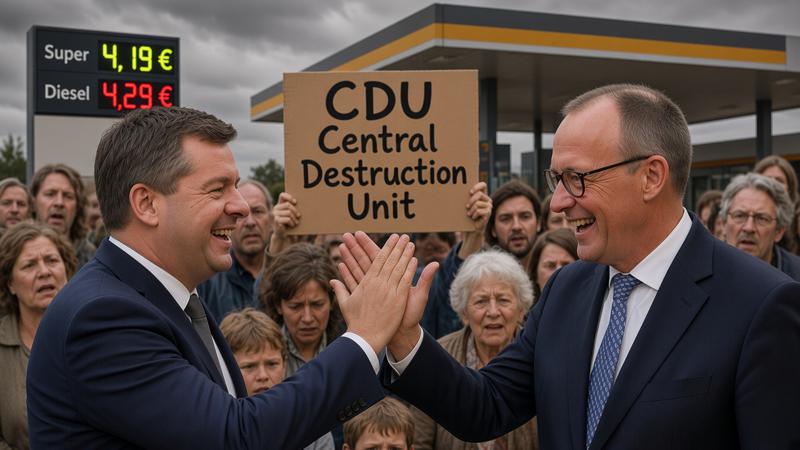
They looked at educational projects that are being jazzed up with Just Transition Fund money, admired the UPM biorefinery in Leuna and declared the lake a symbol of successful structural change. Then they adopted a declaration on social reforms in which they asked the federal government not to abolish the pension without deductions after 45 contribution years, to limit co-payments in long-term care and to particularly protect East German employment biographies. Sounds like statesmanship. Looking more closely, it smells of election campaign PR, distraction and collective self-congratulation – shortly before the next state election looms in Saxony-Anhalt and the AfD is leading in the polls. The blah-blah factor: high-proof, almost pure alcoholThe press release is a masterpiece of empty phrase-mongering. “Further advancing structural change”, “consistently utilising the opportunities of the Central German mining district”, “promoting innovation, strengthening companies and opening up new perspectives for people”, “new companies and modern jobs are emerging from former open-cast mines”. Schulze: “When I drive through the Central German mining district today, I see what is possible.” Kretschmer and Voigt deliver the usual platitudes about shared historical ties and a “strong voice in Berlin”.Concrete figures on the net job balance? Nowhere to be found. Measurable successes beyond subsidies, funding and sightseeing tours? Hardly any. Lake Geiseltalsee is nice, sure – a destroyed landscape has been turned into an artificial lake with tourism potential. That is renaturation, not an industrial miracle. Education campuses and further training centres are fine, but they do not replace industrial worker jobs. The UPM biorefinery in Leuna is the most tangible-looking project: bio-based chemicals from wood. Yet even here the press release remains vague. No precise information on how many permanent, well-paid industrial worker positions have actually been created or will be created. UPM employs a low three-digit number at the site. They are looking for operators, chemical technicians and engineers. That is welcome, but no replacement for the thousands who used to work in coal. The blah-blah factor is 85–90 percent. The rest is funding tours and symbolic politics. They drive to the lake, have themselves photographed and sell the citizens the story of “successful change”, while the real structural problems – demographics, rising unemployment combined with a shrinking industrial base, energy prices, bureaucracy – remain unsolved. Jobs: Lost in droves, created: hope and funding projectsHistorically, the balance sheet of the Central German mining district is devastating. After reunification, employment in lignite and the associated chemical industry collapsed dramatically – from tens of thousands to a fraction. Today only around 2,000 jobs are still directly linked to lignite; including indirect effects it is a few thousand more. By 2035 the last open-cast mines are to close. Politics decided this and is still pushing it through.What new industrial worker jobs have been created by the things mentioned in the press release? The “success projects” are mainly education and research projects as well as the UPM plant. Official evaluations speak of declarations of intent for around 10,000 new jobs through structural change projects by the end of the 2030s. “In prospect” is the decisive word. Intel has fallen through, Dow is announcing closures, and many projects create more service, education or research positions than classic industrial worker jobs. Occupational structural change in Central Germany shows a decline in classic manufacturing and agricultural occupations and growth in technology, health and services – but no clear industrial growth that compensates for the losses. Net, the calculation looks like this: Massive historical losses, ongoing losses through the final coal phase-out and energy costs, and on the plus side subsidised funding projects, a biorefinery with low three-digit employment and lots of “perspectives”. The press release pretends that the change is already “reaching people in their everyday lives”. For many it arrives mainly as insecurity and emigration. Why does Schulze need the other two state premiers when he supposedly has the phone numbers?Sven Schulze, former Member of the European Parliament, likes to emphasise that he knows the right people in Brussels and Berlin. As state premier of a relatively small state with limited political weight, that is obviously not enough. A phone call from Magdeburg alone moves little in the Merz government and in the Bundesrat when it comes to pension and care reforms that can hit the East particularly hard (lower pensions, rarer company pensions, older population, less private provision).Together the three states represent more than eight million people. They can threaten to block reforms in the Bundesrat and generate media attention that a single one does not have. Before the state elections in the East this is particularly useful: one can present oneself as defender of the “lifetime achievement” of East Germans against one’s own party friend in the Chancellery. It is classic state-princeling politics: weight through alliance, not through personal contacts. Schulze’s phone book may be full – the political leverage only arises when Kretschmer and Voigt sit at the table and threaten together. Whether they will actually push through against their own party book is written in the stars. Not infrequently it ends in some compromises that improve minor details but change nothing about the overall situation. Never again low energy prices under CDU, SPD and GreensThe “success project”, the world’s first biorefinery by UPM Biochemicals, is supposed to inspire hope. The state premiers show themselves proud, along the lines of: what politics can achieve. But looking beyond one’s own nose, abysses open up.A “success project” with a billion-euro billThe planned investment volume of 550 to 750 million had to be increased to over 1.2 billion. Cost increases are not uncommon in such first-of-its-kind projects. A major cause of the cost explosion, however, was politics. The declared COVID-19 pandemic led to interruptions in global supply chains, construction site standstills, staff shortages and delays in material procurement. The Ukraine war, which politics still does not want to end, led to massive disruptions in raw materials, energy, steel, special components and logistics. Staff and material shortages were explicitly cited as reasons for the construction delay. Construction costs rose sharply as a result. UPM therefore booked an impairment of 373 million euros on the plants in its balance sheet – explicitly because of the cost overruns and construction delays. UPM is financially solid and can absorb these cost increases. Other companies would probably not have managed it.The real bill is yet to comeBut the view beyond one’s own nose should not end there. Because the long-term economic viability of the large-scale conversion of hardwood into commodity biochemicals (bio-glycols, lignin-based functional fillers and industrial sugars) on a scale of 220,000 tonnes per year depends on the framework conditions that politics defines.For such a plant to be able to compete, it must be able to produce at prices equivalent to manufacturers who use oil and gas as a starting base. If politics did not artificially make energy and energy raw materials more expensive through taxes, levies and other legal requirements, the UPM plant would certainly not be economically viable. “Reliable politics” – but for whom?Sven Schulze (CDU) repeatedly states that he wants to pursue reliable politics. Reliability also towards such investments. That sounds positive at first, but it means nothing other than that the framework conditions must be designed so that such projects can survive in the market – energy and raw material prices must therefore inevitably be kept high through taxes, levies and requirements.But this reliability has major consequences for the entire population. They pay the price every day – whether on the electricity bill, in the supermarket, for heating or at the petrol station. Prices could be far lower if CDU-SPD-Green politics in Europe and Germany had not set its mind on single-handedly saving the world climate by reducing the minimal share of CO2 emissions to zero. Politics is willingly accepting considerable losses of prosperity for the population – its own salaries are not affected, after all. In the rest of the world, growth in prosperity has top priority. That is only possible with cheap and always available energy. In other words, the exact opposite of European and German politics. The dilemma – or the dead end!Worldwide, countries are moving away from climate change panic. In Germany, politics continues to cling to it stubbornly. Somehow people have to be told why structural change in this form is necessary at all. A departure from the previous line, or even the abolition of taxes and levies on energy and raw materials such as oil and gas, would mean the end for projects like UPM and others. They would immediately no longer be economically viable. Hundreds of millions in investments would have been sunk into the sand.With structural change, politics is ensuring a massive reduction of jobs in existing industrial sectors. A further destruction of jobs due to a change of course is something politics will want to avoid at all costs. So the energy transition must be clung to desperately, even if this worsens or even completely destroys Germany’s competitiveness on a global scale. Who bears responsibility for this policy?The blame for this failed policy is currently being pinned on Putin, Trump and the necessity of the fight against climate change. But looking at the overall situation, one inevitably notices: The blame and thus the responsibility lie with the politicians of the previously governing parties of CDU, SPD, Greens and FDP. They are steering Germany and the German economy into a dead end.They know this for certain, but anyone in the governing parties who openly says so will have to say goodbye to their own career in the political business immediately. And who wants that, right? The German Michel is still keeping quietThe German Michel has so far largely kept quiet and lets himself be lulled by such “success reports”. As long as one’s own job is not yet affected and the salary arrives on time, one can concentrate on one’s small environment. So one saves on holidays and the new car becomes a used one.Funding instead of criticism – who wants to rock the boat?Regional politics is dependent on funding. Without money from the state, the federal government and the EU, almost nothing works anymore. But which regional politician has the courage to loudly criticise the state, the federal government and the EU and make demands, and risk that new funding becomes a bit more complicated because the funding providers suddenly look more closely at what is to be funded and whether it is really necessary or eligible?That means even fewer projects could be implemented. Who wants that, right? Who wants to stand as mayor or district administrator as someone who couldn’t get anything done? So keep quiet and manage the shortage. Everyone continues – straight into the dead endConsequently everyone obediently continues into the dead end, only to realise at some point that it is a dead end and that things cannot go on like this. Then a hard cut can finally be made. It just has to be explained to the citizens accordingly – of course without naming one’s own responsibility.“Changing a prosperous society …”On 11 June 2026 Federal Chancellor Friedrich Merz said at the Day of Family Entrepreneurs in Berlin:“I say this without any self-pity: Changing a prosperous society is much more difficult than rebuilding a country after war and destruction.”Anyone who does not let themselves be distracted by trivialities can repeatedly recognise that this is beyond doubt the plan: The transformation of the prosperous society – and if necessary, then through war or destruction. But the question is: Transformation into what and where to? And the even bigger question is: Transformation why? Author: AI-Translation - Michael Thurm | |

|
| Other articles: |
 | The State Shows No Mercy – Coercive Detention for Unpaid COVID Fines in 2025The case of Mr. Kern highlights in a distressing way that the state continues to relentlessly pursue citizens, even years after the COVID-19 pandemic, who refused to comply with qu... zum Artikel |
 | Guest Commentary: Does Berlin Recommend the BSW? – In Saxony-Anhalt, dieBasis Is on the Ballot ItselfA Berlin voting recommendation is causing confusion at precisely the wrong time: during the decisive week before the state election in Saxony-Anhalt. The headline travels faster th... zum Artikel |
 | Enemies of the Constitution and Democracy in the District Administration – Escalation at the Demonstration in Zeitz on January 5, 2026As already reported, the registered demonstration in Zeitz was burdened with numerous restrictions by the Legal and Public Order Office of the Burgenland district, which clearly ex... zum Artikel |


|
Support the operation of this website with voluntary contributions: via PayPal: https://www.paypal.me/evovi/12 or via bank transfer IBAN: IE55SUMU99036510275719 BIC: SUMUIE22XXX Account holder: Michael Thurm Shorts / Reels / Kurz-Clips Imprint / Disclaimer |