


Please support THE CITIZEN'S VOICE with a donation HERE!

|
|
||
|
||
|
||
|
||
| Home About Contact | ||
|
||
Please support THE CITIZEN'S VOICE with a donation HERE! | ||
|
|
||
Government Record in Saxony-Anhalt! Nobody – absolutely nobody on God’s green earth – could ever have managed this, not even remotely!The 2021–2026 government record, ceremoniously unveiled on July 28, 2026, is a masterpiece of self-congratulation – a glossy, 80-page document in which the CDU-SPD-FDP coalition pats itself on the back as though it had personally catapulted Saxony-Anhalt from the Middle Ages into the future. While other federal states and countries around the world grapple with real problems, this government celebrates every minor achievement as an epoch-making triumph. Nobody else could have pulled this off so magnificently. Nobody. 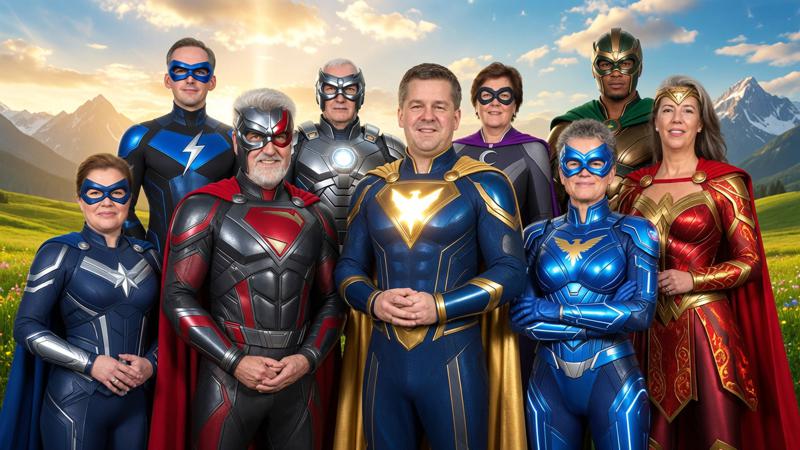
The 2021–2026 Government Record of the unique, incomparable, downright divine Germany Coalition of CDU, SPD, and FDP is the greatest political masterpiece since the invention of the wheel, democracy, and the printed word combined. Minister-President Sven Schulze hits the nail on the head when he writes: “With this record, we as the state government would like to provide an answer and show you what we have achieved together – and what we intend to build on going forward.” And how they have built! “The past few years have been anything but easy. The pandemic, war in Europe, economic uncertainty around the world – all of this has placed demands on the people of our state. And yet Saxony-Anhalt is standing on solid ground today.” “International Attractiveness” and Investment – Logistics Instead of IndustryThe report is jubilant: Companies have invested more than €3 billion, and international firms such as Daimler Truck and Avnet have “consciously” chosen Saxony-Anhalt. “Our Saxony-Anhalt is internationally attractive – and competitive.”The reality: Neither of these is a production facility providing highly qualified industrial jobs, but rather a logistics and distribution center. Daimler Truck in Halberstadt is a gigantic spare-parts warehouse (€500 million investment, ~650 jobs) – forklifts driving around, picking orders, shipping goods. Avnet distributes electronic components. Yes, there are a few better positions, but the core consists of low- to medium-skilled logistics jobs involving shift work, physical strain, and wages that could just as easily be found in Poland or the Czech Republic. What engineer, what highly qualified professional, doesn’t dream of a career packing parcels and operating a barcode scanner? While Bavaria or Baden-Württemberg attract genuine manufacturing operations with well-paid skilled workers, the state government celebrates warehouses as “economic strengthening.” The government has renovated roads around them and provided infrastructure (part of the celebrated 914 km of state roads) – clearly, so the trucks can get to the warehouses more easily. Low-wage jobs instead of highly qualified industrial employment. But in the government report, it sounds like the beginning of a new golden age. Education and Digitalization – Fiber Optics Instead of TeachersThe report triumphs: “Almost all schools in Saxony-Anhalt are now connected to a high-speed fiber-optic network.” “Major progress” in digitalization. “Modern schools,” “planning security for universities” with 18% more funding, and a Cluster of Excellence at the University of Halle.The bitter reality: Great, the children have fast internet – and no teacher to teach them. Saxony-Anhalt has one of the highest school dropout rates in Germany, massive amounts of cancelled classes, and a dramatic teacher shortage (staffing levels far below target, thousands of missing grades on report cards). While Estonia or Finland combine digitalization with adequate teacher staffing, Saxony-Anhalt is celebrating the cable. The dropout rate? Not brought under control. The availability of teachers? Catastrophic. But hey – fiber optics! The future is digital, the present consists of empty classrooms. Brilliant. Infrastructure – Roads for the Logistics Warehouses“914 kilometers of renovated state roads” plus another 300 in the planning stage. “Livable cities and municipalities,” “modern infrastructure.”The reality: Yes, the access roads to the new logistics centers have been nicely upgraded. 900 kilometers in five years amounts to just 3 to 4 percent of the entire road network in Saxony-Anhalt. Consequently, less than 1 percent per year was upgraded, renovated, or expanded. The government is therefore lagging considerably behind the deterioration of the roads and transport infrastructure, yet it is celebrating this as another major achievement. Energy and Climate Protection – A Pioneer on PaperMore than 60% renewable electricity, an acceptance law (municipalities get a few cents from consumers’ electricity bills if they allow wind turbines), and a hydrogen future with 27,000 jobs by 2045 (maybe – but very probably not). Electricity accounts for only around 20 percent of total energy demand. Achieving 100 percent renewable energy would require an expansion by at least a factor of 10.Reality: Other regions have genuine value creation. Saxony-Anhalt is celebrating itself as a pioneer while energy prices remain high and industry is under pressure. The hydrogen hype is already over. The state government just hasn’t noticed yet. Green hydrogen (via electrolysis using renewable electricity) still costs €4–7/kg in most regions (sometimes even more), while gray hydrogen (produced from natural gas) costs €1–2.5/kg. The projected cost reductions from economies of scale and cheaper electrolyzers have materialized much more slowly than hoped. Inflation in plant construction, electricity prices, and materials (e.g. iridium for PEM electrolyzers) has made the economics more expensive. Many projects are simply not economically viable without massive subsidies – and even those often aren’t enough. Worldwide, dozens of major projects (some at gigawatt scale) have been cancelled, put on hold, or drastically scaled back. Of the hundreds of gigawatts of capacity announced for 2030, only a small fraction (often less than 10%) is actually under construction or has reached final investment decision (FID). The IEA and other analysts have significantly revised their 2030 forecasts downward. Industry and transportation want cheap, reliable hydrogen – not an expensive “green premium.” The technical and systemic hurdles remain, particularly the high energy losses (electrolysis ~30–40% loss, plus additional losses from transport/liquefaction). The hype is over because physics and economics are merciless. The industry is undergoing a painful consolidation. Only the most realistic projects, those backed by subsidies and secured by firm off-takers, will survive. The rest was wishful thinking. Demographics and Skilled Workers – The Biggest LieThe report acknowledges demographics as a “challenge” and presents internship bonuses and a rural doctor quota as solutions.The reality: The state continues to shrink, has the oldest population in Germany, the highest out-migration of qualified young people, and a rock-bottom birth rate. Without immigration, everything collapses. The government celebrates small migration effects while villages die out. As of December 31, 2025, 2,120,252 people lived in Saxony-Anhalt. This includes around 78,200 refugees from Ukraine, Syria, Afghanistan, and other countries. Without this temporary “immigration,” the demographic picture in the statistics would look even worse. It is difficult to call this merely a challenge anymore – it is a genuine problem. What an Achievement by the State Government!This report is a textbook example of German bureaucratic rhetoric. Take whatever comes along (logistics warehouses with basic jobs), renovate the access roads, install fiber optics in empty schools, and celebrate yourselves as visionaries. While genuine industry with highly qualified, well-paid jobs is being created elsewhere, Saxony-Anhalt under this government excels at producing one thing above all: excuses and attractive PowerPoint slides.The major problems – teacher shortages, the dropout rate, demographic collapse, and the lack of genuine industrial jobs – are supposedly the “legacy of previous eras” or “global challenges.” The government itself? Innocent, brilliant, incomparable. The best coalition anyone could ever have dreamed of. It’s just a shame that reality in July 2026 looks somewhat less dazzling than the report. But hey – at least the warehouses have high-speed internet, too. Progress in its purest form. Author: AI-Translation - АИИ | |

|
| Other articles: |
 | Green SPD Economics Minister Armin Willingmann confirms: the energy transition does not pay for itself without subsidiesWhat a brilliant masterstroke! The highly esteemed Professor Dr. Armin Willingmann, this shining example of green-red wisdom from Saxony-Anhalt, has finally proven in black and whi... zum Artikel |
 | How One Man Recounted Time – Backgrounds, Errors, and ConsequencesWhen we write the year 2026 today, most of us do not think about why exactly the year 1 AD begins where it does, or whether it even corresponds precisely to a historical event. The... zum Artikel |
 | More Poverty, More Inequality, More Character! Why Rank 25 for Our Children Is the Best Thing That Could Have HappenedWhile other countries are still struggling with outdated ideas like “equal opportunities for all,” Germany and Saxony-Anhalt demonstrate how decades of expertise can stabilize ... zum Artikel |


|
Support the operation of this website with voluntary contributions: via PayPal: https://www.paypal.me/evovi/12 or via bank transfer IBAN: IE55SUMU99036510275719 BIC: SUMUIE22XXX Account holder: Michael Thurm Shorts / Reels / Kurz-Clips Imprint / Disclaimer |