


Please support THE CITIZEN'S VOICE with a donation HERE!

|
|
||
|
||
|
||
|
||
| Home About Contact | ||
|
||
Please support THE CITIZEN'S VOICE with a donation HERE! | ||
|
|
||
District Council Chairman pushes for AfD election victory to lower heating costs in Hohenmölsen in the Burgenland districtIf you listen closely from time to time, you come across insights that reveal solutions to quite a few problems. 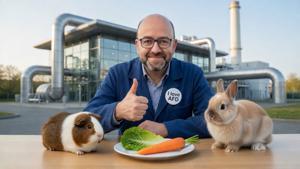
Dwarf rabbit: Hey buddy, that district heating situation in Hohenmölsen seems to have made some bigger waves after all. Guinea pig: Why’s that? Dwarf rabbit: Well, there was an article in the Mitteldeutsche Zeitung because someone on the city council apparently dug a bit deeper. That was probably the guy from that “Bürgerstimme,” who occasionally focuses on such topics. And then even the Mitteldeutsche Zeitung can’t avoid writing something. They didn’t mention a name, but they found a pensioner who complained that his heating costs have more than tripled since 1993, even though he no longer heats his entire house. He used to pay the equivalent of 98 euros per month, and now it’s 322 euros. Guinea pig: Well, the mayor is already on it and working toward an AfD election victory. Dwarf rabbit: Wait, what? I don’t get that. Guinea pig: So, what has Mayor Andy Haugk actually said about district heating? Dwarf rabbit: He’s said quite a bit. For example, that they will rely on gas in the future. In addition to a heat pump, a gas-fired power plant is supposed to be built. He didn’t say what kind of gas it would be. He also didn’t say how expensive district heating in Hohenmölsen will be in the future. A concept once mentioned over 20 cents per kWh. But that’s probably already outdated again. He just leaves it open, as if he has no clue or no plan. Guinea pig: See? There you have it. He’s pushing for an AfD election victory. Dwarf rabbit: I still don’t understand. Guinea pig: The mayor, who is also the district council chairman, said that the missing 75 percent of heating energy would have to be generated with gas. In the end, that can only mean Russian gas. And who wants to import Russian gas again? The AfD! Dwarf rabbit: No, no. They could also use hydrogen. Green hydrogen. Guinea pig: You mean the green hydrogen that MIBRAG doesn’t want to produce because investing in an electrolyzer doesn’t pay off even with 90 million in subsidies? The green hydrogen that is significantly more expensive than gray hydrogen, which could be produced from natural gas—although natural gas is even cheaper when used directly for heating. Dwarf rabbit: Well then, the people of Hohenmölsen will just have to set up a few wind turbines. That can’t be so hard. Guinea pig: Not hard, perhaps. But expensive. Dwarf rabbit: Why? Guinea pig: Let’s do a quick calculation. According to the concept presented by the mayor, about 75,000 MWh of heat from gas are needed. The hydrogen is supposed to be burned directly. That results in an overall efficiency of about 60 percent. That means not 75,000 MWh of electricity are needed, but rather around 135,000 MWh. And for that, you’d probably need at least 20 wind turbines. A single wind turbine can easily cost 6 to 8 million euros. Since everything is getting more expensive anyway, let’s assume 8 million. To have a buffer and enough reserves, let’s say 25 turbines at 8 million euros each—that’s 200 million just for the turbines. On top of that come land leases and maintenance. Also, wind turbines are usually replaced every 25 years. So every 25 years, another 200 million euros or more, since everything will be more expensive. Dwarf rabbit: Wow, that’s not exactly cheap for 15,000 people who need to keep their homes warm. Guinea pig: The wind turbines are only the smaller part of the system. The electrolyzer is estimated to cost another 60 million euros, and then the hydrogen also has to be stored. This system could easily cost another 100 million euros. So altogether 300 million euros, in addition to the roughly 60 million already planned for the heat pump and heating plant. So roughly—give or take—360 million euros. Dwarf rabbit: Okay, that’s no bargain. Then let’s just use biogas. Guinea pig: Great idea! I once talked about that with my buddy, the field hamster. His family is heavily involved in agriculture. He’s not enthusiastic at all, because biogas often means growing corn. Constantly corn—his family isn’t keen on that. It’s so monocultural and lacking variety in terms of food. Dwarf rabbit: But other plants can be used too. Guinea pig: True, but they yield less per area. Still, let’s roughly calculate it. To get the required amount of biogas, you need enough crops and also some manure—so animals that need to be fed. For that energy amount, you’d need about 2,000 hectares of agricultural land. That’s roughly half the area around Hohenmölsen. You’d also need about five biogas plants. Altogether, that could cost around 40 million euros. Then there are annual crop purchases and operating costs of about 7 million euros. At least that’s what the field hamster told me after calculating it with his family. Dwarf rabbit: Then it’ll be biogas. Biogas makes everything cheaper. Guinea pig: Do you like eating lettuce, carrots, and other greens? Dwarf rabbit: Of course! It’s delicious! Guinea pig: Then you’ll have to go on a diet. Because using half of the agricultural output just for biogas also means for you: eat half! Dwarf rabbit: So the people of Hohenmölsen have to decide whether to heat less and eat less? Guinea pig: Not eating at all might be the consequence. Because if cities like Leipzig also switch to biogas, there won’t be much land left to produce food for humans. Dwarf rabbit: Oh, and that’s why Mayor Andy Haugk is aiming for an AfD election victory. But isn’t the mayor the best buddy of District Administrator Götz Ulrich? And Götz Ulrich is in the CDU. Isn’t the mayor also in the CDU? Guinea pig: No, Andy Haugk is clever. He’s non-partisan and has secured the best position to push for an AfD election victory so he won’t eventually be driven out of office when district heating costs become unaffordable. Dwarf rabbit: You mean as district council chairman? But in that position, he keeps shutting down critical questions from citizens. He’s supporting the district administrator that way. Guinea pig: Are you sure? Haven’t you read the first handbook of psychopathy? Dwarf rabbit: I devoured it. Lots of fiber. But I get what you mean. By seemingly supporting the district administrator in behaving undemocratically and pushing things through against the citizens… Guinea pig: …he achieves the exact opposite, because people see it and say: I’m not voting CDU anymore. Dwarf rabbit: Yeah, Mayor Andy Haugk really is clever. But in the Mitteldeutsche Zeitung article, the pensioner also said that CO₂ must be reduced for climate protection. Guinea pig: Yes, that’s what’s called “long Tagesschau” these days. Dwarf rabbit: Long Tagesschau? What’s that? Guinea pig: Those are the long-term effects of constantly hearing things on the news like CO₂ and climate change. They don’t explain how small the amount of CO₂ in the atmosphere actually is, or how much smaller the human contribution is. And they certainly don’t explain how vanishingly small the amount of CO₂ produced by Germany is. Dwarf rabbit: That’s not much then? Guinea pig: 0.2 ppm of CO₂ comes from Germany! Dwarf rabbit: That sounds like a lot, doesn’t it? Guinea pig: That’s 0.00002 percent. Is that a lot? Is 0.00002 percent of a lettuce leaf a lot? Dwarf rabbit: Not really! And that’s why they want to invest 360 million euros in hydrogen in Hohenmölsen, or 100 million in biogas, and only eat half as much? That’s crazy, right? Guinea pig: Humans are very often irrational. And German humans are right at the forefront. Dwarf rabbit: Okay, and if the mayor achieves his goal and the AfD wins the election, what happens then? Guinea pig: The AfD wants to continue coal-fired power generation beyond 2038, and they want peace with Russia so that cheap Russian gas can be imported again. Dwarf rabbit: And that means cheap Russian gas can be used for heating again? Guinea pig: At the very least, it means that no investments would be needed for now, because lignite could continue to be used. And the AfD also wants to abolish CO₂ taxes and levies as well as other taxes tied to this energy transition. Because, as you could read in the Mitteldeutsche Zeitung, well over 30 percent of heating costs already consist of these CO₂ charges. Prices could therefore be 30 percent lower—but the CDU, SPD, Greens, FDP, and Left Party don’t want that. Dwarf rabbit: Well then, let’s see if the mayor’s strategy works. Guinea pig: Are you still eating your carrot? Dwarf rabbit: Eat half! I’ll eat the other half. Author: AI-Translation - Maximus Heurekus | |

|
| Other articles: |
 | NEW! Collective Punishment for Relatives of Government Critics - The Order Came from AboveAnyone who thought that with the end of the COVID-19 pandemic the persecution of critics would stop can be proven wrong almost every day.... zum Artikel |
 | Monday Demo in Zeitz Unites Citizens, Farmers, Truckers, and Craftsmen for a Better FutureOn February 26, 2024, at 6 p.m., around 120 pedestrians as well as 60 farmers, truckers, craftsmen, and small business owners with their families gathered in Zeitz for an impressiv... zum Artikel |
 | €250,000 Fine or 6 Months Imprisonment – City Council Chairman Ekkart Günther Continues Fighting Against Democracy and Press FreedomThe chairman of the Weißenfels city council, Ekkart Günther, has obtained a court injunction without oral hearing from the Weißenfels District Court, prohibiting the video recor... zum Artikel |


|
Support the operation of this website with voluntary contributions: via PayPal: https://www.paypal.me/evovi/12 or via bank transfer IBAN: IE55SUMU99036510275719 BIC: SUMUIE22XXX Account holder: Michael Thurm Shorts / Reels / Kurz-Clips Imprint / Disclaimer |