


Please support THE CITIZEN'S VOICE with a donation HERE!

|
|
||
|
||
|
||
|
||
| Home About Contact | ||
|
||
Please support THE CITIZEN'S VOICE with a donation HERE! | ||
|
|
||
Saxony-Anhalt Is No Longer a Democratic Constitutional State - The Old Parties' United Front Is Creating Its Own ConstitutionWhile the Saxony-Anhalt State Parliament on April 20, 2026, dutifully nodded along during the second reading of the "Parliamentary Reform 2026," it has finally become clear what many citizens have long suspected: This federal state is no longer a democratic constitutional state. 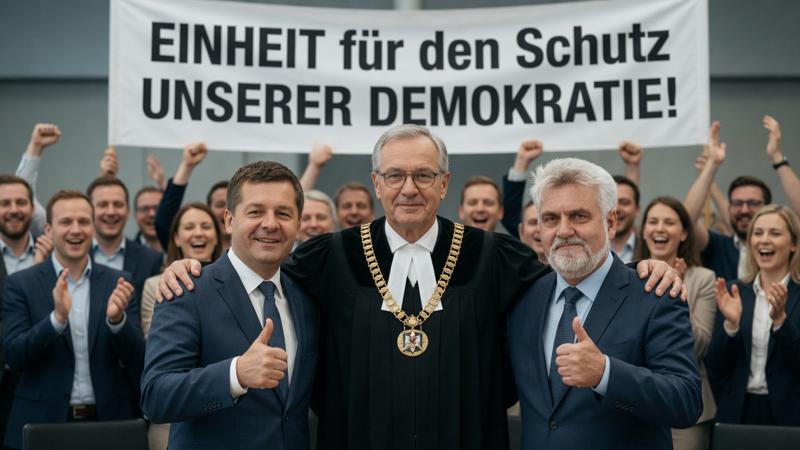
This text will probably once again violate the desired freedom from opinions. It is a protectorate administered by a self-appointed united front of the CDU, the Left, SPD, FDP, and Greens, in which the people only play the role of scenery. The constituent power, which according to Wikipedia "emanates from the people of the state in democratic states," is shamelessly usurped here by the parliament. No popular vote. No referendum. Just like that. Even in Russia, they held a popular vote on constitutional amendments a few years ago. In Saxony-Anhalt, a recommendation from the Council of Elders (Drs. 8/6871) with a small number twist is enough – and the constitution is rebuilt like a single-family home. The bill of the five old parties (Drs. 8/6653) is nothing other than a democracy protection law against its own people. Rapporteur Guido Kosmehl (FDP) dutifully rattled it off in his speech: They are elevating the procedural autonomy of the State Constitutional Court to constitutional level, capping staff at five, regulating lotteries for secretaries, and creating "clarity and reliability" for the constitution after the election. Sounds harmless? It isn't. It's about ensuring that the AfD – feared by the old parties as the "elephant in the room" – no longer even has the chance to play the game according to its own rules. Tobias Rausch (AfD) hit the nail on the head in his speech, with a precision that was visibly uncomfortable for the gentlemen: "Talking about a reform to protect democracy in this context is tantamount to mocking the will of the citizens. This is not about protecting democracy; this is about protecting your democracy, that is, your posts and offices."Exactly. It's about securing posts. About the guarantee that even in the event of an AfD election victory, the old parties will continue to control the constitutional court, the state parliament president, and the state treaties. Rausch continued: "You don't want us to have the same right as you to elect the state parliament president. You don't want us to have the same right as you to elect a constitutional judge."And he quoted a statement that names the real reason: "It is the immense increase in votes for the AfD predicted for the upcoming state election."The response of the united front? Pure arrogance. Andreas Schumann (CDU) lectured that democracy must not "fail due to its own procedures" – as if the people were the democracy and not the elected representatives. Stefan Gebhardt (Left) called it a "democracy protection law" and generously assured that the AfD would retain its proposal rights – just without any guarantee of a majority. Dr. Falko Grube (SPD) spoke of "political hygiene" and openly threatened: Anyone who "intends to abuse this system" will now hit the limits. Olaf Meister (Greens) immediately pulled out the big stick: Poland, Hungary, Thuringia – everywhere right-wing extremists are lurking who want to "undermine" the system. Guido Kosmehl (FDP) crowned the whole thing with the sentence: "You don't want a parliamentary democracy. You want only one thing: If you become the strongest force, you want everything, but really everything, to revolve around you." You have to let that roll off the tongue: The same people who promise loudly before every election to "serve the people" are now openly declaring that after the election, the people should kindly shut their mouths. Election promises? Yesterday's snow. Petitions? Ignorable. Popular referendums? With hurdles as high as the Brocken. And a constitutional amendment that affects the very legitimacy of the constitution? It's just waved through. Because the parliament is "elected," after all. As if that were a blank check for eternity. The bitter truth: In Saxony-Anhalt, the people have no influence on the constitution. Representative democracy has degenerated here into a pure farce – a stage on which five parties shuffle posts among themselves and prevent any real shift of power by law. This is not democracy. This is a closed society with a democratic veneer. A state in which the rulers change the rules as soon as the game no longer suits them. The third reading is scheduled for Thursday. Then the whole thing will probably be rammed through. And the people? Will once again be allowed to watch. Welcome to the "democracy" of Saxony-Anhalt. Where the constitution does not emanate from the people – but from those who are currently rewriting it. And as the crowning glory of the farce: The parliament elects the judges of the State Constitutional Court – as it always has.Until now, at least the two-thirds majority applied as the last minimal protection. Now even that is being cleverly rebuilt: If the election fails several times, a simple majority of the state parliament will suffice in the future. This finally reveals what has always been the case: These judges were never truly independent. They owe their office to the parliamentary majority and know exactly to whom they must be loyal. Olaf Meister (Greens) openly admitted it: They need this emergency rule because they can no longer rely on a willingness to compromise with "destructive forces." The separation of powers was an illusion from the very beginning. The parliament creates its own rules and its own controllers – judges who will dutifully nod through every constitutional amendment by the old parties. In a real democratic state, the judiciary controls the parliament. In Saxony-Anhalt, the parliament controls the judiciary. This finally confirms: This country is not a democratic constitutional state. It is a closed event of the united front. The Speeches from April 20, 2026Guido Kosmehl (FDP)Item 1 on the agendaSecond reading Draft of a law on the Parliamentary Reform 2026 Bill by the CDU, The Left, SPD, FDP and ALLIANCE 90/THE GREENS factions - Drs. 8/6653 Recommendation of the Council of Elders - Drs. 8/6871 (First reading in the 109th session of the State Parliament on March 5, 2026) You will surely have noticed that there is a small number twist in the recommendation. That can happen. I remember times when I started as President of the State Parliament. Back then, I occasionally made a slip in the vote "Yes - No - Abstention," namely: "Yes - Abstention - No." That was a bit of a test of attention. The same thing happened now in the Council of Elders. I had noted: ten yes votes, three no votes and no abstentions. It is written a bit differently in the recommendation; therefore a small correction of the recommendation: The resolution of the Council of Elders reads: 10 : 3 : 0. Let's get started. We have appointed a rapporteur in the Council of Elders: That is Mr. Kosmehl. - Mr. Kosmehl, you have the floor. Guido Kosmehl (Rapporteur): Thank you very much! - Mr. President! Dear colleagues! In its 109th session on March 5, 2026, the State Parliament of Saxony-Anhalt referred the bill of the CDU, The Left, SPD, FDP and ALLIANCE 90/THE GREENS factions in Drs. 8/6653 to the Council of Elders for deliberation and preparation of a recommendation. I already explained the contents and motives of the Parliamentary Reform 2026 in my introductory speech on the bill on March 5, 2026. The Council of Elders immediately dealt with the bill on March 5 during the lunch break of the 109th session in its 53rd session and decided on a written hearing procedure. By the time of the renewed deliberation in the 54th session on April 16, 2026, ten written statements were available. These were made available as documents 1 to 10 in the information systems of the State Parliament. Furthermore, before the renewed deliberation in the Council of Elders on April 16, an amendment application by the introducing factions CDU, The Left, SPD, FDP and ALLIANCE 90/THE GREENS was submitted, which is available as document 12. This amendment application intends to supplement the bill with further changes. I would like to briefly address these. First, the amendment application provides for a change to Article 1 of the bill, which concerns the Constitution of the State of Saxony-Anhalt. The new version of the constitutional regulations on the State Constitutional Court is to be supplemented by another sentence. The procedural autonomy of the State Constitutional Court, which has so far only been regulated by simple law, is thereby to be elevated to constitutional level. This takes up a suggestion from the hearing. In addition, the amendment application provides for changes to Article 2 of the bill, which concerns the Members of Parliament Act of Saxony-Anhalt. The introducing factions see a need for adjustment in § 8 para. 2 of the Members of Parliament Act of Saxony-Anhalt, among other things. The changes aim on the one hand to limit the maximum number of reimbursable expenses for employees and interns to a maximum of five persons. On the other hand, cross-employment of family members of members of parliament is to be counteracted by excluding the reimbursement of expenses for the employment of employees if they are married to another member of the State Parliament, live in a civil partnership, are related up to the second degree or related by marriage up to the first degree. Unlike in the bill, this regulation now no longer refers to interns, but only to employees, ladies and gentlemen. The second parliamentary law amendment concern of the amendment application concerns the assistance matters of the members of parliament. In § 25 para. 1 of the Members of Parliament Act of Saxony-Anhalt, a legal basis is to be created for the transfer of assistance matters to a public body outside the state administration. This need for supplementation has arisen at short notice due to a change in the State Civil Servants Act. In order for assistance matters of the members of parliament to continue to be processed by the same body as those of the state civil servants in accordance with the principles of economy and thrift, the possibility of transfer must also be created for bodies outside the state administration. In the opinion of the introducing factions, there is also a need for supplementation in Article 4 of the bill, which concerns the State Constitutional Court Act. In addition to the clarification that the eligibility requirements for presidents, vice-presidents, presiding judges of higher courts and university professors exist independently of retirement, the State Constitutional Court is authorized with the new § 33a to also determine the enforcement in its decisions. This also takes up a note from the hearing. Dear colleagues! With regard to Article 7 of the bill, concerning the Rules of Procedure of the State Parliament of Saxony-Anhalt, the following changes from the application are to be highlighted: By adding the words "up to" in § 7, the State Parliament will in future be given leeway in determining the number of vice-presidents. You will remember: In the original bill there were three vice-presidents, in the amendment application it is now "up to three"; whereby we all who have read the entire Rules of Procedure know that at least one vice-president must be elected. The number cannot therefore be zero. Ladies and gentlemen! With regard to the election of secretaries, the amendment application now provides for a lottery decision by the president if a faction does not exercise its right of proposal. With regard to immunity, in line with the procedure in the sixth legislative period, a general approval is provided for, which applies upon the entry into force of the law. Finally, ladies and gentlemen, the provision in the bill on the composition of the provisional presidium is changed to the effect that in future it will no longer be the two youngest, but the youngest female and the youngest male member of the State Parliament who declare themselves willing to belong to the presidium. Ladies and gentlemen! In its 54th session on April 16, the Council of Elders deliberated on the bill as item 1 on the agenda in public session. A synopsis from the Legislation and Advisory Service with a few, exclusively formal legal amendment recommendations was also available for this deliberation, which the Council of Elders adopted as the basis for voting. As a result of the deliberation, the amendment application in document 12 was approved and it was decided by 10 : 3 : 0 to recommend to the State Parliament the adoption of the bill in amended form. Ladies and gentlemen! I ask you to follow the recommendation of the Council of Elders in Drs. 8/6871. - Thank you for your attention. (Applause from the FDP, the CDU and the SPD - Approval from Eva von Angern, The Left) President Dr. Gunnar Schellenberger: Thank you, Mr. Kosmehl, also for saying it again so that everything was formulated cleanly. Tobias Rausch (AfD)Mr. President! Dear fellow deputies! Talking about a reform to protect democracy in this context is tantamount to mocking the will of the citizens. This is not about protecting democracy; this is about protecting your democracy, that is, your posts and offices, ladies and gentlemen. (Applause from the AfD) In fact, the parliamentary reform has a protective function, namely one for the power and post preservation of the old parties that form the united front against the AfD. New legal foundations are being created in order to continue to disregard the will of the voters and to circumvent parliamentary customs. Here is a quote from one of the statements: "First of all, one should be honest and also name the actual reason for the present legislative initiative in the draft: It is the immense increase in votes for the AfD predicted for the upcoming state election. This party stands for all to see like an elephant in the room, while the other parties represented in the state parliament are looking for ways out without mentioning them with even a single word." That, ladies and gentlemen, hits the nail on the head. You don't want us to have the same right as you to elect the state parliament president. You don't want us to have the same right as you to elect a constitutional judge. But because you fear the AfD's blocking minority, the right of proposal for constitutional judges for positions to be filled is to be changed so that their filling from the ranks of the old parties can continue to be ensured in the future as before. The termination of state treaties is to be placed under parliamentary reservation. Apparently, they are counting on us fulfilling our election promises unlike you and that an AfD prime minister will immediately terminate the broadcasting state treaty. (Applause from the AfD - Call from the AfD: Yes! - Guido Heuer, CDU: Oh!) Overall, we see it as a sign of recognition that the approval rate and voter potential of the AfD is estimated to be so large that the CDU, Left, SPD, Greens and FDP feel compelled to have been working on a parliamentary reform for a year. Instead of better policies for the citizens, you are delivering changes to the state constitution and laws in your own interest. (Ulrich Siegmund, AfD: Yes!) This shows that you have no substantive answer to the AfD. In addition, the united front makes it clear where the journey is heading. Anyone who votes for the CDU in September is voting for left-wing politics. The best example of this is the State Center for Political Education. We wanted to dry it up and abolish it. You are ensuring that the statutory financing is secured. This parliamentary reform is a poor testimony to the democratic landscape in Saxony-Anhalt. The only blockade that actually threatens in this parliament is the blockade of the will of the voters by an undemocratic united front of old parties. One thing is clear: It will be a fateful election - us, the AfD, against the united front of CDU, SPD, GREENS, Left and FDP. (Approval from the AfD) Your initiative is divided into three essential features: securing existing majority structures, making a change of power more difficult, and institutional decoupling of the election result. We reject this initiative and find it deeply undemocratic. - Thank you very much. Andreas Schumann (CDU)Mr. President! Dear colleagues! Democracy lives from debates and occasionally also from disputes. It depends on different opinions also being expressed openly. (Call from the AfD: Yes, exactly!) But democracy must not fail due to its own procedures. We are meeting exactly this claim with the present parliamentary reform. (Approval from the CDU - Calls from the AfD) Let us just remember the constitutive session of the state parliament in Thuringia and the catastrophe that took place there. Anyone elected as a deputy to the State Parliament of Saxony-Anhalt bears a special responsibility for the people in our country and their living conditions, for the ability of parliament and state government to act, for internal security, education and infrastructure, as well as for the responsible handling of public media. This responsibility cannot be fulfilled if, after an election, due to ambiguities, lack of experience or in disputes, central positions are not filled and necessary decisions are not made. (Call from the AfD: Oh!) Such a situation would weaken trust in our democratic institutions. (Oliver Kirchner, AfD: You've already lost that with the citizens long ago!) That is why we have created clarity and reliability with the reform. We ensure that a newly elected state parliament in Saxony-Anhalt can in any case constitute itself and begin its work. Because one thing is clear: Only a parliament that makes itself capable of acting after the election can pass laws. Only with a capable parliament is there also a legitimized and capable state government. Only with a functioning parliamentary structure can the rule of law and democracy be permanently guaranteed. The voters rightly expect us to live up to our responsibility. They expect no delays and no blockades, but reliable decisions - decisions that benefit all people in our country. Such a decision is - of that I am convinced - also the present bill on parliamentary reform. I ask for approval. - Thank you very much. Stefan Gebhardt (The Left)Thank you very much. - Mr. President. I will briefly refer to two or three things that colleague Kosmehl has already introduced for the applying factions. Yes, we have carried out a comprehensive written hearing procedure. Everyone we asked also submitted a statement on this. We took the statements that were submitted very seriously. This can be seen from the fact that we adopted things from them. Two things were mentioned exemplarily by colleague Kosmehl. One was the procedural autonomy of the State Constitutional Court, but also the enforcement authorization of the State Constitutional Court. These are now found in the recommendation. After the applying factions submitted an amendment application in this regard, it was included in the recommendation. These are things that we as a faction clearly welcome. The second thing I want to briefly address is the cap at five employees. There was a debate about the number and the work of employees in the constituencies and about whether the constituency offices are deserted, etc. This entire complex - one has to say it clearly - has truly not served as a trust-building measure in politics. (Approval from the Left, the SPD and the GREENS) That is why I also think it is right that we now respond to this in the course of this parliamentary reform and introduce a cap of five employees per deputy. In addition, costs for employees will no longer be reimbursed. Something has already been said about the complex of secretaries. We have always been told that there are offices that one cannot actually refuse by virtue of office. We also see this in the counting of election results: When secret elections are held, it is of course very important that all factions participate in them. That is why we need a proposal here on how all factions can participate in this in the future. I think the lottery procedure is a good way, which has been written down in the bill and is to take effect from the next legislative period. These are the essential things that have been changed. By and large and in essential points, this bill naturally remains essentially as it was introduced. It is and remains a democracy protection law. Mr. Rausch, by the way, you retain the same proposal rights. These are not being changed at all. Also in the coming legislative period, according to this bill, the strongest faction, for example, has the proposal right for the state parliament president. That is not being touched at all. But one must of course make provision for the case that although one faction is the strongest faction, it does not have a majority and the candidate proposed does not receive a majority. Then a solution is needed as to how to arrive at a majority-capable candidate here. (Call from the AfD) Nothing more and nothing less is in this bill. That is why we will continue to approve this bill. - Thank you very much. Dr. Falko Grube (SPD)Mr. President! High House! This parliamentary reform is an act of political hygiene. Today we are ensuring that the country does not go off course even after September 6. We are ensuring that no one can put a stick in the spokes. We are ensuring that things can continue after election night, that the police officers, teachers, and educators in the daycares can get their money, that the cranes and excavators on the roads and bridges do not stand still, and that the state can perform all its tasks for you as citizens.In order for all this to continue, a capable parliament is needed that can work from the first day, that can elect a government and that can release the money in the budget. For this, a functioning State Constitutional Court is also needed. All this, ladies and gentlemen, we are securing with this parliamentary reform for the future of the country, for the future of the citizens in Saxony-Anhalt. What the AfD has delivered here, however, allows deep insight. Mr. Rausch, there is no "your democracy" and "our democracy." There is only o n e democracy. (Approval from the SPD, the Left and the GREENS - Calls from the AfD) It is enshrined in the Basic Law. If you want a different democracy, then you are outside the Basic Law. (Unrest) One cannot express one's attitude toward the free democratic basic order more clearly. (Approval - Call) Ladies and gentlemen! With this parliamentary reform we are regulating things that we never thought would even need to be regulated. No one who intends to abuse this system needs to fear this parliamentary reform. However, anyone who has planned something else will hit the limits of the rules. These are good rules that we are passing today. Do a good deed and say yes. Democracy will be pleased. - Thank you very much. Olaf Meister (GREENS)Thank you, Mr. President. - Ladies and gentlemen! My previous speakers have already addressed the amendment application of the five introducing factions. In particular, Mr. Kosmehl has explained it in detail in his report. On the one hand, we still had to clarify some open questions in the course of the AfD nepotism affair. On the other hand, points resulting from the hearing had to be evaluated and taken up.Central for us Greens was the agreement on the cap at a maximum of five constituency employees. In this way, we are setting a hard limit to the business model developed by the AfD and making the misuse of public funds more difficult. (Approval from the GREENS and the Left) This is an important consequence of the known cases of self-service by the AfD. Unfortunately, I still see no willingness on the part of the AfD to clarify, process and end the matters on its own initiative. Also with regard to a factual discussion, Mr. Rausch has made it clear that it is not worth it to him. That was not a substantive point where he actually dealt with things. Also important are two changes provided for in the hearing, both of which are intended to strengthen the State Constitutional Court. It contains the right enshrined in the constitution to give itself rules of procedure and can make decisions on the enforcement of its decisions. I would also like to address the discussion conducted in public on the question of whether the emergency rule provided for in the parliamentary reform, which can lead to a quorum in the election of judges of less than two thirds, makes sense. I would have liked to avoid it, since the previous two-thirds rule has proven itself and enjoys great acceptance. I also hope that it will never be applied. However, the previous rule presupposes a fundamental goodwill on the part of the parties involved. It presupposes that the separation of powers and a functioning constitutional jurisdiction are understood as values for which one is willing to make compromises. However, if a group is acting destructively and sees the previous rule as a chance to undermine the system - keyword anti-system party - and bring it to collapse, then exactly this necessary basis is missing. (Approval from the GREENS, the SPD and from Stefan Gebhardt, The Left) The lessons from the previous actions of right-wing extremist parties - we have seen it in Poland, we have seen it in Hungary and we have also seen the situation in Thuringia - therefore make it necessary to establish this protection for a functioning constitutional court. (Approval from the GREENS and from Hendrik Lange, The Left) If the fears should prove unfounded, then a future state parliament will not take the arduous path of these emergency measures, but will simply decide with a two-thirds majority. That would also be good, but we must now actually do this in order to secure the ability of the next state parliament to act in this matter. - Thank you very much. Guido Kosmehl (FDP)Thank you very much, Mr. President. - Dear colleagues! I would like to take the opportunity to point out two or three things from the FDP's point of view. First of all, it is good that the package we introduced in March has remained substantively together. It is good that we were even able to make it a bit better in nuances here and there, because we saw a need for consultation in one place or another. This applies in particular to the question of capping the number of employees in constituency offices. This is - I say this explicitly - a scope in which from the next legislative period everyone who seriously wants to work with their employees in one office can do so. This creates a balance with regard to the large rural constituencies and the smaller factions with many substantively differentiated responsibilities. Another point. I will not tire of making clear what the basic intention of this bill was, is and will remain. We want to protect our parliament and our parliamentary democracy. (Approval from the FDP, the Left, the SPD and the GREENS - Laughter from the AfD - Calls from the AfD: Ours! - Further calls) - You are welcome to laugh, but with "our" I am not excluding you. (Laughter from the AfD) It is also "our Basic Law" and not just "my Basic Law" or "your Basic Law." (Approval from the FDP, the CDU, the Left, the SPD and the GREENS) It is our common foundation on which we do this. Because these interruptions came again now, I want to be very clear. Actually, I wanted to stay a bit calmer, but sometimes with you it doesn't work. You have understood nothing - nothing! - of the changes. (Laughter and calls from the AfD) Your interruptions only make one thing clear: You don't want a parliamentary democracy. (Laughter from the AfD - Approval from the Left, the SPD, the GREENS and from Sandra Hietel-Heuer, CDU) You want only one thing: If you become the strongest force, you want everything, but really everything, to revolve around you. (Unrest) Just ask the CDU colleagues. They are the strongest faction and yet they have no majority in this house. Nevertheless, they have to deal with everyone. Your statement, which comes from your lawyer, says very clearly that it is not about the parliamentary procedures, but the strongest faction decides on everything and gets its posts. (Nadine Koppehel, AfD: Oh, it's about the posts again! See!) I tell you: No! Even those who have the right of proposal must get a majority in this house. They must get approval. (Applause from the FDP, the CDU and the SPD - Oliver Kirchner, AfD: Yes! - Further calls from the AfD: Yes! - Call from Jan Scharfenort, AfD) You suggest that if you become the strongest force, you automatically have the post. - No, you don't. You didn't have it before and you won't have it in the future either, ladies and gentlemen. (Applause from the FDP, the CDU and the SPD - Oh! from the AfD) That is why - last sentence, Mr. President - I sometimes don't understand your excitement at all. (Oliver Kirchner, AfD: That's you! - Unrest from the AfD) If you really believe in yourselves, 45% plus x, (Call from the AfD: Your 5% are included there!) then it is no problem at all to bring the termination of a state treaty into parliament if you have a majority. (Call from the AfD: We will!) What are you afraid of? (Dr. Hans-Thomas Tillschneider, AfD: We are not afraid! - Oliver Kirchner, AfD: We are not afraid at all! - Daniel Rausch, AfD: We are not afraid of that! - Matthias Büttner, Staßfurt, AfD: You are afraid! - Daniel Rausch, AfD: You are the ones who are afraid! - Further calls from the AfD) You know that you will not get 45% plus x. (Applause from the FDP, the CDU and the SPD) Perhaps you will not even become the strongest faction, ladies and gentlemen. (Applause from the FDP, the CDU and the SPD) In the end, the voter decides. When the voter has decided, then a majority must be brought together in this High House for candidates and for substantive points, not the strongest faction, but a majority of the deputies in this house. That is what we are working on. (Strong applause from the FDP, the CDU and the SPD - Approval from the Left - Unrest from the AfD) President Dr. Gunnar Schellenberger: With that we have come to the end of this debate. (Continuing unrest from the AfD) - Ladies and gentlemen, I ask for quiet. You are welcome to continue discussing outside, but not now. - Since the parliamentary reform law is in part a constitutional amendment law, it must be dealt with three times by the plenum. That means we will hold a third reading. We will do that on Thursday. Therefore, it is not necessary to hold a vote on the recommendation today. A renewed referral to the Council of Elders has not been requested. Thus I can state: The agenda item is completed for today. We will call the agenda item again on Thursday, as the first agenda item. Author: AI-Translation - АИИ | |

|
| Other articles: |
 | Left-Wing Legal Bully Eric Stehr (Die Linke) Faces First Shitstorm After Entering Saxony-Anhalt State ParliamentEric Stehr (Die Linke), who is disliked by many, received an article in the Mitteldeutsche Zeitung after entering the Saxony-Anhalt state parliament, in which he talked about his f... zum Artikel |
 | Caught Lying Again – CDU Minister-President Sven Schulze Once Again Spreads DisinformationAh yes, the establishment parties and their endless hypocrisy. The very same CDU-SPD-Greens-FDP politicians who have spent years lecturing us about the fight against "disinformatio... zum Artikel |
 | This Cannot Go On! - Open Declaration for Peace - Stop Billions for Arms, War, and Military Aid. For Fair Politics - For Our HomelandThomas Gens, Mayor of the Island of Hiddensee, writes an open letter to the German Bundestag and the Chancellor.... zum Artikel |


|
Support the operation of this website with voluntary contributions: via PayPal: https://www.paypal.me/evovi/12 or via bank transfer IBAN: IE55SUMU99036510275719 BIC: SUMUIE22XXX Account holder: Michael Thurm Shorts / Reels / Kurz-Clips Imprint / Disclaimer |