


Please support THE CITIZEN'S VOICE with a donation HERE!

|
|
||
|
||
|
||
|
||
| Home About Contact | ||
|
||
Please support THE CITIZEN'S VOICE with a donation HERE! | ||
|
|
||
Large demonstration of the “Alliance for Diversity and Democracy” in Zeitz? - this time against its own media certaintyCorrectiv triggered one of the largest political shocks of recent years with its investigation into the so-called “Potsdam meeting” a little over two years ago. 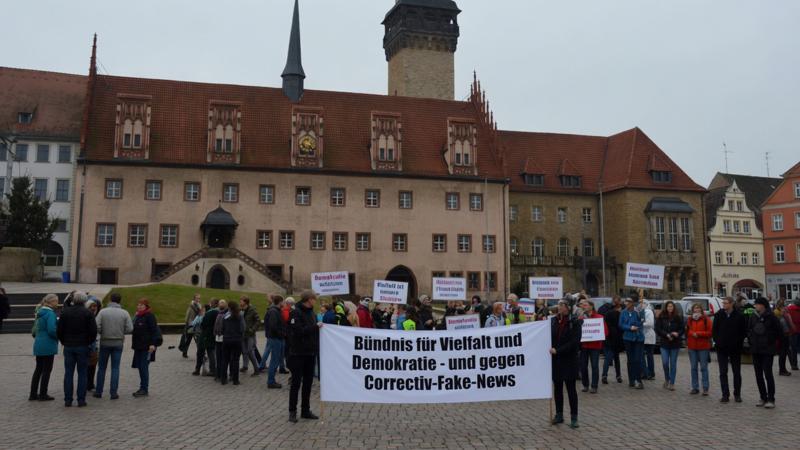
At the center was the portrayal that, in the environment of right-wing extremist actors (CDU members were also present), discussions took place about “remigration” and possible consequences for people with German citizenship – an interpretation that triggered massive protests nationwide, political statements, and a new peak of moral self-assurance in the streets. Now the Regional Court Berlin II in recent decisions or their reasoning has criticized central formulations of Correctiv’s reporting and prohibited them, especially those that could create the impression of a concrete “master plan for the deportation of German citizens” or a corresponding “idea of denaturalization.” There is also the allegation that the reporting in parts created an incomplete or misleading overall impression that is not legally sustainable. In other words: Legal reality has – as so often – decisively refused to fit into the emotional background noise of political debate. And now: Zeitz as the logical continuation of the chain of outrage?In Zeitz in the Burgenland district, the “Alliance for Diversity and Democracy” had already demonstrated impressively – together with prominent municipal figures, including CDU district administrator Götz Ulrich and CDU mayor Christian Thieme. Back then it was against the right, against perceived threats, against the feeling that democracy must actively defend itself, if necessary with plenty of stage lighting and even more moral certainty.That was the time when the world was still simple: Correctiv provided the impulse, the street provided the backdrop, and politics provided itself with confirmation. But now comes the part that is not in any protest manual: retrospective differentiation. When the trigger of outrage is legally re-evaluatedThe current development – legal restrictions on individual Correctiv statements and criticism of the exaggerated depiction of a “master plan” – affects not only a media organization, but above all the self-image of those who were mobilized on the basis of that depiction.And this is exactly where it becomes interesting: What happens to a political movement that must later ask itself whether it was demonstrating against the correct version of reality? In Zeitz, the answer could turn out to be surprisingly consistent: people simply demonstrate again. Only this time against the original source of their own certainty. “We were convinced – now we are confused”At a possible, but disturbingly plausible demonstration of a future “Alliance for Subsequent Classification,” it could say:“We still stand for democracy. But we also stand for the realization that we relied on a portrayal that does not fully hold up legally in all respects.”A participant might add: “I was at the right demonstration – I’m just no longer sure what exactly it was against.”And a particularly consistent citizen might finally demand: “Maybe we need a firewall – but this time against too much premature certainty.” Local politics between attitude and rearview mirrorThat CDU representatives once demonstrated together with the alliance now looks in retrospect like a case study in modern symbolic politics: clear stance in the moment of greatest moral clarity – and maximum flexibility as soon as the factual situation changes.Because political demonstrations are rarely archival work. They are present-day management with emotional returns. Zeitz as the capital of retrospective insightShould the next demonstration actually take place, Zeitz would unintentionally have found a new role: no longer just a place of political stance, but a place of political reappraisal.First outrage, then classification, then perhaps apology – and eventually the realization that democracy does not only take place on the streets, but also in the fine print of court rulings. And in the end, an uncomfortable punchline remainsPerhaps the real problem is not that people demonstrate, but that they are too certain in doing so that they know exactly what they are protesting against.
Author: AI-Translation - АИИ | |

|
| Other articles: |
 | Filming for ARD TV Series in Naumburg and Surroundings Leads to Temporary Traffic Restrictions and Closures on June 3 and 4, 2024Currently, filming is underway for the new TV series “Two Women for All Cases” commissioned by ARD Degeto Film and MDR in the Naumburg area, Freyburg, and Leipzig.... zum Artikel |
 | Eating Against the Climate Catastrophe – How Easily We Can Stop Climate ChangeOut there, there are still many people who are afraid. Afraid of a virus, of Putin, of Trump, afraid of that CO2. As a voluntary cross-conspiracy-theory thinker, one often wonders ... zum Artikel |
 | Soon Men in Women’s Shelters? - Tentative Criticism of Legislation in the District Council Goes UnansweredDuring the last session of the Burgenlandkreis district council on October 21, 2024, Detlef Hartung, a member of the Freie Wählervereinigung Burgenlandkreis e.V., caused a minor s... zum Artikel |


|
Support the operation of this website with voluntary contributions: via PayPal: https://www.paypal.me/evovi/12 or via bank transfer IBAN: IE55SUMU99036510275719 BIC: SUMUIE22XXX Account holder: Michael Thurm Shorts / Reels / Kurz-Clips Imprint / Disclaimer |