


Please support THE CITIZEN'S VOICE with a donation HERE!

|
|
||
|
||
|
||
|
||
| Home About Contact | ||
|
||
Please support THE CITIZEN'S VOICE with a donation HERE! | ||
|
|
||
Self-Praise with Taxpayer Money – CDU Election Campaign in Wolmirstedt: Many Funding Programs – But Is This Really Economic Success?When state politicians travel to the provinces during election season for a cabinet meeting, it usually comes with a long list of success messages. The cabinet meeting in Wolmirstedt was no exception. 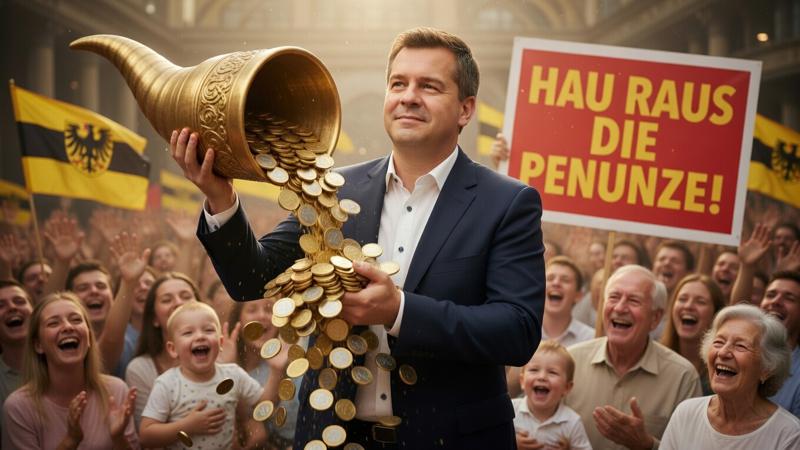
Minister President Sven Schulze (CDU) praised the Börde district as a "growth engine" in the press release. But a closer look at the numbers tells a different story: the economic successes mainly consist of funding programs – and less of genuine economic dynamism. Almost €60,000 in Funding per New JobThis becomes particularly clear with the state government's most important economic policy tool: the joint task "Improvement of Regional Economic Structure" (GRW). According to the press release, around €371.3 million in grants have been paid out in the Börde district since 2000.These funds allegedly created 6,420 new jobs. Calculating these numbers yields a remarkable figure: €371.3 million in funding / 6,420 new jobs = roughly €57,800 per job. Even when including the supposedly "secured" jobs – a politically convenient but statistically generous term – there is still around €11,500 in funding per job. And this is only a single program. According to the state government, additional millions flowed into urban development, flood protection, schools, digitalization, culture, and agriculture. Structural Problems Do Not Disappear with Funding ListsThe press release paints a picture of a economically strong region. But long-term structural problems are barely mentioned.The Börde district today has about 171,000 inhabitants (https://stadtistik.de/kreis/landkreis-boerde/). While it is one of the larger districts in Saxony-Anhalt, like many regions in eastern Germany, it has been struggling with demographic change for decades. The long-term trend is clear: since reunification, the population has shrunk significantly. At the same time, the population is aging – a problem for the labor market, infrastructure, and municipal finances. Income Above State Average – But Below National LevelIncome also shows a typical East German pattern. The Börde district indeed has the highest average per capita income in Saxony-Anhalt.In 2022, disposable income was around €24,420 per inhabitant (https://statistik.sachsen-anhalt.de/.../Statistische_Monatshefte). But this top value immediately loses perspective when compared nationwide. In Germany overall, disposable income was about €25,830 per capita – significantly higher than in the Börde district. In other words: the region does well within Saxony-Anhalt, but remains below the national prosperity level. Energy Transition as an Economic Engine?Another point highlighted by the state government is the expansion of renewable energies. The Börde district is indeed among the regions with particularly many wind and solar installations.But wind and solar parks have a peculiarity: they are extremely capital-intensive – yet create comparatively few jobs. Their effect on regional employment is therefore limited. Many municipalities benefit from lease income and business taxes, but this does not generate an industrial structural transformation. Dependence on Transfer PaymentsThe situation is even clearer when it comes to municipal finances. The Börde district receives large annual payments from the state's municipal financial equalization system.In 2025 alone, this amounted to around €87.7 million from state funds. Without these transfers, many municipal tasks could hardly be financed. New programs like the "Special Infrastructure Fund" bring additional millions to the region. For the municipalities in the district, over €72 million is allocated, and for the district itself almost €60 million. The Difference Between Funding and GrowthFunding programs are not inherently bad. Roads, schools, or flood protection obviously need to be financed. But when a political track record consists almost entirely of funding measures, a crucial question arises:Is this really economic strength – or merely a region that can hardly function without permanent state subsidies? The state government's press release does not answer this question. It mainly lists multi-million euro amounts. But economic success is not measured by the number of funding programs – but by whether a region can sustain itself in the long term without them.
Author: AI-Translation - АИИ | |

|
| Other articles: |
 | Off the couch, you old lazy bums!Enough with the golden pensions, eternal brunches, and cruises at the expense of the youth. Marcel Fratzscher, president of the DIW, has finally said what has long been overdue: No... zum Artikel |
No Solar Outside Germany?Christoph Gallas reports in the public Facebook group Bürgerinitiative-Braunsbedra about his impressions regarding solar installations in southern Europe.... zum Artikel |
 | State Promises and Bitter Reality: When People Harmed by COVID Vaccines Are Left AloneDuring the COVID pandemic, a remarkably simple standard applied: a single test was enough to classify a person as “infected.” On this basis, far-reaching intrusions into fundam... zum Artikel |


|
Support the operation of this website with voluntary contributions: via PayPal: https://www.paypal.me/evovi/12 or via bank transfer IBAN: IE55SUMU99036510275719 BIC: SUMUIE22XXX Account holder: Michael Thurm Shorts / Reels / Kurz-Clips Imprint / Disclaimer |