


Please support THE CITIZEN'S VOICE with a donation HERE!

|
|
||
|
||
|
||
|
||
| Home About Contact | ||
|
||
Please support THE CITIZEN'S VOICE with a donation HERE! | ||
|
|
||
Who Owns the Cave Beneath My Garden? – A Short Excursion into the Wonderful World of German BureaucracyImagine digging a little deeper in your own garden – and suddenly you hit a cave. Or an old wartime bunker. Jackpot? Secret party room? Deluxe wine cellar? Well… welcome to Germany. 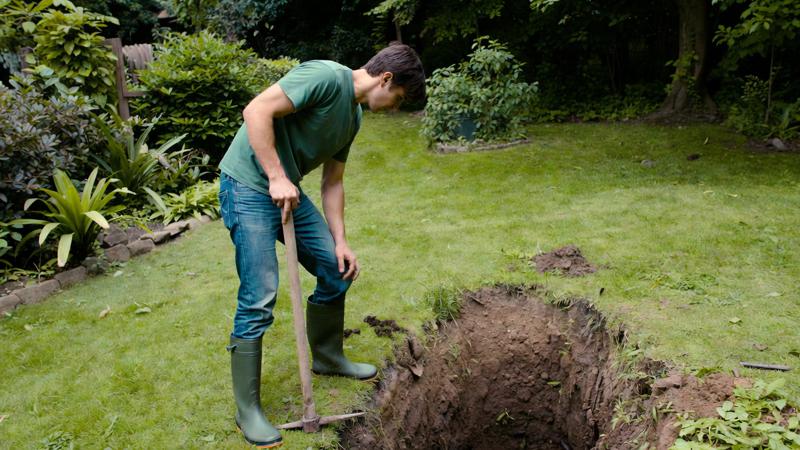
Because the first question is not: “How do I make this look nice?”, but rather: Who does this actually belong to? And am I even allowed to go in there? Purely by gut feeling, one would say: My property, my cave. But German legal reality loves fine distinctions. While you generally own everything that is permanently connected to your land – including natural cavities – this only applies as long as no other laws say otherwise. And those “other laws” are already standing around the next corner with their arms crossed. If the cave happens to be a habitat for bats, for example, your newly discovered hobby cellar suddenly turns into a strictly protected biotope. At that point, it is no longer your design ambitions that matter, but the Federal Nature Conservation Act, which decides when you are even allowed to enter the cave – and when you are not. In some cases, only outside certain months. Welcome to the bat calendar. Things get even more exciting with old bunkers. Many of them still belong to the federal government or the state to this day – even if they are located right in the middle of your property. Your land may be yours, but the concrete block underneath it might not be. You own the lawn above a structure that does not belong to you. Bureaucratic Zen philosophy in its purest form. And even if the cave does in fact belong to you, that by no means implies that you are free to simply lay a floor or put up a shelf down there. Depending on the location, building permits may be required, along with nature conservation assessments, water law clarifications, and sometimes even geological expert reports. For a space that has existed for thousands of years. The absurd part: In Germany, you can build a house – but under certain circumstances, you are not even allowed to roll out a carpet in an existing cave without completing a marathon of authorities. The cave in your own garden thus turns out to be less about adventure and romance and more a textbook example of German administrative artistry: Everything is possible – but only with Form 17b, Appendix C, and a processing time of six to twelve weeks. And if you are unlucky, a bat moves in first. Author: AI-Translation - Karla Kolumna | |

|
| Other articles: |
 | Neither ox nor donkey can stop structural change in its tracks!There is fantastic news to report. It is election campaign season and thus funding season. And so the Burgenland district has been blessed with 124.4 million euros.... zum Artikel |
 | No New Landfill Construction in the Heart of the "Tuscany of the North"Open Letter: No New Landfill Construction in the Heart of the "Tuscany of the North," in the Middle of the Wine-Growing Region on the Saale and Unstrut!... zum Artikel |
 | Who will dare to process the Corona period in the Burgenlandkreis?The Corona period has left deep scars in society – including in the Burgenlandkreis.... zum Artikel |


|
Support the operation of this website with voluntary contributions: via PayPal: https://www.paypal.me/evovi/12 or via bank transfer IBAN: IE55SUMU99036510275719 BIC: SUMUIE22XXX Account holder: Michael Thurm Shorts / Reels / Kurz-Clips Imprint / Disclaimer |