


Please support THE CITIZEN'S VOICE with a donation HERE!

|
|
||
|
||
|
||
|
||
| Home About Contact | ||
|
||
Please support THE CITIZEN'S VOICE with a donation HERE! | ||
|
|
||
“Fuel Discount” Propaganda Speak: How Politicians and Moralizers Pick Citizens’ Pockets — and Then Preach the Welfare StateKarlheinz Skorwider rejects the “fuel discount” in a post and calculates billions in “costs” for the state. 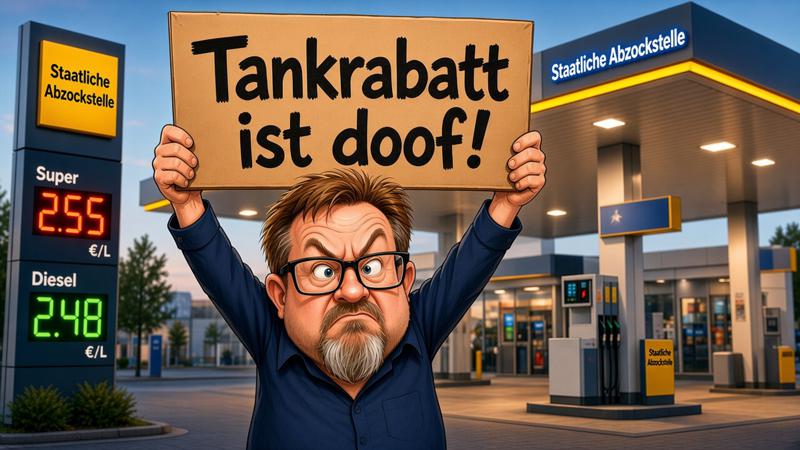
But what he fails to recognize is this: it is not an expenditure; the state is simply collecting less. While Germany and Europe strangle fuel with taxes, other countries deliberately keep energy cheap — and thereby create prosperity. Skorwider’s way of thinking? Classic “welfare socialism” that turns tax cuts into “gifts” and sells bureaucracy as justice. The media propaganda surrounding the term “discount” blinds him to this. Karlheinz Skorwider considers the “fuel discount” wrong. He calculates: The first one “cost” the state 1.6 billion euros, the next one is supposed to add up to 2.5 billion — 4.1 billion from the “state coffers” in total. Our tax money. Then comes the usual litany: blanket distribution instead of targeted assistance for commuters with low and middle incomes, families, single parents, and small businesses. While people are stingy with social spending and children’s sick days, billions suddenly flow here. Corporations and high profits would be spared, while the general public pays. And the low-income earner who commutes 50 kilometers gets the same “discount” per liter as the high earner. The CDU’s priorities, loss of trust, end of story. It sounds morally charged and socially just. On closer inspection, however, it falls apart into rhetorical tricks, bureaucratic illusions, and a way of thinking that loses its bearings at the very next bend. The State Pays Nothing — It Simply Steals LessSkorwider consistently speaks of costs, of billions that the state “spends,” of money that is “available” and then “spent.” This is classic fiscal obfuscation. A “fuel discount” — that is, a temporary reduction in the energy tax on fuels — is not an expenditure. It is a decision to forgo revenue. The state simply reaches less deeply into citizens’ pockets. The 4.1 billion are not “gone” somewhere; they remain with those who buy fuel: the commuter, the tradesperson, the delivery driver, the family man on his way to work.Anyone who frames this as “costs for the state” implicitly assumes that every potential euro of tax revenue belongs to the state and that every reduction is a kind of handout or gift. That is the logic of the Leviathan: everything belongs to the public authorities first, and citizens should be grateful if they are allowed to keep anything. In reality, the energy tax is an additional burden on consumption that is already heavily taxed. Reducing it means collecting less, not “spending money.” Skorwider reverses the causality: the state is not giving up something to which it is entitled — it is reducing a levy that it itself has driven upward and that is particularly painful during periods of high prices. Anyone who records this as expenditure turns a tax cut into a subsidy and the citizen into a recipient of charity. Germany: A Tax Hell on Wheels — The International ComparisonLet’s take a look at how brutally Germany and large parts of Europe tax fuel. The EU prescribes minimum tax rates: 0.359 euros per liter of gasoline and 0.330 euros per liter of diesel. Most countries are well above these levels. Germany levies around 0.655 euros in energy tax per liter of gasoline and about 0.470 euros per liter of diesel — plus 19 percent VAT and often additional CO₂ costs. As a result, taxes and levies can easily account for 50 percent or more.Across the EU, average excise duties are around 0.55–0.57 euros per liter of gasoline and 0.45–0.47 euros per liter of diesel. Countries such as the Netherlands (gasoline often above 0.78–0.87 euros), Italy, and France are among the leaders. Even the lowest EU rates (Bulgaria and Malta at the minimum) are still significantly higher than what is customary in the United States — there, total taxes (federal plus state) often amount to the equivalent of only 0.12–0.15 euros per liter. Gasoline Prices WorldwideAnyone with the courage to do so can look at the current gasoline prices worldwide at https://de.globalpetrolprices.com/gasoline_prices/. In countries such as Libya, Iran, and Venezuela, a liter costs between 2.1 and 3.1 euro cents. By comparison, it gets really expensive in Angola (28.8 cents/liter), Kuwait (30 cents/liter), followed by Algeria (31 cents/liter).Germany is at the very bottom of the list along with other countries. It is not yet as expensive here as in Hong Kong (3.89 euros/liter). But the political leaders in Berlin and Brussels, so beloved by many, are working diligently to reach this price level in the foreseeable future. While Europe milks its citizens at the pump, other countries are taking the opposite approach. Where Energy Is Subsidized — and Prosperity EmergesIn numerous countries, especially oil-producing states, gasoline and diesel are deliberately subsidized or kept below production cost. Saudi Arabia, Iran, Venezuela, Libya, Kuwait, Algeria, Egypt, and parts of Russia and Indonesia keep prices artificially low. The state pays the difference or forgoes revenue so that mobility, transportation, and production remain cheap. The goal: to promote economic activity, keep industry competitive, and provide citizens with tangible prosperity through affordable energy.These subsidies are fiscally expensive and can lead to inefficiencies, smuggling, and environmental problems. But they demonstrate one thing clearly: Cheap energy is a direct factor in prosperity. High taxes, by contrast, are a political choice that restricts mobility and hampers the economy. Skorwider acts as though every reduction is a gift to “the wrong people.” In reality, in high-tax countries like Germany, it is often merely a correction of a burden created by the state itself. The Illusion of “Targeted Relief” — Bureaucracy as Social JusticeThings get even better when it comes to the alternatives. The same billions could be used to “target” commuters with low and middle incomes, provide relief to families and single parents, support small businesses, or “reduce burdens elsewhere that hit people with little money particularly hard.” Sounds noble. In practice, “targeted” almost always means: application procedures, income thresholds, proof requirements, dealing with government agencies, waiting times, rejection rates, and a new layer of administrative overhead.Who really wants to fill out forms for a few hundred euros in relief, document pay slips, commuting distances, family circumstances, and business data, only for the tax office or responsible authority to check whether they are truly “needy” enough? The simple “fuel discount” takes effect immediately and across the board at the pump — no application, no stigma, no delay. Every “precisely targeted” alternative creates friction, misallocations, and different kinds of free-rider effects. Bureaucracy eats up part of the sum that was actually supposed to provide assistance. And it discriminates precisely against those who have little time and little administrative expertise: single parents, shift workers, and small self-employed business owners. The Propaganda Machine: Why “Discount” Distorts RealityThis is where things become particularly transparent. The media and politicians almost unanimously speak of the “fuel discount.” The word is no coincidence. In ordinary usage, a discount is a reduction granted by a retailer or the state — a gift, a benefit, something one “receives.” This exact framing technique turns a tax cut into a state benefit. Citizens are not supposed to think: “The state is taking less money from me.” They are supposed to think: “The state is giving me something.” This shifts the underlying question of ownership: the money no longer belongs to the citizen who earned it, but to the state, which is “generously” giving it back.This propaganda works on several levels. It normalizes the idea that high taxes are the normal state of affairs and that any reduction is an exception, an act of grace. It creates gratitude instead of entitlement. And it makes any criticism of the measure morally suspect: anyone who opposes the “discount” is against relief, against ordinary people, against justice. At the same time, it obscures the fact that during periods of high prices, the state is already collecting billions in additional revenue through the existing tax burden — and that with a reduction it is merely foregoing part of this additional extraction. The media outlets that uncritically adopt the word “discount” systematically reinforce this effect. They adopt the state’s prescribed terminology instead of deconstructing it. Why Skorwider Does Not Recognize This — The Mindset Behind the Blind SpotSkorwider’s text operates on a double standard. On the one hand, he criticizes the fact that every euro is “turned over three times” when it comes to citizens and that social spending is supposed to be limited. On the other hand, he wants to provide relief to those same citizens through complicated, selective programs that institutionalize exactly this turning over and checking. He complains that corporations and high profits are being spared — while simultaneously proposing that the state collect more in order to redistribute it afterward. This is the classic detour: first take more from citizens (or give less back), then return parts of it “targetedly” through bureaucratic channels. It is not efficient. Nor is it transparent.The thinking stops at the edge of the table. It does not ask why fuel prices are so high — regulatory costs, CO₂ charges, global markets, the tax burden. It does not ask whether a broad, simple reduction in the tax burden creates more long-term incentives than selective handouts. It does not ask whether the state, which supposedly has “money available,” might be better off not extracting that money in the first place to such an extent. Instead, the political decision is framed as a moral failure of the CDU: the “wrong” people are being spared and the “right” people burdened. How Should This Mindset Be Assessed — and Why Does the Propaganda Remain Invisible?It is classic moralizing redistribution fetishism with a strong pro-state bias. Money is viewed as a zero-sum game that the state “has” and “spends.” Tax cuts are reinterpreted as “gifts,” while genuine subsidies in other countries (which keep energy cheap) are ignored. Empathy is applied selectively: the low-income commuter is supposed to suffer as long as the “rich” do not save the same cent per liter. Efficiency, incentives, and the ordinary citizen who does not want to fill out forms play no role.The propaganda surrounding the “discount” goes unnoticed because it fits perfectly into this worldview. Anyone who fundamentally sees the state as a redistributive institution that “has” and “spends” money will logically perceive a tax cut as an expenditure or gift. The linguistic reinterpretation confirms the underlying assumption instead of questioning it. Anyone who thinks in terms of “blanket distribution versus targeted assistance” and “corporations versus ordinary people” needs the moral charge of the “discount” to justify their own criticism. The media’s adoption of the term is not perceived as framing, but as a neutral description — because it corresponds to their own framing. It is “edge-of-the-table” thinking par excellence: ideologically charged, factually thin, and politically convenient because it always needs “those people up there” and “the corporations” as scapegoats while systematically obscuring the actual question of power — who does the money really belong to? Skorwider is right that priorities are being set. He is fundamentally mistaken, however, in his description of what is happening here. The “fuel discount” is not an expensive blanket giveaway from the state coffers. It is the decision not to reach even deeper into citizens’ pockets during a period of high prices. Everything else is rhetoric that turns a tax cut into a subsidy and simple solutions into bureaucratic castles in the air — and the propaganda surrounding the “discount” is the glue holding this narrative together. What is interesting is that Skorwider deals with language and the manipulation of people through language, yet apparently does not recognize that he himself has already allowed himself to be manipulated. Source: facebook.com/kennymaple/ 
Author: AI-Translation - АИИ | |

|
| Other articles: |
 | Mysterious Place Names: What's Behind Finne, Finneland, Eckarstberga, Obschütz, and Karsdorf?Five place names that sound as if they hide a riddle within: Finne, Finneland, Eckarstberga, Obschütz, and Karsdorf. What could be behind them? Ancient legends, mysterious structu... zum Artikel |
 | Give Them Rainbows – and Take Their FreedomChristopher Street Day (CSD) has become the perfect backdrop for a political distraction. Thousands parade through the streets, adorned with glitter, makeup, flags, and slogans, co... zum Artikel |
 | Greetings from Russia – Foreign Ministry Spokeswoman Zakharova on October 3, 2025, German Unity DayRussia’s Foreign Ministry Spokeswoman Zakharova delivers a bitter assessment of German reunification on October 3, 2025, accusing united Germany of lacking sovereignty, social di... zum Artikel |


|
Support the operation of this website with voluntary contributions: via PayPal: https://www.paypal.me/evovi/12 or via bank transfer IBAN: IE55SUMU99036510275719 BIC: SUMUIE22XXX Account holder: Michael Thurm Shorts / Reels / Kurz-Clips Imprint / Disclaimer |