


Please support THE CITIZEN'S VOICE with a donation HERE!

|
|
||
|
||
|
||
|
||
| Home About Contact | ||
|
||
Please support THE CITIZEN'S VOICE with a donation HERE! | ||
|
|
||
Is a Life Without Fear Possible—or Even Unthinkable?Some people seem to need fear the way others need air to breathe. Without it, everyday life would suddenly be empty, moral superiority would be gone, and the enemy image would become blurred. 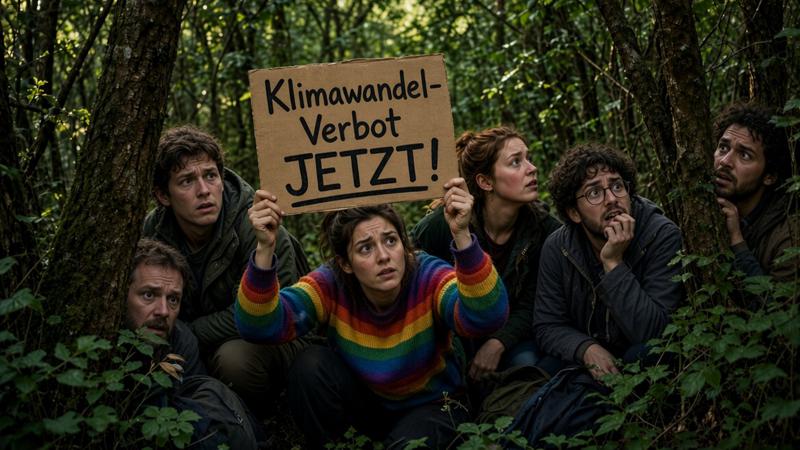
“Naumburg für alle” provides a vivid example of this. A post by Volker Quaschning is being shared on Facebook, portraying the summer as proof of a climate apocalypse: more than 14,000 heat-related deaths (estimated), drought, crop failures, forest fires, productivity losses, economic damage of up to 42 billion euros (estimated)—almost one percent of economic output. “This is what the consequences of the climate crisis look like. We are shredding our prosperity… Wouldn’t now be a good time to pick up the pace?” A simple counter-question—“Which extreme summer?”—is enough to make the machine stutter. As evidence, a chart of summer temperatures since around 1760 is presented, suggesting a rise beginning in the 1940s. As if the climate had previously been sitting in a climatic deep freezer. The memory of Europe’s last 10,000 years is awkwardly avoided: the Early Holocene Climatic Optimum (approx. 8000–5000 BC), with summers warmer than today in parts of Europe. Yes, “than TODAY!!!” The Holocene Thermal Maximum. The Bronze Age Warm Period. The Roman Warm Period. The Medieval Climate Anomaly. All periods in which it was noticeably warmer in some regions—without SUVs, coal-fired power plants, or “climate crisis” hashtags. Then came the Little Ice Age, which cooled things down again. The “today” in the description of those early warm periods remains there like an inconvenient witness. The reaction from “Naumburg für alle”: silence. The “Extreme Summer” That Wasn’t—or Just a Cave Summer with Breaks?And what about this summer of 2026? Yes, there were heat waves, particularly in June, with local records, brief peak temperatures of around 41–42 degrees, and persistent dryness. Overall, the summer was somewhat above the long-term average. But at the same time, there were significant interruptions: cooler periods, showers, thunderstorms, fresh temperatures. Toward the end of August, there were repeated headlines saying “summer is taking a break”—with temperatures often below 25 degrees nationwide, regionally as low as 17 to 23 degrees, clouds, rain, and wind. At times it felt like a classic cave summer: cool, rainy, unsettled—a far cry from a permanent infernal furnace proving the apocalypse. A normal Central European summer of ups and downs, just with the usual media and ideological exaggerations.Fear needs no nuance. Fear needs drama. The current summer has to be “extreme,” otherwise the narrative does not work. 14,000 “Heat Deaths”—and Why Do More People Die in the Cooler North Than in the South?Strangely enough, the warmer countries of southern Europe report significantly lower numbers. While Germany’s Robert Koch Institute reports around 14,000 heat-related deaths (estimated through early August)—a large proportion of them occurring during the hot week in June—Spain is reporting around 4,500 to 4,900, while estimates for Italy range from 5,000 to 8,000. France lies somewhere in between. Germany, which is by no means the hottest country climatically, tops the statistics. Strange, isn’t it? Perhaps it is due to the age structure, a lack of air conditioning, the way the statistics are attributed (excess mortality during hot weeks is readily attributed wholesale to heat)—or perhaps because the fear narratives in the north are particularly in need of cultivation.For comparison: around one million people die in Germany every year. One million! The alleged 14,000 “heat deaths” therefore represent only a fraction of normal mortality—and are largely older, already vulnerable people whose deaths occur during hot weeks and are statistically attributed to heat. That puts the panic into considerable perspective if one looks at the figures honestly. Living on the Equator—Impossible Because Heat Causes Instant Death? Or Perhaps Not?And now for the polemical question that logically suggests itself: Is human life even possible around the equator? Temperatures there remain permanently within ranges that are considered “deadly” during European heat waves. And yet hundreds of millions, indeed billions, of people live there—in India, Southeast Asia, Africa, and South America. No mass die-off has occurred. No continents have become desolate. How can that be if heat supposedly leads to near-immediate heat death?The answer: People adapt. They build houses differently, live differently, work at different times, use shade, ventilation, air conditioning, clothing, and established habits. Evolution and culture are stronger than any alarmist chart. Anyone claiming that a few additional degrees in Central Europe would “shred” prosperity and cause mass deaths must explain why the tropical and subtropical world has not already gone extinct. If they cannot, all that remains is ideology. Fear as an Identity DrugThe catastrophes predicted over the past few decades—an ice-free North Pole by year X, island nations sinking beneath the sea, regions becoming uninhabitable at the promised pace—have largely failed to materialize or have been massively qualified. That does not stop the fear machine. On the contrary: the longer the great doomsday predictions fail to arrive, the more loudly the moral cudgel is wielded. Anyone who doubts is a climate denier, right-wing, a fascist, or at the very least “against everyone.” The rainbow banner and the fight against the AfD serve as additional identity markers: one is on the right side of history, and history is a single heat wave heading toward hell.Philosophically, things get interesting. Fear is evolutionarily useful—it protects us from genuine dangers. Pathological fear, however, creates dependencies. It legitimizes authority, justifies interventions into freedom and prosperity, and provides a sense of meaning in an otherwise often mundane existence. Without climate fear, one would have to confront real, measurable problems: demographic change, energy supply, migration, education, infrastructure. That is hard work. Climate fear is convenient. It has clear culprits (the West, capitalism, the “obstructionists”), clear solutions (more speed, more sacrifice, more government), and clear enemies. Anyone who questions it is not merely challenging data, but their own self-image. A life without this fear would be possible. It would mean taking temperature records spanning centuries and millennia seriously, not inflating regional extremes into a global apocalypse, placing greater weight on adaptability than on predictions of doom, and not casually “shredding” prosperity because a chart supposedly points upward since 1760 or because a summer happened to have both hot and cool periods. It would mean accepting that the climate has always changed—and that humans and civilizations in warmer periods of the past and in the hottest regions of the present have by no means perished, but in some cases flourished. For some, that is unthinkable. Fear has become too much a part of their identity. Without it, all that would remain is the sober question: How do we deal sensibly with weather, energy, and risk? That sounds like work. And work is more exhausting than outrage.
Author: AI-Translation - АИИ | |

|
| Other articles: |
 | The Coffers Are Empty - District Council Meeting of December 9, 2024Numerous topics were on the agenda. One thing became clear: The coffers are empty.... zum Artikel |
 | Why Is District Administrator Götz Ulrich Inciting Against Children, Ukrainians, and Welfare Recipients?The district administrator of Burgenlandkreis, Götz Ulrich, lashes out at those already at the very bottom.... zum Artikel |
 | Heroines of Caregiving Are Being Punished! The Merz Government Wants to Cut Pension Credits for Family Caregivers! Yet Government Supporters Keep Warning About the AfD!While the black-red federal government under Chancellor Merz is pouring billions into international adventures, green ideology, and bloated bureaucracies, it is now planning to sla... zum Artikel |


|
Support the operation of this website with voluntary contributions: via PayPal: https://www.paypal.me/evovi/12 or via bank transfer IBAN: IE55SUMU99036510275719 BIC: SUMUIE22XXX Account holder: Michael Thurm Shorts / Reels / Kurz-Clips Imprint / Disclaimer |