


Please support THE CITIZEN'S VOICE with a donation HERE!

|
|
||
|
||
|
||
|
||
| Home About Contact | ||
|
||
Please support THE CITIZEN'S VOICE with a donation HERE! | ||
|
|
||
Foreigners for the old German ass! Sven Schulze (CDU Minister-President of Saxony-Anhalt) still wants immigration... because the locals supposedly are no longer enough and politicians have been systematically allowing working conditions in the care sector to deteriorate for years. 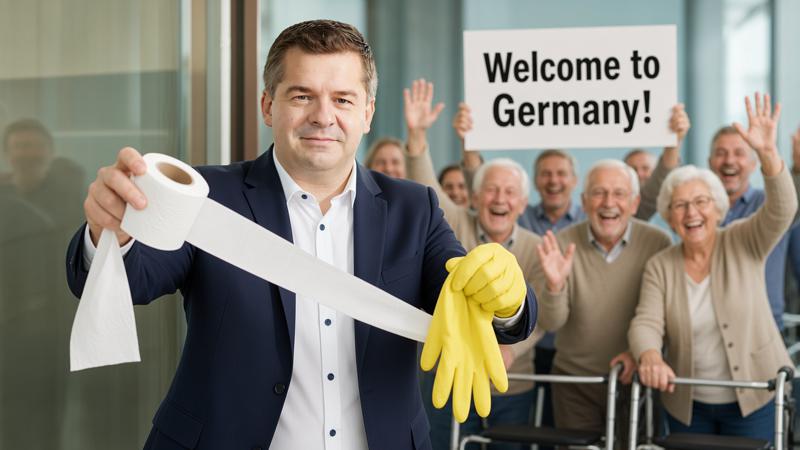
There he stands, state father Sven Schulze (CDU), explaining in a Facebook video from August 23, 2026, with that syrupy seriousness that only CDU politicians seem capable of: No immigration into the welfare system – absolutely not! The people of Saxony-Anhalt don't want that. Instead, we need skilled workers in hospitals, nursing care, and the skilled trades. We are the oldest federal state, with an average age of 48.3 years. Only around 12,000 children are being born each year (in 2025, the exact figure was 11,978). Even if all women were to devote themselves exclusively to having children starting the day after tomorrow, we wouldn't solve the problem. So let's integrate those who want to work. Welcome to anyone willing to roll up their sleeves. How touching. How statesmanlike. And how transparent. 90,000 unemployed? Doesn't matter – better to bring in fresh hands from abroad!While Schulze sings the praises of “targeted immigration of people who want to work here and support themselves,” around 90,000 unemployed people are sitting around in his state (July 2026: 89,916, with an unemployment rate of 8.1 percent – significantly above the national average). A substantial proportion of them are long-term unemployed and older people. Yet these people, according to the unspoken message, are apparently not good enough, not motivated enough, not cheap enough, or simply not willing enough to do the jobs on offer. Better to import fresh workers than to shape the working conditions in such a way that the people already here will start rolling up their sleeves again.Nursing care: Poor pay, lousy conditions – and still a “shortage of skilled workers”Let's take a look at nursing care – that wonderland where Schulze so urgently needs immigrants. The working conditions? Shift work until you drop, chronic understaffing, physical and psychological strain at permanently high levels, documentation instead of human attention. Qualified nursing professionals in Saxony-Anhalt earn an average of around €3,800 to €4,000 gross. Non-qualified workers – nursing assistants and care aides, who shoulder the bulk of the day-to-day work – earn considerably less: typically €2,700 to €3,200 gross. After taxes, that often leaves only around €2,000 to €2,150 (tax class I, no church tax). For many locals, that is simply unattractive: Why work yourself into the ground when you can have less stress and a similar net income elsewhere or in another profession?Why foreigners still take these jobs – and why that is so convenientWhy do foreigners nevertheless “gladly” work there? Because their expectations are often lower and the relative jump in wages compared with their country of origin still appears attractive – at least until the reality of permanently living in Germany sets in: high rents, taxes and social contributions, inflation, and the realization that it is almost impossible to build wealth on this salary. At first glance, it sounds like a win-win. In reality, it is the classic low-wage trap that locals are no longer willing to subject themselves to and that is sold to immigrants as an “opportunity.” And yes: The workers brought in from abroad end up disproportionately often in precisely this lower wage segment.Another advantage from an employer's perspective that is rarely stated publicly: Many of these foreign workers do not (yet) have a family here. No partners, no children, no relatives in need of care on site. That makes them extremely flexible. They can more easily take night, weekend, and holiday shifts, fill in at short notice, work overtime, or be transferred to rural areas. The “family calendar” disappears. There is less need for part-time work because of childcare, parental leave, or daycare places. Greater mobility, often with accommodation close to the facility. As long as the relative jump in wages is large enough, they are more likely to accept inconvenient shifts and fixed-term contracts. Locals with families often cannot or do not want to do this – and that is then interpreted as a lack of motivation. Politicians have ruined nursing care themselves – and are now looking for a scapegoatAnd what about government policy? It could have massively improved working conditions in nursing care years ago: genuine collective bargaining coverage with meaningful bonuses, mandatory minimum staffing levels that actually exist beyond paper, relief from bureaucracy, and better compatibility between family and career. Instead, the sector has been systematically bled dry. Particularly cynical: During those “wonderful COVID years,” the government pushed thousands of experienced care workers out of their professions or placed them on leave without pay, thanks to the facility-based vaccination mandate introduced in 2022. If you refused the jab, you were no longer allowed to work. Many never returned. Now politicians complain about a shortage of skilled workers and call for immigration, as if they hadn't driven their own people away.The old German ass needs flexible cheap handsSchulze's message is clear: The German ass is getting old, the birth rate is in the basement, so let's bring in fresh hands to wipe it – preferably flexible, childless, unattached workers in the lower-wage segment. Integration, yes, but only for those who work. Welfare systems remain off-limits – rhetorically, at least. In practice, everyone knows that “targeted immigration” and “well-functioning integration” often enough result in parallel societies, language barriers, and additional costs. And with 90,000 unemployed people in one's own country, one could first tap into the potential already available before using the demographic emergency as a blank check for further immigration.But that would be hard work. It would require real reforms: better wages, decent working conditions, a family policy that produces more than Sunday speeches, and the courage to stop constantly signaling to one's own citizens that they are too lazy or too demanding. Instead, politicians make things easy for themselves and let the “people who want to work here” pull the cart – and take care of the old German ass. Philosophical afterthought: Is this racism?This is where an uncomfortable question is worth asking. If employers and politicians systematically favor workers who “don't have a family here” and are therefore more flexible, cheaper, and easier to deploy – and if this group disproportionately comes from abroad – is that racism?Racism in the classical sense presupposes the belief in biological or cultural inferiority. Here, on the surface, it is about economic usefulness: flexibility, wage levels, availability. One is not looking for the “foreigner”; one is looking for the person who will work the unattractive shifts without complaining and without family obligations. The fact that this type of worker is currently more common among immigrants is a consequence of the recruitment model and the living circumstances of many migrants – not necessarily of a racist ideology. And yet: The practice leaves a bitter aftertaste. Workers are imported whom the country's own citizens are no longer willing or able to subject themselves to under the same conditions. The relative poverty and lack of family ties in other countries are exploited to conceal the country's own demographic and political failures. This is not biological devaluation, but it is instrumental. The human being becomes a disposable resource – and origin becomes a selection criterion because it statistically correlates with greater flexibility and lower expectations. Whether you call this “racism” depends on the definition. Some would describe it as structural or economic racism: an order that sorts people according to their origin and usefulness. Others simply see market rationality in an aging society that no longer produces enough young people of its own and fails to treat its existing workforce attractively enough. Both can be true at the same time. The real hypocrisy lies elsewhere: The same political establishment that preaches “diversity” and “anti-racism” in fact practices selective recruitment of particularly useful, preferably unattached workers from abroad – while concealing the fact that, indirectly, it labels its own citizens as too demanding, too family-oriented, or too expensive. This is not racism in the classical sense. It is something colder: reducing human beings to their usefulness to the old German ass.
Author: AI-Translation - АИИ | |

|
| Other articles: |
 | Allegedly Not Enough Police Forces in MerseburgFor April 12, 2024, starting at 5 PM, a demonstration by government critics has been registered in Merseburg. There will be a car convoy and a protest march running in parallel, me... zum Artikel |
 | How Would You Be in War?A thoughtful glance back at Corona – and a pressing question for us all: How would you act in war?... zum Artikel |
 | Prof. Christian Drosten escalates at the Social Court – refusal to provide expert report, disregard of deadlines, unprofessional conductBy order of evidence of the Social Court of Munich dated 07.02.2025, Prof. Dr. Christian Drosten was appointed as expert in the field of virology (§ 118 para. 1 SGG in conjunction... zum Artikel |


|
Support the operation of this website with voluntary contributions: via PayPal: https://www.paypal.me/evovi/12 or via bank transfer IBAN: IE55SUMU99036510275719 BIC: SUMUIE22XXX Account holder: Michael Thurm Shorts / Reels / Kurz-Clips Imprint / Disclaimer |