


Please support THE CITIZEN'S VOICE with a donation HERE!

|
|
||
|
||
|
||
|
||
| Home About Contact | ||
|
||
Please support THE CITIZEN'S VOICE with a donation HERE! | ||
|
|
||
Germany’s Green Beacon: How Saxony-Anhalt Is Saving the Energy Transition with 15 Hectares of Fertile Farmland – Or Maybe Not?Ah, what a triumphant moment for Germany’s energy future! Energy Minister Prof. Dr. Armin Willingmann (SPD) personally breaks ground for Germany’s largest battery storage park near Klostermansfeld. 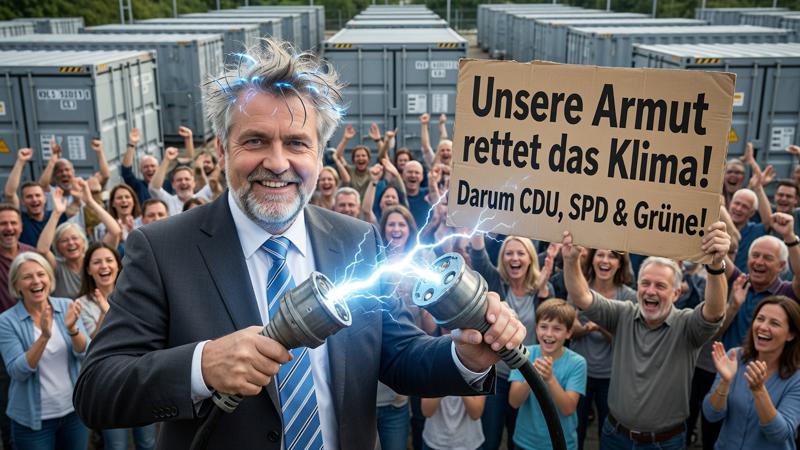
On a “roughly 15-hectare site,” more than 1,100 battery containers will be built, providing 1 gigawatt of power and up to 5.7 gigawatt-hours of storage capacity. “This is enough to supply around three million households with electricity for at least four hours,” boasts the Ministry’s press release. Or was it only 600,000 households for one day, as stated in the MWU Facebook post? Never mind—precision is clearly overrated. The government is setting new standards! For a strong energy future that citizens will be paying for. Absolutely. And after those four hours, the lights go out anyway. How wonderful that this flagship project is being built on agricultural land of all places. Photos and video clips from the groundbreaking ceremony make it perfectly clear: fertile farmland is being taken out of agricultural production and sealed over. Fifteen hectares of soil that once produced food will now serve to store intermittent electricity generated by wind and solar power. Marvelously efficient! In a country concerned about food security and dependence on imports, politicians have finally got their priorities straight: containers full of lithium—or whatever else they will contain—that feed “surplus” electricity into the grid whenever needed. What a brilliant solution to a problem that renewable energy itself has greatly exacerbated. Analyzing Land Consumption – A Masterpiece of SustainabilityFifteen hectares are, of course, peanuts. Just a tiny patch of Saxony-Anhalt. But multiply that by dozens or hundreds of additional projects (by the end of May 2026, Saxony-Anhalt already had 23 large-scale battery storage facilities in operation and another 30 in planning), and you end up with a beautiful mosaic of sealed landscapes. It used to be called “stopping urban sprawl.” Today it’s called a “flagship project.” The landscaping measures for “nature conservation and visual screening” sound delightful—as if the loss of farmland could be compensated for with a few wildflowers.Would Other Countries Sacrifice Fertile Farmland for Projects Like This?In the United States or China, brownfields and former industrial sites are often prioritized. But in Germany, the world champion of ideological consistency, naturally the very best land is selected: the soil that feeds us. Brilliant.The Requirements of a CO₂-Neutral FutureIf Germany truly intends to become completely CO₂-neutral (80–100% renewable energy combined with the electrification of transport and heating), electricity demand would soar to 800–1,000 TWh per year or more. To bridge extended periods of low wind and little sunshine (one to two weeks in winter), not thousands but tens of thousands of storage facilities like this would be required—or enormous alternative long-term storage solutions. For more ambitious protection against prolonged renewable droughts requiring several hundred to over 1,000 GWh of storage capacity, we are quickly talking about 60,000 hectares or more—roughly the area of a major city like Hamburg (approx. 75,000 hectares) or almost two-thirds of Berlin (approx. 89,000 hectares). Entire regions would become battery fields. And that does not even include the land required for power generation itself. The price tag? Trillions of euros—to be paid by taxpayers and consumers, in other words, the people.Prosperity Gone! Climate Saved?In this context, the following short clip is highly recommended. Prof. Dr. Dr. F.-J. Radermacher explains to a distinguished audience where the journey must lead if the climate is to be saved.If enough people in Europe become sufficiently poor that they essentially can no longer consume resources—meaning they cannot afford to drive a car, cannot heat their homes in winter, and cannot eat meat—then the energy and climate problems would indeed be solved. Electricity Prices Must Never Fall AgainThis project makes perfect business sense—in Germany’s highly subsidized, artificially inflated electricity market with expensive intermittent power, high grid fees, and opportunities for price arbitrage. But imagine Germany had electricity prices comparable to those in the United States or China (often only one-third to one-half of current German industrial electricity prices). The entire business model would collapse. No more large price fluctuations to exploit with storage systems, no more need to “park” expensive surplus electricity. The project would simply become uneconomical.That is precisely why electricity prices in Germany must never again fall significantly. Policymakers must actively ensure that prices remain high—through surcharges, grid fees, CO₂ pricing, subsidies, and the deliberate restriction of inexpensive electricity generation. Falling prices would amount to a death sentence for such “flagship projects,” turning them into stranded investments. The energy transition depends on artificially inflated electricity prices as much as it depends on air. Without permanently increasing the cost of conventional (or even renewable) electricity generation and without ongoing subsidies, the entire system would not be economically viable. The government is creating its own reality—and taxpayers along with what remains of German industry are footing the bill. A true flagship project in distancing itself from market economics! The IPCC and the Withdrawn Horror ScenarioFor years, the entire rush surrounding the energy transition was based on alarming scenarios presented by the IPCC. Yet recently, the scientists themselves withdrew the notorious worst-case scenario (RCP8.5/SSP5-8.5), declaring it “implausible.” According to them, reality—despite or perhaps because of political developments—is no longer following the catastrophic trajectory once envisioned. Thousands of scientific studies, political speeches, and media reports were based on it. And now? Quietly shelved. Yet politicians in Berlin and Magdeburg continue as though there were no reason whatsoever to reconsider their course. One could almost conclude that the urgency serves purposes other than climate protection.Subsidies, Jobs, and the Great Value CreationOfficially, there are no direct mega-subsidies for this specific project—BW ESS says it is self-financed and will later earn revenue through electricity trading. But the overall energy transition system depends on subsidies, renewable energy levies (formerly EEG), grid fees, Flex-E programs, KfW loans, and state programs such as “Saxony-Anhalt STROMSPEICHER.” Most of the local business tax revenue is expected to remain in the municipality (90 percent according to output), plus “voluntary community benefit payments” amounting to several hundred thousand euros for local associations. How generous of the investors! Taxpayers finance the surrounding infrastructure, the grid expansion (SuedOstLink), and the overall framework conditions.And the jobs? Certainly some temporary positions during construction, plus maintenance, security, and service work. Permanent employment? A handful per facility. The investor speaks vaguely about economic benefits. Meanwhile, German industry is losing tens of thousands of jobs due to high energy prices, deindustrialization, and an increasingly uncertain energy supply—automotive suppliers, chemicals, steel. Commentator Harald Kvicala sums it up: “There used to be decentralized, baseload-capable power plants providing inexpensive electricity. Today we have expensive intermittent power [...] with deindustrialization as the worst outcome, while entire landscapes are being covered over.” Another user sarcastically points to former lignite mining pits that have become lakes. True enough—the old pits have become idyllic landscapes while new areas are being sealed over. Max Moritz warns about future hazardous waste from batteries. And Container TP calculates that storing electricity for one week would require tens of thousands of such facilities. Physics can be rather inconvenient. Great Praise for the VisionariesHow wise of Minister Willingmann and the state government to rely on “homegrown energy” that does not come “through some random maritime strait.” Instead, we pave over our own farmland while importing battery technology and raw materials from China. Brilliant! Roberto Jiménez of BW ESS says he is “proud” to help create “a resilient modern energy system.” Yes, perhaps resilient against affordable electricity and reliable baseload power. Smart grid integration, landscaping—it’s all first class. Saxony-Anhalt is setting standards. Standards for a future in which electricity is more expensive, industry is weaker, and the countryside is increasingly covered in concrete.The comments beneath the MWU Facebook post reflect public opinion: many see “ideological central-planning nonsense” (Rico Schirrmacher), “absurdity,” and growing dependence on the weather. Others defend the project passionately, dismissing critics as “Putin trolls” or “the uneducated.” Classic. Anyone asking what happens on the second day without sunshine is lectured that battery storage merely smooths peak demand. Correct. During prolonged periods of low renewable output, gas-fired power plants or imports are still required. Or perhaps simply hope for sunshine. A Policy That Sacrifices Fertile LandThis project is symbolic: a policy willing to sacrifice fertile farmland to prop up a system whose underlying assumptions have, according to the author’s interpretation, been exposed as exaggerated even by the IPCC itself. Through enthusiastic talk of “value creation” and “community benefit payments,” people are distracted while the major costs are spread across society. Bravo, Mr. Willingmann! You truly are setting new standards—for the decline of affordable, reliable, and down-to-earth energy supply. Germany thanks you. The farmers whose fields disappear, perhaps somewhat less. But who cares about farmland when there are flagship projects to build?
Author: AI-Translation - АИИ | |

|
| Other articles: |
 | Neighborhood Festival – Us Together – Merseburg SouthA festival by residents for residents and guests, May 17, 2025, from 12:00 PM to 8:00 PM, Primary School "Am Geiseltaltor" – Schoolyard, Straße des Friedens 66, Merseburg... zum Artikel |
 | True Crime - Has the Monster of Hohenmölsen Struck Again?Hohenmölsen – once only known for open-pit mining, tractors, and dreary weekends, is once again shaken by a nocturnal mystery that sends even hardened local journalists spiralin... zum Artikel |
 | Finally, Random Identity Checks Almost Everywhere! Cheers to the Traffic Light Coalition: How They Now Protect Us from Ourselves!At last, the time has come: The traffic light government has erected a true milestone of freedom – the freedom to fear freedom itself!... zum Artikel |


|
Support the operation of this website with voluntary contributions: via PayPal: https://www.paypal.me/evovi/12 or via bank transfer IBAN: IE55SUMU99036510275719 BIC: SUMUIE22XXX Account holder: Michael Thurm Shorts / Reels / Kurz-Clips Imprint / Disclaimer |