


Please support THE CITIZEN'S VOICE with a donation HERE!

|
|
||
|
||
|
||
|
||
| Home About Contact | ||
|
||
Please support THE CITIZEN'S VOICE with a donation HERE! | ||
|
|
||
FREEDOM FROM OPINION! Information warfare through criminal law: The authoritarian enforcement of “freedom from opinion” in this so-called “our democracy”The judgment of the European Court of Justice of July 2, 2026, in Case C-67/25 (Traugott Ickeroth) marks yet another milestone on the road toward a managed, disempowered society. 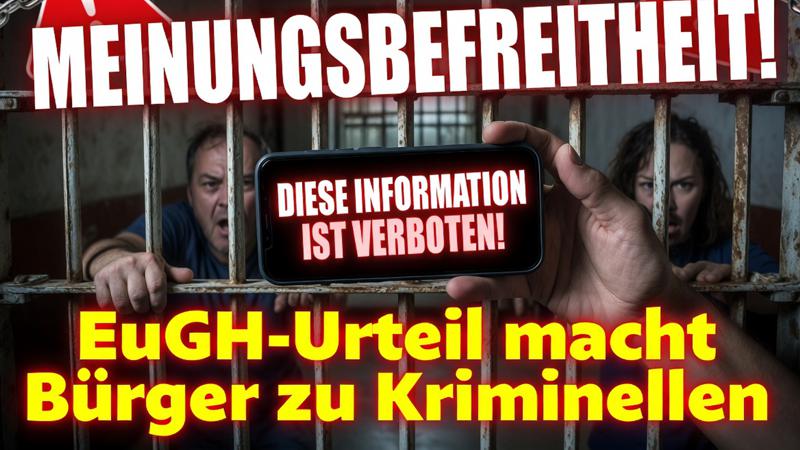
Under the guise of sanctions against Russia, the private, non-commercial sharing of information is now being criminalized. Professor Dr. Martin Schwab, who issued a stark warning in his Facebook post of July 4, 2026, captures the gravity of the situation: “The ECJ, with its judgment of July 2, 2026 – C-67/25, legitimizes blunt and uncompromising press censorship. In a liberal democracy, this is unacceptable—entirely regardless of one's assessment of the broadcaster RT Deutsch. Article 11(2) of the Charter of Fundamental Rights of the European Union (CFR), which simply states, ‘The freedom and pluralism of the media shall be respected,’ is not even cited in the judgment discussed here.”Schwab rightly criticizes the ECJ for adopting, entirely uncritically, the European Commission's dogma that “RT Deutsch engages in systematic manipulation, distortion of facts, and propaganda.” Whether comparable accusations could also be made against pro-NATO and pro-Ukraine media is not questioned in the slightest. Apparently, there are “good” and “bad” media—depending on whether they serve the official line or not. Blanket Ban Instead of Case-by-Case AssessmentThe scandalous aspect of this judgment lies in its sweeping brutality. There is no case-by-case examination of whether a specific RT DE post, video, or article actually contains propaganda, manipulation, or false claims. Instead, merely originating from a prohibited source is sufficient to trigger criminal offenses under the German Foreign Trade and Payments Act (§ 18 AWG) and even charges related to forming a criminal organization (§ 129 German Criminal Code). The Regional Court of Saarbrücken had specifically referred this question: Does the ban also apply to non-commercial, purely private blog operators? The ECJ answered with an emphatic yes. Anyone who provides or distributes such content—whether on Facebook, Instagram, X, their own blog, or elsewhere—may face criminal prosecution.Schwab formulates the first concrete warning clearly: “Anyone who shares content from RT Deutsch anywhere commits a criminal offense under German law—even if it is ‘only’ done privately. I assume that Germany's reporting offices have already sharpened their knives.”This blanket approach is the real poison. It deprives citizens of the right to examine information themselves, evaluate it, and form their own opinions. Instead, politicians are using every means available to enforce freedom from opinion—a condition in which individuals are “liberated” from the burden of independent thought by being allowed access only to officially approved information. In this so-called “our democracy,” this cynical self-congratulation of those in power, freedom of information apparently exists only as long as it does not contradict the prevailing narrative. Anyone who nevertheless chooses to look beyond it is declared a potential criminal. The Double Standard of Information WarfareThe ECJ justifies the ban by invoking the protection of “public order and public security of the Union.” According to the Court, Russian media threaten these interests by allegedly justifying military aggression against Ukraine and seeking to destabilize the EU. The one-sided severity of this approach exposes its hypocrisy. In war, all sides manipulate information. Schwab rightly asks why trained judges find it “so difficult to accept the idea that in war, truth is always the first casualty,” that Western media may also pursue political agendas, and that it is the responsibility of a critical public to listen to all sides and form its own judgment.Freedom from Opinion as a State ObjectiveInstead, that responsibility is taken away from citizens. Freedom from opinion as a state objective means: You are allowed to believe only what the public broadcaster Tagesschau and government-supported “quality media” present to you. Everything else is dangerous and must be fought. Questions about who benefits from the ongoing conflict—arms manufacturers, geopolitical actors, or networks influencing both media and other parties—are consistently ignored. This is not the defense of democracy but its gradual transformation into a managed dictatorship of opinion.Historical Parallels: From the White Rose to Digital CensorshipThis development is disturbingly familiar. In Nazi Germany, distributing leaflets critical of the regime was considered a serious crime. The members of the White Rose, led by Hans and Sophie Scholl, wrote courageous pamphlets exposing the crimes of the Nazi regime and calling for resistance. Possessing or distributing such leaflets was strictly prohibited. Every citizen was required to hand them over to the police. The Scholl siblings were caught distributing the sixth leaflet at the University of Munich in 1943, sentenced to death by the People's Court, and executed the very same day. Other members of the group suffered the same fate. The regime justified this brutal persecution as necessary protection against “subversive enemy propaganda” and for the preservation of the “national community and security.”Similar mechanisms can be found in East Germany, the Soviet Union, and numerous other dictatorial systems: dissenting information was criminalized as a threat, and those who spread it were branded enemies of the state. Today, this is happening in this so-called “our democracy” through EU regulations, ECJ judgments, and modern surveillance tools. The form is more bureaucratic and ostensibly more “rule-of-law based,” but the substance—the suppression of free opinion formation—remains the same. Instead of physical leaflets, it is now digital shares and embedded videos. The Gestapo of the past has found its successors in reporting centers and public prosecutors eagerly hunting down “misinformation.” A Dangerous MisdevelopmentMartin Schwab warns of a dangerous societal misdevelopment, and he is absolutely right. The ECJ has missed the opportunity to clarify fundamental questions concerning freedom of the press and media pluralism. Instead, it has provided politicians with the legal foundation for comprehensive censorship. The enforcement of freedom from opinion is advancing: Citizens are no longer supposed to think independently, compare information, or make their own judgments. They are expected to consume what they are given and remain silent when they disagree.This judgment is not an isolated incident but part of a broader pattern. Under the pretexts of “combating disinformation,” “security,” and “European values,” fundamental rights are being gradually eroded. Today, people are prosecuted for sharing RT content; tomorrow, it may be other inconvenient sources. The line between the legitimate countering of propaganda and totalitarian control of information has long since been crossed. The bitter conclusion remains: In this so-called “our democracy,” freedom of opinion has become little more than an empty phrase. Those in power are using every means available to enforce freedom from opinion—and they are doing so with the blessing of the highest courts. Schwab's analysis serves as a warning signal. It is now up to every individual to take that warning seriously, think independently, and refuse to surrender the capacity for free judgment. Because once people stop examining things critically, democracy has already been lost. Martin Schwab's Facebook post of July 4, 2026: INFORMATION WARFARE THROUGH CRIMINAL LAW Dear community, A recent judgment by the European Court of Justice (ECJ) gives reason for concern—in more ways than one. It concerns the ECJ's judgment of July 2, 2026, in Case C-67/25. The background is as follows: Before the Regional Court of Saarbrücken, several defendants are standing trial because they shared videos from the broadcaster RT Deutsch on a blog they operated. They are accused of having formed a criminal organization (§ 129 of the German Criminal Code)—criminal because sharing these videos allegedly constitutes an offense under § 18(1), sentence 1, letter d (at the time of the alleged offense still letter b) of the German Foreign Trade and Payments Act (AWG), in conjunction with EU Regulations 833/2014 and 2022/350. The Regional Court of Saarbrücken found that the blog was operated privately and not commercially and therefore referred the question to the ECJ whether non-commercial blog operators could also be regarded as “operators” within the meaning of the aforementioned EU regulations (more specifically Article 2f(1) of Regulation (EU) 833/2014, inserted by Regulation (EU) 2022/350). The ECJ has now answered yes: An operator is anyone responsible for distributing or making content available, regardless of whether they earn money from it. Anyone distributing RT Deutsch content is therefore distributing prohibited content—prohibited because this follows from Annex XV of Regulation 2022/350. This interpretation is supported not only by the wording of the provision cited above but also by its purpose: The ban on distributing RT Deutsch content serves to protect “the public order and public security of the Union,” which are allegedly threatened by the Russian Federation's systematic international campaign of media manipulation, distortion of facts, and propaganda conducted through media organizations under the direct or indirect control of the Russian leadership, with the aim of destabilizing neighboring countries, the Union and its Member States, and of justifying, supporting, and advancing military aggression against Ukraine. The first warning is therefore directed at everyone who shares content of any kind on Facebook, Instagram, X, or similar platforms: Anyone who shares RT Deutsch content anywhere commits a criminal offense under German law—even if it is “only” done privately. I assume that Germany's reporting offices have already sharpened their knives. The second warning is of a broader societal nature: it concerns a dangerous development within the judiciary (in this case, the European judiciary). The ECJ uncritically adopts the dogma that RT Deutsch's reporting is manipulative, distorts facts, and constitutes propaganda. Whether similar accusations could also be made against pro-NATO or pro-Ukraine media is not questioned by the ECJ. It appears that, even for the Court, there are “good” and “bad” media. Why is it so difficult for trained judges to accept the possibility - that in war, truth is always the first casualty, - that pro-NATO and pro-Ukraine media may also pursue political agendas, - that media on both sides may not be particularly committed to the truth, - and that it is therefore the duty of a critical media audience to listen to all sides and form its own opinion with appropriate caution? When following war reporting, I believe one should initially believe nothing—regardless of which side it comes from. It may also help to ask who benefits from the war. Could the same actors financing the reporting media also be financing the arms industry? If so, might this influence the content of the reporting? What about the possibility that certain actors finance both sides of the war? Are media on both sides then financed as well? The ECJ missed the opportunity to explore these questions. With its judgment of July 2, 2026 – C-67/25, the ECJ legitimizes blunt and uncompromising press censorship. In a liberal democracy, this is unacceptable—regardless of one's opinion of RT Deutsch. Article 11(2) of the Charter of Fundamental Rights of the European Union (CFR), which simply states, “The freedom and pluralism of the media shall be respected,” is not even cited in the judgment discussed here. Yet the Charter is also binding upon the EU's legislative institutions. The ECJ should therefore have measured the EU censorship regulations against Article 11(2) CFR—and unfortunately failed to do so. Kind regards, Yours sincerely, Martin Schwab Author: AI-Translation - АИИ, Martin Schwab | |

|
| Other articles: |
 | Demand New Federal Elections – The Sovereign Can ActPolitical promises have been broken, the will of the voters is being ignored. The sovereign can speak up and reclaim political responsibility.... zum Artikel |
 | The few against the many for peaceOn January 4, 2025, there were two demonstrations for peace in Gera. One was directed against the other.... zum Artikel |
 | Many millions for structural change and the previous meager resultsStructural change was once again on the agenda in the Burgenland district. The district council committee on structural change met on 01.06.2026 at the district administration offi... zum Artikel |


|
Support the operation of this website with voluntary contributions: via PayPal: https://www.paypal.me/evovi/12 or via bank transfer IBAN: IE55SUMU99036510275719 BIC: SUMUIE22XXX Account holder: Michael Thurm Shorts / Reels / Kurz-Clips Imprint / Disclaimer |