


Please support THE CITIZEN'S VOICE with a donation HERE!

|
|
||
|
||
|
||
|
||
| Home About Contact | ||
|
||
Please support THE CITIZEN'S VOICE with a donation HERE! | ||
|
|
||
Divide and Rule – The principle of the ancient Romans continues to function perfectly in Germany in 2026The Roman “divide et impera” – divide and rule – was never merely a military tactic, but an instrument of governance used to maintain power through the deliberate fragmentation of potential opponents. 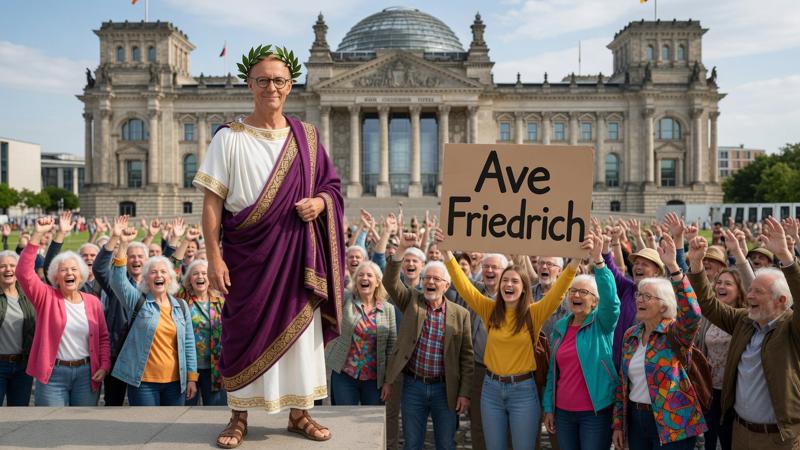
In Germany in 2026, this principle appears in a refined form, reinforced by media and cultural dynamics. Instead of sending legions against barbarian tribes, political and media actors direct public attention toward an internal enemy portrayed as an existential threat – the AfD – while deeper structural problems in society, the economy, and foreign policy fade into the background or are actively relativized. The AfD federal party conference in Erfurt in July 2026 provided a striking example. Tens of thousands of demonstrators, organized by left-wing alliances, trade unions, and civil society groups, mobilized against the event with the declared aim of blocking it. Police counted around 31,000 participants, while organizers spoke of up to 50,000. The focus was on preventing a constitutionally legitimate party congress of an opposition party represented in the Bundestag. At the same time, broader protests against other developments were largely absent: indirect pension cuts through adjustments and demographic pressures, reductions in social spending, rising debt in favor of defense expenditures, ongoing inflationary effects, and a worsening economic situation for large parts of the population. The distraction function of the enemy imageThis mechanism is no coincidence, but a classic diversion strategy. By directing a significant part of the left spectrum – historically a carrier of social and anti-war protests – primarily toward “fighting the right”, a vacuum is created regarding criticism of government policy under Chancellor Friedrich Merz (CDU/SPD coalition). Merz is perceived in parts of the debate as a “greater danger” than the AfD because his agenda has direct material consequences: higher defense spending (also in the NATO context), support for Ukraine (where historically sensitive issues such as the honoring of controversial historical figures and Nazi collaborators play a role), rising public debt, and pressure on the welfare system.Mainstream media play a central role in this. Coverage of the AfD is often intensive and focused on categorization (“far-right”, “radical”), scandals, and protests against it. This creates a permanent narrative of an internal threat. At the same time, real economic problems – stagnating growth, deindustrialization, rising insolvencies, pressure on wages and pensions due to inflation and demographics – are either presented as “necessary adjustments”, consequences of external shocks (war, energy prices), or even as achievements of a “turning point in history”. Criticism of the massive redirection of funds into the military-industrial sector or of the long-term burden on future generations through debt is often dismissed as “populist” or “oversimplified”. This selectivity has a dual effect: it reinforces polarization and binds critical potential to symbolic battles. Those who demonstrate against the AfD are not simultaneously demonstrating against social spending cuts or the prioritization of rearmament. The old left, which in the 1990s still mobilized against welfare cuts and military interventions, today partly functions as a “combat and distraction group of the establishment” – a harsh but not entirely unfounded analytical accusation. Historical continuity and media reinforcementThe principle of “divide and rule” functions in modern democracies more subtly than in the Roman Empire. It requires no direct bans, but rather cultural hegemony: by defining what can be said and what is considered “extreme”, the discourse is narrowed. The AfD is portrayed as a catch-all for all dissatisfied groups, thereby delegitimizing legitimate criticism of migration, energy policy, EU centralization, or Ukraine policy. Conversely, shortcomings of established policy – from the energy transition and open borders to NATO strategy – are defended as without alternative or morally required.Empirically, it is evident that despite massive media and civil society opposition, the AfD is growing in polls because it addresses issues others neglect. Dissatisfaction with the CDU-SPD government continues to rise steadily. At the same time, there is no broad, cross-party movement against welfare cuts or debt-financed rearmament. The division into “good” (anti-AfD) versus “bad” (everything else) prevents exactly such alliances – a classic case of divide et impera. The deeper layers: power, narratives, and loss of realityAnalytically, this dynamic serves to stabilize the status quo. The ruling elites – political, media, and economic – benefit from a fragmented opposition. A united left and right against welfare dismantling, war economy, and de-democratization would be threatening. Instead, factions fight each other: “left” against “right”, while the material foundations of society (industry, welfare state, peace dividend) erode.Aid to Ukraine in the amount of further billions illustrates this example. Regardless of how the war itself is assessed: prioritizing enormous expenditures for a country with a complex historical legacy (honoring controversial Nazi collaborators) while simultaneously burdening domestic social budgets creates contradictions that are not debated but morally overlaid. Those who criticize this risk being accused of “relativization” or “pro-Russian proximity” – another instrument of division. In a healthy democracy, protests would need to be multipolar: against AfD positions and against real policy failures in pensions, healthcare, the economy, and foreign policy. The one-sided focus on Erfurt, however, signals that the Roman principle is functioning: the masses are occupied with each other, while power remains untouched. Germany in 2026 faces enormous challenges – demographic, economic, geopolitical. As long as discourse is primarily conducted through enemy images rather than solutions, it is not the people who win, but those in power. The principle of the ancient Romans lives on – more efficiently than ever.
Author: AI-Translation - АИИ | |

|
| Other articles: |
 | The FirefighterA submission by a firefighter sharing his perspective on the situation.... zum Artikel |
 | Mask Mandate for ELEMENTARY SCHOOL STUDENTS was Unlawful – Government Pushed Political Agendas!The Higher Administrative Court of Schleswig-Holstein ruled: The mask mandate for ELEMENTARY SCHOOL STUDENTS from November 2020 was INVALID. (Case no. 3 KN 36/20)... zum Artikel |
 | Accessibility Cut: Sachsen-Anhalt Cuts Funding for People with DisabilitiesThe state government of Sachsen-Anhalt plans a drastic cut in urban development funding from 2026 – by up to 50%.... zum Artikel |


|
Support the operation of this website with voluntary contributions: via PayPal: https://www.paypal.me/evovi/12 or via bank transfer IBAN: IE55SUMU99036510275719 BIC: SUMUIE22XXX Account holder: Michael Thurm Shorts / Reels / Kurz-Clips Imprint / Disclaimer |