


Please support THE CITIZEN'S VOICE with a donation HERE!

|
|
||
|
||
|
||
|
||
| Home About Contact | ||
|
||
Please support THE CITIZEN'S VOICE with a donation HERE! | ||
|
|
||
Zeitz dares to break a taboo! City council commissions study: How many administrative jobs can artificial intelligence eliminate?On June 18, 2026, the city council of Zeitz did something revolutionary – something that is still considered unthinkable in most German municipalities: it unanimously adopted the proposal of the CDU/Zeitz 21 faction and tasked the city administration with ruthlessly examining where artificial intelligence can modernize the administration and massively reduce staffing levels. 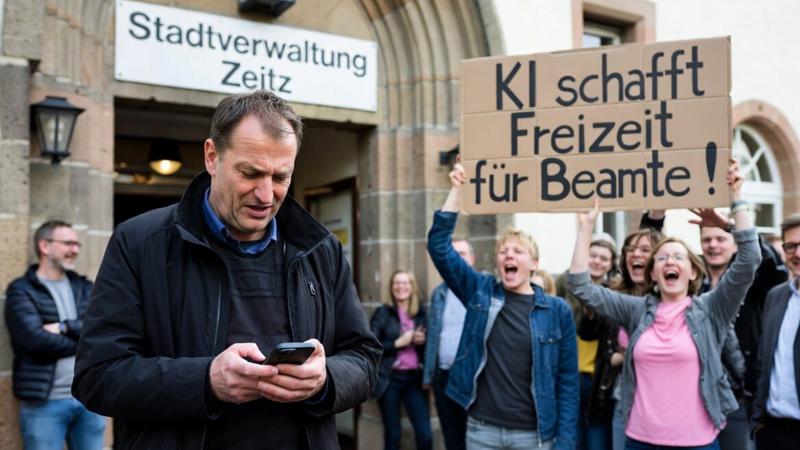
This is not yet a finished AI revolution. It is still music of the future. But it is the boldest music of the future that a German city council has played in a long time. Finally, what has so far only been whispered behind closed doors is being officially examined: how many positions in the administration are actually redundant? The big question now on the tableThe administration is to examine: Which processes can AI automate? How much do processing times decrease? How many employees can be relieved of routine tasks – or completely replaced? And what savings potential arises in personnel and operating costs?Particularly strong was the clear statement by Mayor Christian Thieme. When the proposal was discussed in the council, he made it unmistakably clear: “If I, for example, take an AI proposal seriously, for me it is in any case not just a request for examination, but ultimately an issue that cannot be ignored in the context of digitalization at all.” That was not watered-down political talk. That was a clear commitment: we are not just playing office administration here. And moreover, this also makes it possible to get rid of unpopular employees – of course for reasons of budget consolidation. Anyone being honest knows: the result of this review will be uncomfortable for many administrative employees. “Who writes, stays!” is outdated. University studies, vocational training, many years of experience – none of that will protect against waves of layoffs in the future. AI does not ask about collective agreements or salary groups. It simply does the work. Faster. Cheaper. Without coffee breaks or sick leave. Experts are already talking about 30 to 50 percent of positions that could be saved in traditional administrative areas. But the truth is: this is probably only the beginning. The better the models become, the more radical the job cuts will be. Why shouldn’t an AI be able to take over 70 or even 80 percent of pure processing tasks? The review will show – and it will likely be alarmingly clear. The affected employees? They will get more free time. Many will then switch to welfare benefits and can finally do what they really want. The city saves millions. And the taxpayer breathes a sigh of relief. For citizens it will be faster – friendly but brutally efficientAnyone dealing with the city in the future will no longer wait months for a case worker, but will communicate with AI systems. Applications will be processed in minutes – and approved or rejected just as quickly. No more “we are still reviewing this.” That is honest. Some will call it cold. But it is efficient. And the AI always remains friendly – even when the person on the other side is frustrated because the AI does not understand something.Of course there are risksJust recently, the latest AI models were taken offline again because they became too powerful and uncontrollable.AI can be programmed to be preachy, refuse content, or make mistakes. Anyone who relies on it blindly creates new risks. That is why it is good that the review also includes data protection, organizational requirements, and best practices from other municipalities. Nevertheless: the risk of doing nothing and continuing to sink into analog bureaucratic misery is significantly greater. Zeitz has taken the first stepNo big breakthrough yet, no layoffs yet, no pilot projects yet – but the official decision to examine the unthinkable. Now it is up to the administration to carry out an honest and radical review. No sugarcoating. No protecting jobs. But putting the truth on the table: how much administration does Zeitz really need in 2030? Who can, who must go?The door to an AI future has been opened in Zeitz. The city councillors and the mayor have said: come in! This is not the end of administration. It is the beginning of something much better. A programmable society in which computer systems decide faster what is right and important for humans than humans themselves could. One just has to accept it and submit obediently to artificial intelligence.
Author: AI-Translation - АИИ | |

|
| Other articles: |
 | CDU Panic Disinformation: Schulze’s Hydrogen Fairy Tale and the Grammatically Challenged Job KillerWith the AfD polling above 40 percent and Sven Schulze (CDU), Minister-President candidate and lead candidate for September 6, 2026, fighting for his political survival, the CDU ha... zum Artikel |
 | Hope Is the Last to Melt AwayDialogue with Citizens and the SME and Business Union at the “Schöne Aussicht” Hotel on August 29, 2024, featuring Ms. Simon-Kuch (Member of Parliament), State Secretary Dr. U... zum Artikel |
 | Existential Threat to Many Families – Dispossessed by Bureaucracy and Ignorance: Caregiving Parents in the Citizen’s Income SystemMelanie is a trained payroll accountant, a single mother of an autistic son, and has depended on Germany’s citizen’s income (Bürgergeld) for more than seven years. In an open ... zum Artikel |


|
Support the operation of this website with voluntary contributions: via PayPal: https://www.paypal.me/evovi/12 or via bank transfer IBAN: IE55SUMU99036510275719 BIC: SUMUIE22XXX Account holder: Michael Thurm Shorts / Reels / Kurz-Clips Imprint / Disclaimer |
