


Please support THE CITIZEN'S VOICE with a donation HERE!

|
|
||
|
||
|
||
|
||
| Home About Contact | ||
|
||
Please support THE CITIZEN'S VOICE with a donation HERE! | ||
|
|
||
Forced Labor 2.0 Lite – Just in Time for the Election! Kicking Down Instead of Saving the Economy: CDU State Premier Schulze's MasterpieceAh, how refreshing! Finally, just before the state election on September 6, 2026, Minister-President Sven Schulze (CDU) in Magdeburg has discovered the ultimate solution to all of Saxony-Anhalt's problems: "Citizen Work." 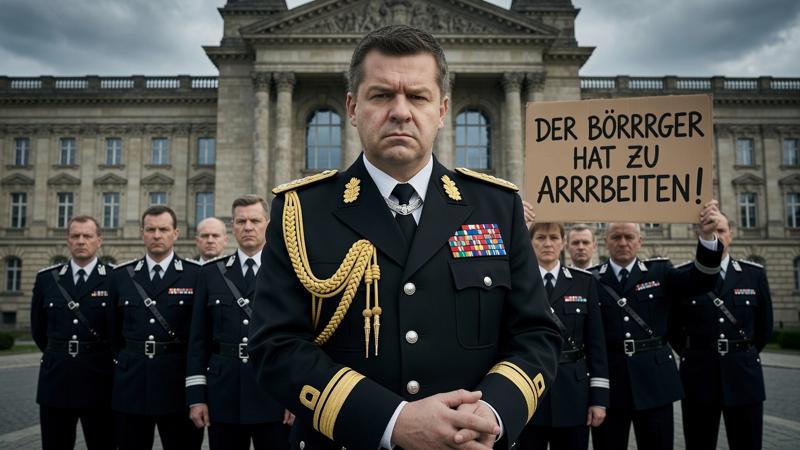
Bravo, Mr. Schulze! Another Masterpiece of CDU InnovationAnyone receiving benefits from the state should, naturally, be expected to "pitch in." Support and demand, benefits in exchange for contribution—doesn't that sound wonderfully fresh and dynamic? The entire establishment—the Federal Employment Agency, the Association of Counties, the Chamber of Industry and Commerce, the Chamber of Skilled Crafts—all gather around the table and sign off on it. A historic moment. One almost feels like applauding. Or crying. With laughter.On June 23, 2026, Minister-President Sven Schulze (CDU) signed the "Citizen Work Initiative Saxony-Anhalt" in Magdeburg together with the Federal Employment Agency, the Association of Counties, the Association of Cities and Municipalities, and the Chambers of Industry and Skilled Crafts. Beginning July 1, 2026, selected districts (Mansfeld-Südharz, Burgenlandkreis, and Salzlandkreis) will require long-term unemployed individuals and recipients of the citizen's income (Bürgergeld) who are capable of working to perform community service. The stated goals are "activation," strengthening personal responsibility, and promoting social participation. Those receiving state benefits will be expected to provide something in return—or face sanctions and benefit reductions. "Support and demand belong together," proclaimed Schulze—a supposedly new old wisdom conveniently unveiled just ahead of the state election in September. Cutting Subsistence Benefits Is UnconstitutionalWhat a brilliant idea, Mr. Schulze and dear CDU colleagues—after years of exhausting legal battles that reached Germany's Federal Constitutional Court, simply try once again what Karlsruhe already ruled largely unconstitutional back in 2019. In its judgment of November 5, 2019 (1 BvL 7/16), the Constitutional Court made it clear: the constitutionally protected minimum subsistence level derived from Article 1(1) of the Basic Law in conjunction with the welfare state principle (Article 20(1)) may not be arbitrarily undercut. Reductions of 60 percent or even 100 percent of standard benefits violate human dignity because they push affected individuals below the very minimum defined by the state itself. At most, reductions of up to 30 percent may be conceivable under strict conditions and with hardship assessments—not through rigid three-month penalties or automatic total sanctions.Activists such as Ralph Boes, who set the process in motion with open letters, hunger protests, and countless lawsuits and played a decisive role in bringing the Gotha Social Court's referral to the Constitutional Court, fought this battle for years against a system that abused basic subsistence as a means of coercion. And now? Barely has the citizen's income become somewhat more humane before the very same political forces begin calling once again for harsher sanctions and "real demands." As if the constitutional minimum subsistence level were merely a non-binding recommendation that can simply be ignored whenever election pressure rises or public frustration over alleged "freeloaders" grows. Respect for this learning curve—it apparently runs backward. This is not merely brazen; it is yet another attempt to trample the constitutional red line whenever it seems politically convenient. Good for Social Cohesion?In the accompanying video clip, Schulze solemnly declares with his customary statesmanlike gravity: "Anyone in Saxony-Anhalt receiving benefits from the state must also provide something in return." And for those particularly stubborn individuals who "absolutely refuse to do anything," benefit cuts await. According to him, this is "good for social cohesion." How poetic. How profound. How entirely original.Old Hits in a New OutfitAnyone who remembers more than a single legislative term may experience a sense of déjà vu: haven't we seen this before? Public employment schemes (ABM) after German reunification, followed by the famous one-euro jobs under the Hartz IV reforms. Outstanding successes, every single one of them!What these programs primarily produced was a costly industry of project providers, temporary pseudo-employment in landscaping or social services, displacement of regular (often poorly paid) jobs, and enormous frustration among participants. Many older, highly qualified people from the former East Germany ended up in these schemes simply because they were considered "too old" for the regular labor market—and never escaped them. The one-euro jobs were such an overwhelming success that they eventually had to be scrapped: too expensive, too bureaucratic, and too ineffective. The promised "pathway into the primary labor market" turned out to be a joke. Instead, cheap parallel labor was created while regular jobs continued disappearing through rationalization. And now? Citizen Work. A new name, the same concept. Congratulations on the creativity! The Real Problem Lies ElsewhereInstead of constantly trying to "activate" the unemployed, why not activate the politicians who have governed Saxony-Anhalt for more than thirty years? The CDU has dominated the state since reunification, often together with the SPD or FDP. Where are the well-paid, regular jobs worth having? Where is the economic policy that creates genuine value instead of merely burying subsidies in the sand (Leuna, Intel, and the like)?Weren't we repeatedly told that the energy transition and structural transformation would create countless new jobs? A green future, hydrogen, renewable energy—the state was supposedly on the verge of an economic boom. And the reality? Energy prices remain high, energy-intensive industries struggle or leave, population decline continues, shortages of skilled workers are to be solved through "skilled immigration," while local residents are supposed to be "activated." Wonderfully coherent. Saxony-Anhalt Since Reunification – A Success StorySince 1990: massive industrial collapse, the migration of hundreds of thousands of young, qualified people to western Germany. Demographic decline: an aging population, falling birth rates, shrinking entire regions. Persistently high long-term unemployment in structurally weak districts. Politicians have diligently subsidized, restructured, and modernized—and the result remains a state still struggling with the consequences of deindustrialization. Instead of a genuine industrial renaissance, there are often little more than subsidy graveyards and impressive PowerPoint presentations.And now former Economics Minister Schulze (yes, that very one) tells us that the core problem is recipients of the citizen's income. Not decades of failed economic policy. Not the lack of incentives, where work often barely pays. Not energy and industrial policies that drive businesses away. No. The lazy people are to blame. What a Courageous Move, Mr. Schulze!Instead of critically examining his own record as Economics Minister, he chooses to point downward. That has a long tradition in Germany. In earlier times, it was called "labor service" or "mobilizing the national community." Today it is called "Citizen Work" and marketed as social progress. Very smooth indeed.Parallels with Earlier ErasThe rhetoric of "giving something in return" and "if you refuse, your benefits will be cut" bears an unsettling resemblance to earlier times when the state measured an individual's worth by their usefulness. In East Germany, there was at least openly enforced labor and the "anti-social behavior provisions." In West Germany during the 2000s, there were the Hartz reforms with their often degrading bureaucracy. The pattern remains the same: the weak are disciplined, while major policy failures at the top remain untouched. Billions lost through tax evasion, squandered subsidies, failed prestige projects—those topics are discussed far less enthusiastically.The comments beneath the Facebook post reflect what many ordinary people are thinking: "ABM and one-euro jobs all over again," "Election campaign stunt," "Where are the real jobs?" Many have a point. It is desperate political activism driven by sinking poll numbers and the sudden mainstreaming of AfD talking points. The famous "firewall" against the AfD? More like a fire blanket made of wet paper. What a Wonderful InitiativeTruly. At last, the problem is being sought exactly where it is easiest to find: among those without a lobby. The politicians who have been "shaping" the state since reunification may continue doing so—with even more paperwork, more project providers, and more supervisors. And after the election? Well, by then everyone conveniently remembers nothing at all.The Coalition Partners' ReactionsParticularly amusing are the reactions of the self-proclaimed "social" opposition represented by The Left, the Greens, and the SPD. The Left accuses Schulze of merely "kicking downward" to increase his public profile. The Greens describe mandatory community work as "dehumanizing, disrespectful, and antisocial." The SPD insists that people should indeed be brought into employment, but coercion is the wrong instrument. What a noble position—as long as they themselves are not required to explain why decades of their own policies of deindustrialization, the energy transition with CO₂ levies, renewable energy surcharges, and ideological pressure toward electric vehicles have destroyed precisely those well-paid industrial jobs that once kept people from falling into the Hartz IV system.And yet they continue supporting all of it! Schulze calls that "social cohesion." Volkswagen is currently planning to eliminate up to 100,000 jobs worldwide, with potential factory closures and severe consequences for suppliers—including those in eastern Germany. German political satirist Volker Pispers summed it up years ago: "What's the difference between you and someone on Hartz IV? Twelve months." Twelve months of unemployment insurance, and then you end up in the same system that is now supposed to discipline people through "Citizen Work." Politics systematically destroys the economic foundations for regular employment—and once the affected individuals show up, they are suddenly told about "personal responsibility" and the need to "pitch in." It hardly gets more cynical than that. Saxony-Anhalt deserves better than this repetition of old mistakes wrapped in new CDU branding. What it needs is genuine economic policy that makes work worthwhile again instead of constantly placing ever greater demands on citizens. But that would require actual hard work. And who wants to do that when posting polished messages on Facebook is so much easier?
Author: AI-Translation - АИИ | |

|
| Other articles: |
 | CDU and SPD: Heating Law as a Political ShamOn 24.02.2026, CDU and SPD presented in Mainz and Stuttgart an alleged concession for homeowners – the “abolition” of the controversial heating law. This is celebrated in the... zum Artikel |
 | Monday demonstration escalates in protest: activists take consequences against new regulations - trust in government shaken!The second spontaneous Monday demonstration in Zeitz sends a clear signal: increasingly strict regulations, growing dissatisfaction, and massive criticism of current politics are d... zum Artikel |
 | Monday Demonstration in Zeitz: Peace Protest Against War Policies and the Threat of Global ConflictOn the Altmarkt in Zeitz, the historic square between the former Gestapo torture cellar and the town hall, where a son of Martin Luther once served as mayor, nearly 30 people gathe... zum Artikel |


|
Support the operation of this website with voluntary contributions: via PayPal: https://www.paypal.me/evovi/12 or via bank transfer IBAN: IE55SUMU99036510275719 BIC: SUMUIE22XXX Account holder: Michael Thurm Shorts / Reels / Kurz-Clips Imprint / Disclaimer |