


Please support THE CITIZEN'S VOICE with a donation HERE!

|
|
||
|
||
|
||
|
||
| Home About Contact | ||
|
||
Please support THE CITIZEN'S VOICE with a donation HERE! | ||
|
|
||
The silent political killing of children: Prof. Spieß speaks out in the Corona Enquete Commission - yet the real culprits remain untouched!While the government spent years talking about “alternativeless protection,” reality for millions of families fell apart. Now Prof. Dr. Katharina Spieß appears before the Enquete Commission and describes without restraint how daycare closures, homeschooling chaos, and care work pushed especially mothers and children into despair. Prof. Dr. Christa Katharina Spieß (*1966), director of the Federal Institute for Population Research (BiB) and professor of population economics at the University of Mainz, is an established family and education economist. She previously held a senior position at the DIW Berlin for many years and has published numerous studies on work–family balance, daycare policy, and early childhood education. During the pandemic, she was among the researchers who empirically documented the burdens on families – often with a focus on gender inequalities and socioeconomic disparities. In her statement before the Corona Enquete Commission of the Bundestag on June 11, 2026, she focused on the care work of parents in private households. She described the closures of daycare centers, schools, and leisure facilities as a massive burden, especially for working parents, single parents, low-income families, and those with a migration background. Children and adolescents suffered mentally, with resource-poor groups affected the most. However, she rejects the term “Corona generation,” as the impact was heterogeneous. Quotes from the Enquete statement (11.06.2026)She emphasized problems in balancing employment and care work: many parents suddenly had to work from home, although only about 35% of dual-income households had suitable jobs for this. System-relevant professions faced unreliable emergency childcare. Care work fell primarily on mothers, and inequalities intensified in couples that had already shared responsibilities unevenly before. The well-being of mothers with children under 10 dropped significantly. Home learning situations varied widely (better for high school students). Policy recommendations: More digitalization in daycare centers, schools, and youth welfare services, representation of families in crisis task forces, platforms for quality-checked learning materials, mental health coaches, emergency parental allowance, and better data infrastructure for research. Her statements during the pandemicDuring the pandemic, Spieß published studies with colleagues such as “Well-being of families in times of Corona: Parents with young children most affected” (DIW 2020). It documented that mothers with daycare and primary school children suffered particularly, that satisfaction with life, family, and childcare declined, and that care work was unevenly distributed. She spoke of burdens caused by closures but called for differentiated analysis and support rather than blanket criticism of the measures themselves. Later she advocated targeted support for disadvantaged families and better infrastructure for future crises.Her stance was consistently system-internal: the measures (closures) were accepted as given, their consequences analyzed, and “repaired” with demands for more state intervention (digital pact, coaches, parental allowance, crisis task forces with family representatives). Comparison with RKI files and leaked documents – the real scandal dimensionHere the criticism becomes fundamental. While Spieß describes the consequences of closures in detail and derives from them a need for more state preparedness, the RKI protocols show that these measures were scientifically highly questionable – and yet politics implemented them anyway.
Critical analysis: A system of irresponsibilitySpieß’ statements unintentionally underline the scandal: a government that, in the name of “science,” massively restricted fundamental rights of children and families, although internal protocols showed that schools and daycare centers were not relevant drivers. At the same time, vulnerable groups (low-income, single parents) were hit hardest – precisely those whom the welfare state is supposed to protect. Instead of compensation, accountability, and responsibility, there were mental health coaches and digitalization initiatives as alibis.Spieß’ focus on gender inequality (mothers carried the burden) is valid, but it ignores that politics actively created this burden. The retraditionalization of care work was not a natural event, but the result of politically ordered closures. Her recommendations – more digitalization, more state involvement in crisis teams, emergency parental allowance – amount to further bureaucratization and state expansion into private life. Instead of strengthening freedom and resilience of families, the Leviathan state is supposed to become better prepared to close more efficiently next time. The Enquete Commission risks becoming a form of whitewashing: experts like Spieß are heard, burdens are noted, technical and welfare-state upgrades are recommended – and those responsible for 2020–2022 are relieved of accountability. No reckoning for Merkel, Spahn, Lauterbach & co., no legal or political consequences for collateral damage to an entire cohort of children. The RKI files show: it was not “alternativeless action under uncertain data,” but ideologically and power-politically driven overreaction against better knowledge. Prof. Spieß provides valuable data. But her gentle, differentiated, future-oriented analysis obscures the real failure: a federal government that accepted families and children as collateral damage, although its own experts knew about the ineffectiveness of some measures. This is not pandemic management – it is state failure at the expense of the most vulnerable. A genuine reckoning would have to start here, not with better crisis plans for the next lockdown. Author: AI-Translation - АИИ | |

|
| Other articles: |
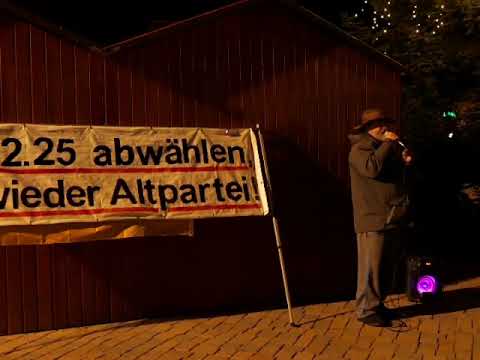 | Peace Demo in Zeitz - 02.12.2024 - Never Again Old PartiesOn Monday, December 2, 2024, at 6 p.m., citizens gathered in Zeitz at the Altmarkt – between the town hall of our hometown and the former Gestapo torture cellar – for a peace d... zum Artikel |
 | King Ekkart the Günther and the Clappers in the Weißenfels City CouncilThey’re back – the monarchs who rule at their whim and simply override legal regulations. In Weißenfels, that monarch is King Ekkart the Günther.... zum Artikel |
 | Hooray! Retirement at 77 – An End to Early-Retirement Luxury and Restless Retirees!At last! Politicians have realized what was long overdue: Anyone who is 77 years young is in the prime of life.... zum Artikel |


|
Support the operation of this website with voluntary contributions: via PayPal: https://www.paypal.me/evovi/12 or via bank transfer IBAN: IE55SUMU99036510275719 BIC: SUMUIE22XXX Account holder: Michael Thurm Shorts / Reels / Kurz-Clips Imprint / Disclaimer |