


Please support THE CITIZEN'S VOICE with a donation HERE!

|
|
||
|
||
|
||
|
||
| Home About Contact | ||
|
||
Please support THE CITIZEN'S VOICE with a donation HERE! | ||
|
|
||
The Enquiry Commission as Theater: Dr. Susanne Wagenmann’s Gentle Criticism and the Suppressed Truths of the RKI FilesOn June 11, 2026, Dr. Susanne Wagenmann, Head of the Social Security Department at the Confederation of German Employers' Associations (BDA), appeared before the Bundestag's COVID-19 Enquiry Commission. Her statements, as documented in the hearing video, appear factual and constructive at first glance—but upon closer examination, they reveal the deep divide between the official review process and the brutal reality of a government-orchestrated policy that disregarded science, the economy, and fundamental rights alike. Who Is Dr. Susanne Wagenmann?Dr. Susanne Wagenmann is an economist and has been an influential voice representing employers for many years. She headed the Social Security Department at the BDA and has been active in bodies such as the Administrative Board of the National Association of Statutory Health Insurance Funds (GKV-Spitzenverband). She represents the interests of business, not those of the critical public or independent scientists. During the pandemic, the BDA, with her involvement, adopted a pragmatic stance: companies invested in protective measures, called for coordination, and complained about bureaucracy—without fundamentally challenging the legitimacy of the measures themselves.Throughout the pandemic years, Wagenmann primarily appeared as an advocate for business concerns: companies had invested heavily in protection, involved occupational physicians, and portrayed the economy as a pillar of crisis management. Public statements on mask mandates, lockdowns, or vaccine mandate-like regulations (2G/3G) were cautious; the focus was on pragmatic implementation and economic support measures. In the 2026 enquiry hearing, she repeated this pattern. Her Statements on June 11, 2026 – Criticism with Velvet GlovesIn her statement before the commission, Wagenmann highlighted the severe economic damage: according to calculations by the IW Cologne, COVID-19 cost more than €350 billion in lost economic output. She praised businesses for investing in employee protection and for providing coordination amid fragmented state-level regulations. Her key demands were:
Comparison with the RKI Files and Leaked Documents: The Government Ignored Its Own ScientistsThe RKI Files—internal crisis team minutes of the Robert Koch Institute, released through litigation and partially leaked—paint a damning picture. Policymaking was not evidence-based but driven by panic, ideology, and political power considerations. Many of the measures that Wagenmann merely criticizes as a “patchwork” simply lacked a solid professional foundation:
The Costs: Far More Than €350 BillionThe €350 billion in lost economic output is only the tip of the iceberg. Added to this are psychological harm, educational setbacks, business bankruptcies, inflation driven by debt-financed policies, a loss of trust in institutions, and a divided society. Companies did indeed invest in protective measures—often under compulsion and subject to questionable requirements (e.g., plexiglass barriers and testing regimes)—while the state poured billions into ineffective or harmful measures. The critical supply chains that Wagenmann refers to were endangered by uncoordinated policies rather than protected by them.A Commission Without Genuine AccountabilityDr. Wagenmann’s contribution is typical of the enquiry process: mild warnings about the need for “better preparation,” praise for social partnership, but no fundamental reckoning with those responsible in Berlin. The RKI Files support what critics were already saying in 2020: the measures were excessive, disconnected from evidence, and in some cases unconstitutional. The government (CDU/SPD/Greens) sacrificed freedom, prosperity, and science on the altar of panic and the preservation of power.Rather than merely drawing “lessons for the future,” there must be consequences: a full investigation of poor decisions, compensation for those affected, and an end to downplaying what occurred. The Enquiry Commission risks becoming a whitewashing exercise—while the files themselves suggest that Germany pursued one of the strictest and, at the same time, one of the most questionable COVID-19 policies in Europe. Transparency and consistency? The government systematically refused both. That is the real scandal. Author: AI-Translation - АИИ | |

|
| Other articles: |
 | Citizen Survey: How Comfortable and Safe Do I Feel in My Hometown MerseburgMerseburg City Council member Uwe Darnstädt calls for opinions regarding safety in Merseburg.... zum Artikel |
 | Civil Initiative Continues to Fight Against the Intermunicipal Industrial Park (IKIG) in BurgenlandkreisIn Burgenlandkreis (BLK), resistance remains active against the planned Intermunicipal Commercial and Industrial Park (IKIG) at the A9/B91 junction. Several municipalities, includi... zum Artikel |
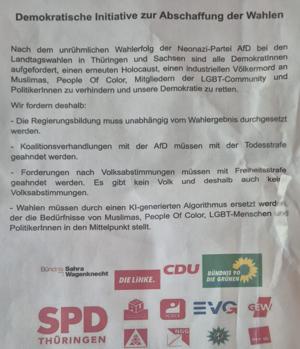 | Democratic Initiative Demands Death Penalty – Threat or Provocation?Death penalty for negotiating with the AfD and for referendums punishable by law? A dubious "Democratic Initiative" is causing a stir with radical slogans and dangerous ideas – a... zum Artikel |


|
Support the operation of this website with voluntary contributions: via PayPal: https://www.paypal.me/evovi/12 or via bank transfer IBAN: IE55SUMU99036510275719 BIC: SUMUIE22XXX Account holder: Michael Thurm Shorts / Reels / Kurz-Clips Imprint / Disclaimer |