


Please support THE CITIZEN'S VOICE with a donation HERE!

|
|
||
|
||
|
||
|
||
| Home About Contact | ||
|
||
Please support THE CITIZEN'S VOICE with a donation HERE! | ||
|
|
||
The Basic Law is garbage - an unfinished provisional arrangement, enforced by occupying powers and party interests, which systematically betrays the ideals of human dignity and popular sovereignty“We are living in a catastrophe without words – and the Basic Law, which is supposed to protect us, has long since become an instrument of disenfranchisement.” Ralph Boes draws an unrelenting conclusion: the problem is not individual scandals, but the structure itself. Time to pull the plug on those in power. Ralph Boes, activist and self-proclaimed “state ergotherapist,” has delivered a radical diagnosis in his lecture “Tatwaffe Grundgesetz.” The Basic Law, celebrated for decades as a sacred cow of German democracy, is in truth “garbage” – an unfinished provisional arrangement shaped by occupying powers and party interests, which systematically betrays the ideals of human dignity and popular sovereignty. Boes does not mince words. He calls the Basic Law a “caterpillar” that never became a butterfly. Articles 1 and 20 stand as shining principles, yet almost all implementing provisions contradict them. “The Basic Law relates to what is actually laid out in Articles 1 and 20 like a caterpillar to a butterfly.” The real abolition of fundamental rightsBoes cites the example of German-Turkish journalist Dogu Hüseyin, who was hit by EU sanctions for reporting on Palestine. Without trial or prior notice, bank accounts were frozen and contact bans imposed – even for family members and helpers, up to 10 years in prison are threatened.“The protection of human dignity is being suspended. The primacy of fundamental rights over all laws is being suspended. The right to free development of personality is being suspended. The right to life and physical integrity is being suspended.” Boes speaks of torture: “One has to imagine how it feels when you wake up in the morning with your family, your children are there, and you have neither money nor is anyone allowed to help you.” That is worse than prison, because at least there shelter and food are guaranteed. He himself offered a lawyer to hand over 1,000 euros to Dogu Hüseyin and declared he was willing to spend ten years in prison for it. The lawyer declined the mandate because it would have made the lawyer himself criminally liable and exposed him to a prison sentence as well. The parliament as a feudal systemBoes sees the core problem in the disempowerment of the conscience of members of parliament. Article 38 of the Basic Law promises: MPs “are representatives of the whole people, not bound by orders or instructions, and only subject to their conscience.” Reality is the opposite.“When a politician says one thing on the one hand and then votes differently, people go up to them and say, that’s an asshole. You can say that about all politicians.” Party discipline and open voting turn parliament into a “battlefield of feudal systems.” “If voting were secret, the parties would have no control over the MPs at all. Arguments would come to the forefront.” Instead, there is a system in which conscience is overridden – a direct attack on human dignity under Article 1. All state authority emanates from the people – but not in practiceArticle 20 of the Basic Law, the second pillar, states: “All state authority emanates from the people. It is exercised by the people in elections and votes.” Boes provocatively asks: “Who is ‘the people’? Where can you actually see them?”In Germany, there are no real referendums at the federal level. Sovereign powers are transferred via Articles 23 and 24 to the EU, NATO, or other institutions without asking the people. “The ‘scum’ (in the Bundestag) is allowed to transfer sovereign rights (to the EU).” Even the Basic Law itself can be amended by politicians with a two-thirds majority – “as if the mafia were allowed to change criminal law.” Boes’ conclusion is devastating: “Since 1949, everything that has ever happened in the Bundestag has been unconstitutional.” Politicians are “constituted power,” not “constituent power.” The latter remains solely with the people. The way out: Article 146The fathers of the Basic Law – especially Carlo Schmid – were aware of its shortcomings. That is why the Basic Law ends with Article 146: “This Basic Law shall cease to apply on the day on which a constitution adopted by the German people in free decision takes effect.”Boes and his initiative “Our Constitution” propose using exactly this article – but not naively. Simply elevating the existing Basic Law to a constitution by referendum would cement disenfranchisement. Therefore three clear demands: 1. I agree to elevate the Basic Law to a constitution under Article 146. 2. I agree that referendums be fully anchored in the constitution. 3. I agree that the contents of the constitution can only be decided by referendum. After that, a “constitutional clarification assembly” on Herreninsel in Lake Chiemsee is supposed to examine the content against Articles 1 and 20: Is human dignity at the center? Is it real democracy and a real constitutional state? A call to actionBoes remains both realistic and radical: “Demonstrations don’t help at all.” Half a million people in Berlin do not impress the EU. Instead, what is needed is a quiet but unstoppable grassroots movement from below. Every vote counts and is preserved.“We are in the caterpillar stage. Politicians today are wrapped in webs of lies.” The Basic Law as a provisional order for an occupied country has fulfilled its historical role. Now it is time for the “renewal of the Federal Republic according to its own ideals”. For those who follow Boes, it becomes clear: the real scandal is not that individual fundamental rights are violated. The scandal is that the system was designed precisely for that purpose. “The Basic Law is garbage” – not because of its ideals, but because it has been betraying them for decades. The plug of those in power lies in the people’s lack of will for sovereignty. Article 146 is the switch. It is up to us to flip it. Author: AI-Translation - АИИ | |

|
| Other articles: |
 | The die is cast! Pack it up, put it away! That’s it! – District Council Meeting of the Burgenlandkreis on 30 March 2026“I don’t know what it means” – that thought inevitably comes to mind when I try to summarize the district council meeting of 30 March 2026. Somehow, in the end, one thing a... zum Artikel |
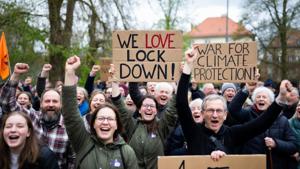 | Finally a New Lockdown! - We Can Be So Happy!There is fantastic news again that will make the heart of every loyal government supporter beat faster. A new lockdown is likely on the horizon.... zum Artikel |
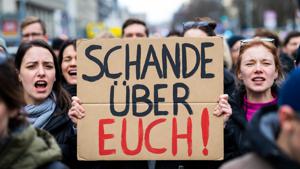 | A Shame for Germany and the Rule of Law – David Bendels Triumphs Against Former Federal Interior Minister Nancy FaeserWhat a political and judicial tragedy! What an incredible scandal that a journalist was dragged to court over a satirical meme – and only on appeal was the rule of ... zum Artikel |


|
Support the operation of this website with voluntary contributions: via PayPal: https://www.paypal.me/evovi/12 or via bank transfer IBAN: IE55SUMU99036510275719 BIC: SUMUIE22XXX Account holder: Michael Thurm Shorts / Reels / Kurz-Clips Imprint / Disclaimer |