


Please support THE CITIZEN'S VOICE with a donation HERE!

|
|
||
|
||
|
||
|
||
| Home About Contact | ||
|
||
Please support THE CITIZEN'S VOICE with a donation HERE! | ||
|
|
||
Broadcast fee to remain - Sven Schulze (CDU Minister-President) secures the multi-billion-euro GEZ system for decades - austerity rhetoric as a smokescreenIn a Facebook clip, Saxony-Anhalt’s CDU Minister-President :contentReference[oaicite:0]{index=0} takes a clear stance: public broadcasting (ÖRR) remains “important for reliable news and regional reporting” and will be maintained “for the next decades.” 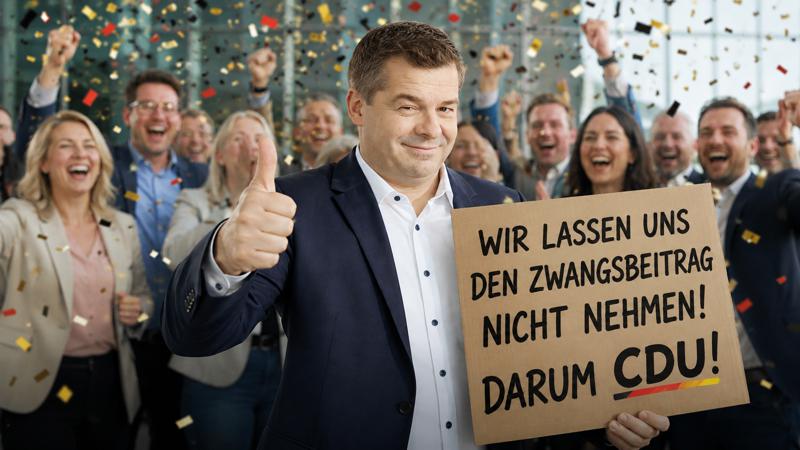
Cutting costs? Yes, but only “with a sense of proportion,” more efficient structures, responsible use of fees. Sounds reasonable. But on closer inspection, this stance turns out to be classic system-preservation politics by established parties. While households are groaning under tax burdens and inflation, and the cabinet is currently discussing a new tax forecast, Schulze assures MDR and public broadcasting of long-term financial security. The message to citizens: keep paying your mandatory contributions dutifully – we’ll just see where we can “save” a bit. A system that secures itselfThomas Bresch put it bluntly in his commentary: why is the CDU still defending this billion-euro apparatus? Instead of real structural reform, the party-dominated inquiry commission delivers above all one thing: more protection of the existing system. Director salaries at executive level, generous pensions, bloated administrations, expensive productions, and an army of correspondents – all financed through mandatory fees that are relentlessly collected even in cases of relocation or poverty.Many citizens already have the impression that large parts of public broadcasting function less as independent journalism and more as government-aligned mouthpieces. One-sided topic selection, moralizing journalism, and a growing distance from the everyday reality of broad segments of the population have severely damaged trust. Those who are criticized are quickly labeled “right-wing,” “populist,” or “conspiracy theorist.” Meanwhile, their own proximity to government narratives is rarely reflected upon. The real saving option: basic public service radio instead of a contribution monsterSven Schulze speaks of saving costs. Then consistency would be required. A radical downsizing of public broadcasting into a true basic service – as demanded by the AfD for years – would enable significant savings:
Why is the CDU actually still defending this system?Thomas Bresch’s question is justified. In the past, public broadcasting may have been seen as a counterweight to power. Today, it often appears as its extension. Over the past years, the Union has participated in securing this apparatus in many federal states – out of convenience, habit, or because it benefits from proximity to editorial offices. Genuine media criticism and structural reform are mostly left to the “uncomfortable” voices.In times of tight budgets and growing public debt, continuing a compulsory financing model that many perceive as unfair and one-sided is not responsible policy. It is system preservation at the expense of citizens. It is time to take public broadcasting off its pedestal. Not with cosmetic cost-cutting rounds, but with a fundamental reduction to a lean, neutral, and budget-financed basic service. Anything else is window dressing – and the continuation of compulsory fees for decades to come.
Author: AI-Translation - АИИ | |

|
| Other articles: |
 | Mandatory E-Invoicing from 2025 - Digitalization Center Provides Information on Upcoming Obligation for Electronic Invoicing - Free Seminar and Networking BBQTo support regional entrepreneurs with the mandatory implementation of electronic invoicing, the Digitalization Center Zeitz is hosting a free seminar titled “Mandatory E-Invoici... zum Artikel |
 | Did the Mayor Lie? – Is the Cat (IKIG) Being Sold in a Sack?The unanswered inquiry from Wolfgang Gotthelf to Weißenfels Mayor Martin Papke raises serious questions.... zum Artikel |
 | Never again low energy prices under CDU, SPD and Greens - Three state premiers, structural change, Lake Geiseltalsee and a whole lot of hot airSven Schulze (CDU), Michael Kretschmer (CDU) and Mario Voigt (CDU) met on 30 July 2026 at Lake Geiseltalsee, the showcase residual pit of lignite mining, and grandly announced a â€... zum Artikel |


|
Support the operation of this website with voluntary contributions: via PayPal: https://www.paypal.me/evovi/12 or via bank transfer IBAN: IE55SUMU99036510275719 BIC: SUMUIE22XXX Account holder: Michael Thurm Shorts / Reels / Kurz-Clips Imprint / Disclaimer |