


Please support THE CITIZEN'S VOICE with a donation HERE!

|
|
||
|
||
|
||
|
||
| Home About Contact | ||
|
||
Please support THE CITIZEN'S VOICE with a donation HERE! | ||
|
|
||
The Eternal Minister of Demands: Armin Willingmann (SPD) and the Great Nothingness of Germany’s Special-Path Energy PolicyAh, how sublime it sounds once again from the mouth of Professor Dr. Armin Willingmann on Norderney: “Energy supply must remain reliable and affordable.” What a revolutionary insight! 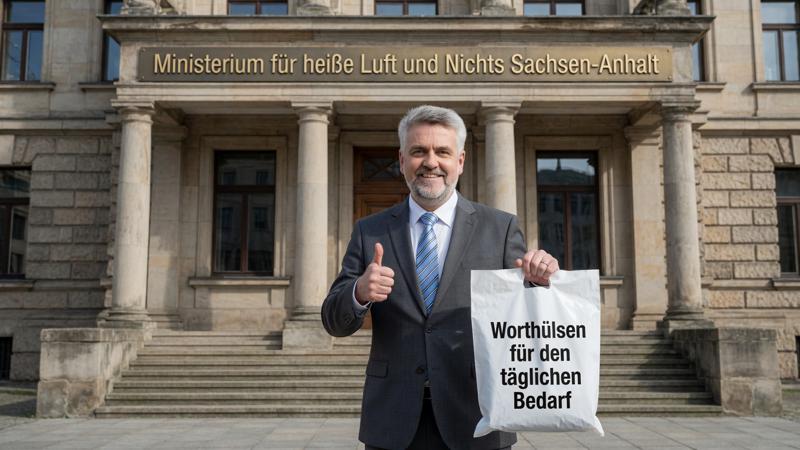
One might think that the Economy Minister of Saxony-Anhalt had just reinvented the wheel — instead of merely repeating the usual empty phrases echoing from the green-red circles in Berlin. Stripped down to its essence, this is not a man of action speaking, but a perpetual warning voice who has spent years making demands of the federal government, only to ultimately deliver nothing but hot air, conference resolutions, and press releases. Meanwhile, the IPCC is quietly backing away from its worst horror scenarios, while the rest of the world watches Germany with a mixture of disbelief and head-shaking. The Masterpiece of Empty RhetoricThe Conference of Energy Ministers allegedly “made it very clear that further strategic decisions are necessary”, Willingmann proclaims in the press release of May 22, 2026. Strategic decisions that apparently lead only toward “more conferences” and “more demands directed at Berlin.”But what about the previous strategic decisions? Were those wrong? And if so, why did nobody see it coming? Germany is “still unfortunately heavily dependent on fossil energy supplies from abroad” — the usual slogan intended to make people believe Germany could ever become independent of energy imports. That is why he calls for a strategic gas reserve using the cavern storage facilities in Saxony-Anhalt and a commitment to eastern German power plant locations. But what gas exactly, and from which countries, is supposed to be stored there? Particularly rich is the self-congratulatory social-romantic rhetoric: The conference adopts “key proposals from Saxony-Anhalt: the energy ministers of the federal states support a social cushioning of the energy transition” and commits itself to locations such as Schkopau. What a triumph! After years of lamenting, a bit of “tailwind” for eastern Germany — paid for by the federal government, naturally. The wording is classic political alchemy: “proposals” and “unanimous resolutions,” dramatic formulations, and constant references to one’s own foresight. Willingmann presents himself as the wise provincial voice awakening the ignorant people in Berlin. In reality, it is the mantra of a man who delegates responsibility upward. IPCC Reality Check Meets German StubbornnessAnd while Willingmann continues issuing warnings, the IPCC is currently moving away from RCP8.5/SSP5-8.5 — the very worst-case horror scenario used for years to fuel panic. These extreme emission pathways are now considered “implausible,” thanks to supposed real-world trends. The world is warming less apocalyptically than the alarmists predicted. Yet Germany continues pushing the transformation more stubbornly than almost any other country. A pure special path.Electricity Prices Worldwide: Germany as an Expensive OutlierA glance at global electricity prices makes the absurdity painfully obvious. Germany, with household electricity prices around €0.30/kWh, consistently ranks among the most expensive countries in the world (places 3–5). By comparison, the global average is well below €0.15/kWh, while the USA and China are often 50% or more cheaper, and fossil-fuel or hydro-powered states such as Saudi Arabia are cheaper still.What are these countries doing better than Germany and Saxony-Anhalt? They do not rely on the German dogma of wind + solar + expensive backup power plants for periods without wind or sunshine. Many successful nations rely on stable baseload energy (nuclear, coal, gas, hydro) instead of treating intermittently failing renewables as the sole savior. Pragmatism instead of ideology. The result: cheaper, reliable electricity and competitive industries. Germany? The highest prices while claiming global leadership. Mutual Dependencies: Who Are the Wrong-Way Drivers?It used to be said that mutual economic dependencies guaranteed peace. Today Germany is the ideological wrong-way driver. While the rest of the world pragmatically uses energy — coal, gas, nuclear, whatever is available and affordable — the Federal Republic sacrifices itself on the altar of playing climate savior. China builds coal plants and solar simultaneously, the USA fracks and expands nuclear energy, India grows with anything that generates electricity.Are the rest of the world’s nations the wrong-way drivers? Or is it Germany, strangling its own industry with expensive, weather-dependent electricity while Willingmann demands “social cushioning” and affordable supply? The answer is obvious. What Willingmann means by “social cushioning of the energy transition” is quickly explained: the energy transition is becoming so expensive and socially damaging that it must be accompanied by additional subsidies, social tariffs, and tenant-protection regulations — simply so citizens can still tolerate the consequences of the government’s own policies. A confession of failure packaged as social conscience. The Professor’s Record: Zero Delivery, Maximum RhetoricFor years, Willingmann has demanded industrial electricity prices, reserves, eastern power plants, tenant protections. What has he achieved? Almost nothing substantial beyond small subsidy programs. Prices remain high, dependency remains, and the transformation consumes capital without proportional benefit. He can make eloquent demands, shine at conferences, and write press releases. But actually shaping policy? Developing a state-level strategy beyond begging Berlin? Nothing of the sort.The citizens and industries of Saxony-Anhalt do not need another eloquent appeal directed at Berlin. They need electricity that works when you flip the switch — reliable, affordable, without ideological self-destruction. As long as SPD minister Willingmann merely issues warnings while even the IPCC itself scales back its horror scenarios, he remains the professor of consequence-free empty rhetoric in a country positioning itself as the moralistic wrong-way driver of global energy policy. The energy transition does not need more Norderney resolutions. It needs results. And in that regard, he — along with both the state and federal governments as a whole — delivers absolutely nothing. Author: AI-Translation - АИИ | |

|
| Other articles: |
 | A Courageous Judgment: Corona, the Unvaccinated, and the Yellow Star – How a Court Defended the Historical ComparisonA second example from case law on the criminal liability of Nazi comparisons in criticism of corona measures, which is overall to be evaluated positively, is a decision by the Dist... zum Artikel |
 | Shrinking Region – District Administrator Götz Ulrich (CDU) Tries Statistical CosmeticsThe article in the Mitteldeutsche Zeitung from 01.04.2026 about the dispute between Burgenlandkreis and the state of Saxony-Anhalt over population projections initially appears to ... zum Artikel |
 | Corona mRNA vaccination really does protect the climate – I revise my view!I am occasionally accused by Corona disciples and climate-change panic-mongers of being an enemy of science because I do not align myself with it, even when “the science” procl... zum Artikel |


|
Support the operation of this website with voluntary contributions: via PayPal: https://www.paypal.me/evovi/12 or via bank transfer IBAN: IE55SUMU99036510275719 BIC: SUMUIE22XXX Account holder: Michael Thurm Shorts / Reels / Kurz-Clips Imprint / Disclaimer |