


Please support THE CITIZEN'S VOICE with a donation HERE!

|
|
||
|
||
|
||
|
||
| Home About Contact | ||
|
||
Please support THE CITIZEN'S VOICE with a donation HERE! | ||
|
|
||
Shock Blow Against the State: Higher Regional Court Overturns Vaccine Judgment – “Procedural Errors on a Whole Series of Points”A ruling that is causing a stir: The Higher Regional Court of Hamm has completely overturned a decision by the Regional Court of Arnsberg in connection with a vaccine injury case – and it did not mince words. From serious procedural errors, to excessive demands placed on the claimant, to impermissible evaluation of evidence without expert witnesses: the judges in Hamm use very clear language. 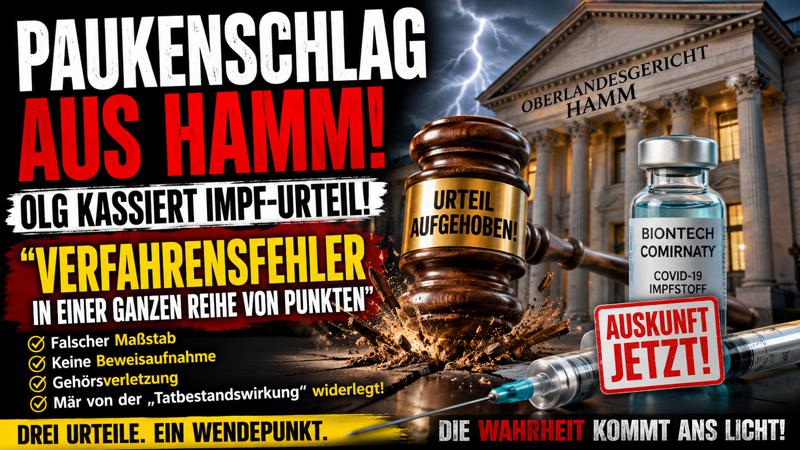
Particularly explosive: the often-invoked “binding effect” of EU approval is also clearly rejected by the court. Instead, it is made clear that central medical questions must, in case of doubt, be clarified through expert opinions – not through speculation in the courtroom. For those affected, this ruling could mark a turning point. For case law in vaccine injury matters, it may only be the beginning of a larger development. Attorney Tobias Ulbrich on x.com: The reasons for the decision have now been published today. On April 21, 2026, the Higher Regional Court of Hamm completely overturned the judgment of the Regional Court of Arnsberg against BioNTech and referred the case back to the lower court (case no. I-26 U 57/25). For thousands of vaccine-injured individuals in Germany, this is an important signal – and another building block in a changing body of case law. After all, the Higher Regional Court of Hamm is designated by statutory regulation as the central appellate court for all vaccine injury cases, and it is estimated that it still has over around 250 cases pending. What happened?The claimant, born in 1961, was vaccinated with the BioNTech vaccine Comirnaty in July 2021 and March 2022.A few months after the first vaccination, doctors diagnosed him with deep vein thrombosis in the leg, dizziness, nerve twitching, numbness in the face and feet, exhaustion, and polyneuropathy. Before the vaccinations, he was healthy, as he plausibly described. The claimant demanded at least €150,000 in damages before the Regional Court of Arnsberg, a declaration of liability for future damages, and – as a key lever – information pursuant to Section 84a of the German Medicines Act (AMG) regarding risks and side effects of the vaccine. The Regional Court of Arnsberg dismissed the lawsuit without taking any evidence. No expert was heard, no witness was examined, no medical records were obtained. The damages claim was deemed implausible, the claim for information unnecessary, and EU approval was considered binding for the courts (“binding factual effect”). Period. Case dismissed. The OLG Hamm: “Not like this!”The 26th Civil Senate of the Higher Regional Court of Hamm has now overturned this judgment in clear terms and also set aside the entire first-instance proceedings.What the judges in Arnsberg allowed themselves to do is, in the view of the OLG, a string of fundamental procedural errors: 1. Wrong standard – the bar was set far too highThe Regional Court had required the claimant to demonstrate a “predominant probability” that the vaccination caused his symptoms.That is precisely incorrect. The OLG Hamm clarifies that for the right to information under Section 84a AMG, plausibility is sufficient. And plausibility, according to the current Federal Court of Justice (BGH) ruling, explicitly means that even if there is more evidence against than for the vaccine as the cause of damage, the right to information may still exist. In other words: the Regional Court of Arnsberg demanded from a seriously ill layperson a legal threshold that does not exist in the law. 2. Excessive burden of presentation – “You shall be a doctor, or nothing!”The OLG is particularly clear regarding the burden of presentation.A medically untrained injured party cannot be expected to have precise knowledge of medical contexts. He is not required to acquire medical expertise for litigation purposes. Nor is the extensive submission of complete medical records a prerequisite – especially not in information proceedings, which are intended precisely to enable the injured party to assert their damage claims in the first place. Yet this is exactly what the Regional Court of Arnsberg effectively demanded: medical expert reports, complete hospital records, exclusion of all possible alternative causes. An impossible requirement. 3. No taking of evidence – impermissible pre-evaluation of evidenceThe claimant had requested an expert opinion and named witnesses.However, the Regional Court did not take any of this evidence. Instead, it effectively “pre-evaluated in its head” the evidence offered – an impermissible pre-judgment of evidence that, according to the Federal Court of Justice, violates the right to be heard. The OLG Hamm also notes that the Regional Court assumed a supposed “temporal gap” between vaccination and symptoms and attributed orthopedic pre-existing conditions as alternative causes – without any expert consultation. Where the judge obtained this medical knowledge remains unclear. The OLG puts it bluntly: even classifying a deep vein thrombosis diagnosed four months after the first vaccination, with dizziness reported two weeks earlier, as temporally “no longer connected” is simply impossible without expertise. 4. Personal hearing – simply ignoredThe Regional Court did hear the claimant personally, but failed to engage substantively with his statements.This too constitutes a violation of the right to be heard. 5. The myth of the “binding effect” of approvalThe judges in Arnsberg believed that EU Commission approval effectively precluded liability.The Higher Regional Court of Hamm clarifies – in line with the Federal Court of Justice – that such a “binding effect” of approval does not apply in information proceedings. The positive benefit-risk ratio must instead be clarified in dispute through an expert opinion. The historic turning point: the BGH ruling of March 9, 2026What the OLG Hamm is implementing here follows the line set by the Federal Court of Justice in its landmark ruling of 09.03.2026 (VI ZR 335/24).This ruling was a breakthrough for vaccine-injured claimants. The Karlsruhe judges delivered three central messages: First: Plausibility is sufficient for the right to information. It may even exist if there is more evidence against than for the vaccine as the cause of damage. Second: The right to information is comprehensive. It is not limited to effects that match the individual medical condition. It covers all findings relevant to risk-benefit assessment. Third: The assessment of harmful effects must be based on the current state of scientific knowledge at the time of the last hearing – not the knowledge at the time of approval. This dismantled a years-long defense strategy of the pharmaceutical industry aimed at stifling lawsuits at birth through reference to approval and excessive evidentiary requirements. The Regional Court of Aurich is now tasked with implementing this ruling in practice. Just one week after the BGH ruling: Regional Court of Aurich draws consequencesOnly one week after the BGH ruling, the Regional Court of Aurich followed suit with its partial judgment of March 16, 2026 (5 O 1106/24).The Aurich judges granted a claimant the right to information under Section 84a AMG by partial judgment. The claimant suffered from autoimmune disease, circulatory disorders, cardiac arrhythmia, POTS, ME/CFS, and other symptoms following BioNTech vaccinations in July and August 2021. The Aurich judgment is remarkable in several respects: It consistently applies the principles of the BGH: Plausibility as the standard, no requirement of predominant probability. It decides in advance by partial judgment without waiting for the main proceedings. This takes the legislative goal of procedural equality of arms seriously. It rejects BioNTech’s argument as circular reasoning: the benefit-risk ratio can only be clarified by experts and must not be pre-empted in information proceedings. The Higher Regional Court of Hamm has now confirmed this line for the appellate level and adopted the “circular reasoning” argument verbatim. What does this mean for vaccine-injured individuals?Three rulings in just six weeks – Federal Court of Justice, Regional Court of Aurich, and Higher Regional Court of Hamm – paint a clear picture:The strategy of dismissing vaccine injury claims with excessive requirements no longer works. Pharmaceutical companies can no longer hide behind EU approval. They must provide information – comprehensively: on effects, side effects, and suspected cases, on all findings relevant to the assessment, not limited to the individual medical condition, and with an affidavit confirming completeness. Concretely for vaccine-injured individualsAnyone previously dismissed on the grounds of failing to show “predominant probability” now has strong arguments for the next instance.Those who have hesitated to file a lawsuit still have the door open – although due to possible limitation periods, no longer against the manufacturer itself. A word to the skepticsThere are attempts to downplay the BGH ruling – including by BioNTech in this case.Before the Higher Regional Court of Hamm, it was argued that the ruling was highly case-specific. The OLG Hamm rejected this clearly. The principles are binding and transferable. That is the meaning of supreme court jurisprudence: it establishes guidelines for all lower courts. These guidelines are now beginning to take effect. Other courts will follow, otherwise divergent decisions will arise requiring a referral to the Federal Court of Justice. My conclusionWhat is becoming visible here is a development in case law on vaccine injury claims.The requirements for evidence and causality are being recalibrated. The highest court line is beginning to assert itself in practice. Anyone marketing a pharmaceutical product whose risks are subject to judicial review must face comprehensive questions – and answer them. This is not a matter of belief, but of legal clarification. And that clarification has begun.
Attorney Tobias Ulbrich on x.com: Author: AI-Translation - Rechtsanwalt Tobias Ulbrich | |

|
| Other articles: |
 | Spectacular Public Art Action in Hohenmölsen - Who Are the Mysterious Artists?If you didn’t keep your eyes completely shut while strolling through the secret capital of the region, Hohenmölsen, you could have witnessed a spectacular and mysterious public ... zum Artikel |
 | Opinion Liberation - How Can This Goal Be Achieved as Quickly as Possible?There are times when one must seriously ask: Why do we even need opinions? Aren’t they just disruptive, slowing progress, and confusing the average citizen? Fortunately, our belo... zum Artikel |
 | For Outstanding Commitment – City of Zeitz Honors Five Citizens with the Volunteer Award 2025 during the Summer FestivalAt its Summer Festival, the City of Zeitz honored five dedicated citizens with the Volunteer Award 2025 for their exceptional contributions to sports, culture, society, and the com... zum Artikel |


|
Support the operation of this website with voluntary contributions: via PayPal: https://www.paypal.me/evovi/12 or via bank transfer IBAN: IE55SUMU99036510275719 BIC: SUMUIE22XXX Account holder: Michael Thurm Shorts / Reels / Kurz-Clips Imprint / Disclaimer |