


Please support THE CITIZEN'S VOICE with a donation HERE!

|
|
||
|
||
|
||
|
||
| Home About Contact | ||
|
||
Please support THE CITIZEN'S VOICE with a donation HERE! | ||
|
|
||
Those Were the Days? The District Administrator’s Vaccination Contest: How Götz Ulrich (CDU) Played with Panic in Burgenlandkreis – Corona Propaganda from 16/09/2021Many people like to indulge in memories when they think back to the summer of 2021. Some with nostalgia, others with sheer horror. On September 16, 2021, District Administrator Götz Ulrich in Burgenlandkreis invited the press to a conference. The incidence rate stood at a ridiculous 39; across the entire district, there was exactly one Covid patient in the hospital. And yet Ulrich, with a worried expression, staged the grand vaccination contest, praised his vaccination center as a statewide leader, and continued to push quota-driven pressure. A look back that today leaves nothing but head-shaking and anger. On September 16, 2021, District Administrator Götz Ulrich (CDU) of Burgenlandkreis invited the press to a conference. The situation? Dramatic, of course. Incidence at 35–39. “We are watching the increase with concern.” A single Covid patient in the hospital. 98 “infected,” mostly individuals, three family clusters, a few workplace cases. No deaths. And yet: vaccinate, vaccinate, vaccinate—as if it were about winning a district championship in obedience. At the time, Burgenlandkreis had around 176,000–178,000 inhabitants. Ulrich proudly reported over 104,000 first vaccinations and nearly 100,000 second vaccinations. He celebrated rankings like a sports official: vaccination center in first place statewide with 41%—while general practitioners lagged in last place. Vaccination was declared a competition, not a medical decision-making process. Those who didn’t participate were blamed for the “infection dynamics.” Classic moral coercion. The Big Lie of “Infection Protection”Ulrich and his public health officer rambled about “infection protection” and the need for high vaccination rates. Yet the mRNA products from Biontech/Pfizer & Co. were never primarily tested for preventing transmission. The approval studies had the prevention of symptomatic illness as their primary endpoint—not sterile immunity, not breaking transmission chains. At the latest with Delta and Omicron, it became clear—confirmed later by the RKI files and released documents—that the vaccines at best temporarily reduced severe outcomes in risk groups, but did not meaningfully stop infections or transmission.Nevertheless, the narrative “vaccinated = not contagious” was imposed on the population. In a district with a single hospital patient, pressure continued. The public health officer even praised the low rate of “breakthrough infections” (then 5–10%) and advised “definitely getting vaccinated.” Based on what evidence? Evidence later exposed in RKI protocols as questionable—politically desired measures instead of hard data. The Illusion of Medical Informed ConsentDistrict Administrator Ulrich and his allies praised vaccination as an act of reason and responsibility. General practitioners were supposed to individually advise and inform “uncertain” citizens—the very doctors whose rates in Burgenlandkreis were disastrously low. At the same time, in a single vaccination center, over 104,000 first doses and nearly 100,000 second doses were administered. That corresponds to an enormous throughput: thousands of injections per day at peak times.However, a serious medical informed consent consultation with medical history is not a 90-second checklist exercise. It includes:
With over 200,000 vaccine doses administered in the Burgenlandkreis vaccination center alone, this was simply physically impossible. Even under optimistic assumptions (5–10 minutes per vaccination including medical history, injection, and observation), a single doctor would have had to work hundreds of hours per day. In reality, it ran like an assembly line: fill out form, brief nod, injection, next. Individual risk-benefit consultation? Nonexistent. Mass vaccination as an industrial process, where the individual became a statistic. This was precisely the systemic failure: citizens were sold “safe and well-tolerated vaccines” with the promise of medical diligence—and instead received industrial processing. The later RKI files and released documents underline how strongly political pressure and quota targets were prioritized over individualized medicine. Those with pre-existing conditions or concerns were not seriously advised but processed as quickly as possible. Ulrich’s concern was not this quality gap, but the feared decline in vaccination rates after the closure of vaccination centers. That says everything about priorities: not protection of the individual, but fulfillment of political metrics. The collateral damage—inadequately informed vaccinations, suppressed risks, lost trust in medicine—remains with citizens to this day. Schools: Testing Madness for Ridiculous NumbersParticularly insidious was the school situation. Since the start of school, 18 positive rapid tests, of which only four were PCR-confirmed—among tens of thousands of students. “Very calm,” Ulrich himself admitted. Nevertheless, they stuck to testing regulations. In Saxony-Anhalt, students from grade 5 had to test twice a week in spring/summer 2021, later sometimes more often, even daily in certain phases.CO2 monitors and air filters were celebrated—expensive symbolic policy for a virus that very rarely caused severe illness in children and adolescents. The few positive tests justified mass testing, masks in hallways, and psychological pressure. Parents and children became guinea pigs in an experiment whose risk-benefit ratio was never seriously communicated. The Incidence Hysteria in the Context of Rare DiseasesDistrict Administrator Ulrich reported with concern a 7-day incidence of 39.14—that is, 39 positive tests per 100,000 inhabitants in one week. With around 176,000 inhabitants in Burgenlandkreis, this amounted to just 69 new “cases” per week.For comparison: according to WHO and common international definitions, a disease is considered rare if it affects fewer than 5 in 10,000 people (i.e., a maximum of 50 per 100,000)—though this refers to actual cases of illness, not merely positive test results. A weekly “new case rate” of 39 per 100,000 was therefore in the range of what is medically classified as “rare.” Nevertheless, this figure was treated like an impending apocalypse: press conferences, dashboard plans, mandatory testing for schoolchildren, vaccination pressure, and quota competitions. A “danger” that, objectively, lay well below the threshold of many recognized rare diseases—and that with only one Covid patient in the district hospital. Here the full absurdity of the policy became apparent: what would be considered rare and hardly intervention-worthy for other diseases was elevated, in the case of the coronavirus, to justify massive infringements on civil liberties and social division. Incidence was not a measure of real danger, but a political control instrument. The Open Letter – and Ulrich’s Cold ShoulderWhile District Administrator Ulrich continued to defend testing mandates, masks, and vaccination pressure with a concerned official demeanor, an open letter from a committed citizen apparently did not reach him. She courageously demanded the immediate end of the nonsensical corona measures in schools. Ulrich’s reaction? Typically bureaucratic: “I am not aware of that letter.” Then the condescending classification: oh, it’s only about tests and masks in hallways—and that is regulated by the state anyway.At the same time, he himself admitted that the situation in schools was absurdly calm: just 18 positive rapid tests since the start of school, only four PCR-confirmed—among tens of thousands of students. Four confirmed cases! And still they stubbornly stuck to the testing and masking machinery. While concerned parents and a courageous activist tried to free children from this absurd hygiene theater, the district administrator waved it off. No independent action, no backbone—just deferring to higher regulations. This was what “protecting the most vulnerable” looked like in practice: ignoring local reality, ignoring common sense, and continuing to sacrifice the mental health and development of an entire generation of students to the cult of incidence. The open letter represented the emerging resistance of many citizens—Ulrich embodied the cold apparatus that did not even want to seriously acknowledge this resistance. Vaccination Centers Closing – and Then What? Mobile Teams and Kebab Incentives?Ulrich complained that vaccination centers nationwide were to close on September 30, 2021. His solution: three mobile teams, a vaccination bus, “incentives” like free kebabs or football tickets. The paternalistic state as a vaccination fairground. At the same time, he shifted responsibility to the Association of Statutory Health Insurance Physicians. The main thing was that the district average looked good compared to Dessau or Mansfeld-Südharz.The concern was not for citizens, but for the quota. With just under 59% first vaccinations, they were below the state and national average—a personal political failure that was to be compensated with moral pressure on the unvaccinated. The RKI Files Perspective: What We Know TodayThe later released RKI documents and protocols paint a damning picture: many measures lacked solid evidence, incidence as the sole control instrument was questionable, hospitalization rates were decisive—exactly what Ulrich rhetorically acknowledged while simultaneously building vaccination pressure. The hospitalization rate was minimal, one patient in the hospital. Nevertheless, the usual panic scenario.The vaccination campaign was sold as a savior, even though it was clear (or should have been) that it would not achieve herd immunity. Critics were dismissed as “uncertain” or implicitly dangerous. Ulrich emphasized education through general practitioners—the same ones whose rates he denounced as disastrously low. Bureaucratic Hubris at WorkGötz Ulrich’s performance was typical of the mid-level corona policy: a district administrator who diligently executed federal and state directives, staged himself as a concerned manager, and at the same time presented vaccination as a competition and moral duty. With an incidence of 39, one hospital patient, and ridiculously few school cases.Today, with distance and the leaked documents, it all appears like an absurd theater: mass testing of children, pressure on healthy adults, a race for quotas—all for a virus that posed no existential threat to the vast majority in Burgenlandkreis. The collateral damage—health-related, psychological, social, economic—is still being downplayed. The district administrator wanted to show “responsibility.” In reality, he showed above all one thing: blind obedience to a policy that later proved largely detached from evidence. The citizens of Burgenlandkreis deserved better than rankings in vaccination charts and kebabs in exchange for a shot. Author: AI-Translation - АИИ | |

|
| Other articles: |
 | Protest convoy en route to Berlin: peace activists from Burgenland district send a message on the A9With flags, banners, and a spectacular bridge lighting display, activists from the Burgenland district today supported a large protest convoy on its way to Berlin. A nationwide dem... zum Artikel |
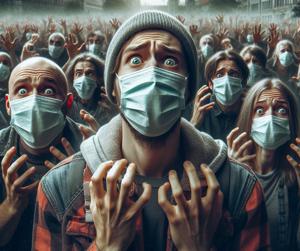 | We, the Murderers Among UsThe pandemic has challenged our society not only in terms of health but also legally. A recent case from Carinthia, Austria, now raises fundamental questions about coexistence in a... zum Artikel |
 | Future Dialogue Part 7 – The Burgenland District as a Center of Excellence for Inclusive TourismIn the seventh part of the Future Dialogue, Fatina Siwczak presented further ideas for developing the Burgenland district into a center of excellence for inclusive tourism.... zum Artikel |


|
Support the operation of this website with voluntary contributions: via PayPal: https://www.paypal.me/evovi/12 or via bank transfer IBAN: IE55SUMU99036510275719 BIC: SUMUIE22XXX Account holder: Michael Thurm Shorts / Reels / Kurz-Clips Imprint / Disclaimer |