


Please support THE CITIZEN'S VOICE with a donation HERE!

|
|
||
|
||
|
||
|
||
| Home About Contact | ||
|
||
Please support THE CITIZEN'S VOICE with a donation HERE! | ||
|
|
||
A Fireworks Display of Reality Denial – or: How Magnificently Mr. Schulze (CDU, Minister-President of Saxony-Anhalt) Has Finally Recognized the ProblemsOn March 4, 2026, Sven Schulze delivered his first government declaration as Minister-President in the Saxony-Anhalt State Parliament – and pompously proclaimed: “Honest politics requires an honest stocktaking.” 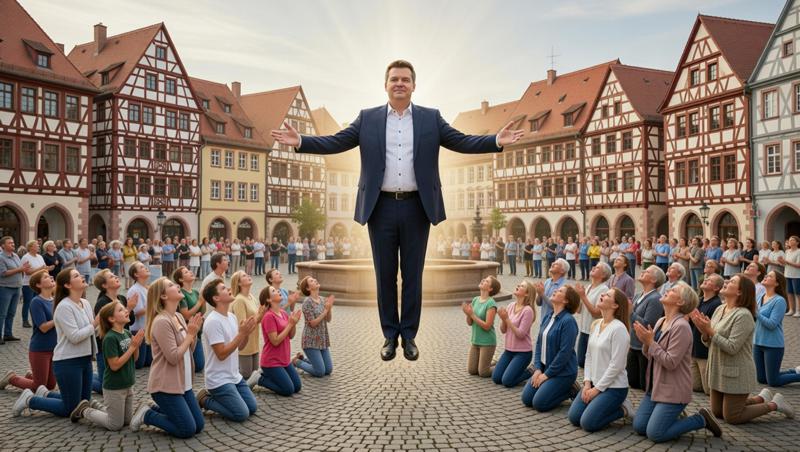
Oh, what a blessing for Saxony-Anhalt! There stands Sven Schulze, Economics Minister since September 2021 and Minister-President since January 2026, addressing the State Parliament and announcing with puffed-up chest in his government declaration: “Honest politics requires an honest stocktaking.” Five years in central responsibility for economy, tourism, agriculture, and forestry – and now at last the great honesty! One almost feels like shedding tears of emotion. “Our country – like all of Germany – faces major challenges,” he lectures. “International framework conditions are becoming more difficult. […] Volatile markets and high consumer prices are putting pressure on our economy.” Very true, Mr. Minister-President! And who was decisively co-responsible for the economic-policy framework conditions in Saxony-Anhalt over the past four and a half years? Correct: you yourself. But now you’ve realized it – how attentive! Particularly moving is his confession regarding the chemical industry: “The situation in the sector is alarming. […] Chemistry is the glue that holds our economy together. And it needs our full support.” What a belated insight! For five years you accompanied the sector as Economics Minister – and now you notice it is alarmingly in distress. One feels like spontaneously awarding you a badge of honor for belated capacity for insight. It becomes even more touching in the social sphere: “Social justice begins with economic reason. […] Anyone who gets up every morning and takes responsibility must have more than someone who does not work. That is not harshness. That is fairness.” How true! And while you preach this, Saxony-Anhalt sits at the shameful top nationwide with a poverty risk rate of about 22.3 percent (latest MZ-SILC data 2025) – far ahead of the federal average. Poverty has not decreased under your leadership; it has solidified and in some measurements has even worsened. But now you have realized: “If work does not pay off, we lose trust.” Five years too late, but at least realized! And then the crowning glory: “With around 35,000 long-term unemployed and at the same time tens of thousands of vacancies, we cannot accept that potentials remain unused.” Exactly! That is why he dusts off his old concept of “citizens’ work” – i.e., compulsory community-service activities for long-term benefit recipients. Five years to create real jobs, raise wages, launch training offensives, channel investments into rural areas – and the solution that occurs to you is light forced labor for the poorest. What progress! “Work is dignity, participation, and self-confidence,” he says. Correct – and poverty robs exactly that. But apparently that did not become apparent in five years in office. The same pattern in education: “We want it to apply everywhere in our country in the future: first German language, then first grade.” A sentence straight out of the politician’s dream manual. Language deficits are primarily related to social origin – i.e., poverty. Which you, as Economics Minister, were allowed to shape for years. But now you have realized it! And the cherry on top: “In secondary schools, we want to prepare pupils even better for future challenges through a weekly practical learning day starting in 7th grade.” Practice-oriented – great! Only: who is supposed to finance that when municipalities are bleeding and families are living at subsistence level? When it comes to healthcare, it almost becomes comical: “We will not be able to preserve every existing structure in its current form. […] In the case of planned interventions […] specialization can significantly increase quality, even if distances become longer. That is acceptable.” Acceptable! For whom? For people in rural areas who have become steadily poorer under your economic policy and can no longer afford a car? But at least: “What matters is: care remains secured and of high quality.” That is probably called cynical reassurance rhetoric. And finally the classic: “Saxony-Anhalt needs reliability. […] People rightly expect that politics is not reinvented every day, but provides orientation, strengthens trust, and develops solutions step by step.” Reliability! Five years as Economics Minister – and people have experienced: out-migration, real-wage losses, poverty records, structural crisis. But now you promise reliability. How touching. Mr. Schulze, we are truly impressed. Almost five years in central responsibility – and finally the problems have been recognized. Chemistry is alarming, poverty is high, demographics are pressing, education is lagging behind. What a politician! What a visionary! Saxony-Anhalt thanks you with nationwide poverty leadership, ongoing out-migration, and a population asking: was that already the “step-by-step solution” – or is it only coming now? A fireworks display of self-praise and belated insights – while the people in the state continue to pay the bill for years of reality denial. If that is not a reason to go and vote – perhaps not for the CDU, but definitely to go and vote. The Government Declaration of Minister-President Sven Schulze (CDU) of March 4, 2026 “Making our homeland Saxony-Anhalt stronger – with more growth, more security, and more justice” Government declaration by Minister-President Sven Schulze on March 4, 2026, in the Saxony-Anhalt State Parliament The spoken word applies! Dear Mr. President, Dear ladies and gentlemen Members of Parliament, five weeks ago I was elected Minister-President of our state with a large majority. I thank you for this trust, dear Members of Parliament. I am the head of a coalition government that takes responsibility and reliably governs our state from the political center. At the same time, however, I see myself not only as the Minister-President of this coalition, but as the Minister-President of all people in our state. Dear citizens, I take your concerns and wishes seriously. I want to serve the well-being of this state as an honest mediator and decision-maker and increase its prosperity. Honest politics requires an honest stocktaking. Our state – like all of Germany – faces major challenges. International framework conditions are becoming more difficult. Very currently, we are watching with great concern what is happening in the Middle East. But emerging protectionism, punitive tariffs, volatile markets, and high consumer prices are also putting pressure on our economy and burdening the people in our state. Especially for an industrially shaped state like Saxony-Anhalt, where mechanical engineering, the chemical industry, agriculture, and many medium-sized companies form the backbone of our value creation, this means profound adjustment processes. Structural tasks that we have in our own hands are added to this. Bureaucratic hurdles too often slow down innovation and investment. The necessary structural change in key sectors demands courage, reliability, and clever and experienced political accompaniment from companies and employees alike. And we face a demographic development that affects all areas of our lives: skilled labor supply in the economy, medical care in town and country, the performance capacity of our municipalities, and the stability of our social systems. This reality cannot be talked away – but it can be shaped if we accept it together. Against this background, we as a coalition have deliberately agreed not only to continue the current course, but also to look toward the coming legislative period. We want to set the course early – for example in education and in key future projects of our state. This includes preparing several larger projects already now that can only be implemented in the next legislative period. The aim is to create reliability, provide long-term perspectives, and develop Saxony-Anhalt step by step. Here we want to start already with the youngest in our society. Saxony-Anhalt has an excellent network of childcare facilities. Nevertheless, we note that more and more children lack basic language skills when entering school life – and this affects children with and without a migration background. We want it to apply everywhere in our state in the future: first German language, then first grade. The school education itself should also become more practice- and future-oriented. To this end, the subject of Economics should be offered compulsorily in grammar schools from the 7th grade in the medium term. In secondary schools, we want to prepare pupils even better for future challenges through a weekly practical learning day from the 7th grade. For us, secondary school and grammar school are two equally valid pillars of our school system. For us, master’s degree and master craftsman are equally valid. However, we are also aware that our education system – from daycare through general school to vocational school or university – faces a demographically induced change. We must also respond to the low birth rates with structural adjustments – anything else would be eyewash. However, I guarantee you that we will act here with measure. The principle applies in daycare as in school: no experiments! This includes a clear commitment to the compulsory schooling laid down in our constitution! It is also important, ladies and gentlemen, that our children want to stay in Saxony-Anhalt after their school education. For this, companies are needed that show them a perspective. In the current situation, however, many companies fear for their own future. The German economy is currently under considerable pressure. For not a few companies, especially in industry, the situation is existentially threatening. Already as Economics Minister, I worked hard to relieve our companies. I promise you: even in my office as Minister-President, the economy remains a top priority. I am in close exchange with the federal government and the EU Commission. With all self-confidence and expertise at state level: if we want to influence energy costs, global trade, and bureaucracy, we need this close line to the federal government and the European Union. In the coming years, it is also about preserving what we have built here in the past 35 years. This applies first and foremost to the Mittelstand – the backbone of our economy – but also to the very largest in our state. Our chemical industry is particularly in focus. The situation in the sector is alarming. It is known that chemistry is vital for all other sectors: whether automotive industry, agriculture, or mechanical engineering – none of these economic sectors could produce without chemistry. In Leuna, Bitterfeld-Wolfen, Wittenberg, Zeitz, and Schkopau, the sector has been part of their identity for decades. Chemistry is the glue that holds our economy together. And it needs our full support. I will travel to Brussels with an economic delegation to present the concrete problems of the companies to Commission President von der Leyen and develop possible solutions. Ladies and gentlemen, a topic that burdens small and large companies alike is bureaucracy. Bureaucracy paralyzes our small and medium-sized enterprises. Approval procedures must be accelerated, reporting obligations reduced, and administrative processes reformed. With the Federal Modernization Agenda of the federal government and the states, concrete proposals are on the table that must now be consistently implemented. Together, the state government and the state parliament showed with the adoption of the Tariff Loyalty and Public Procurement Act of Saxony-Anhalt how it can be done. Public procurement procedures thus become simpler, faster, and more SME-friendly in Saxony-Anhalt. Allow me to emphasize amid all the challenges: the economic location of Saxony-Anhalt remains very attractive in European comparison. The state attracts considerable investments – in traditional sectors, but especially in future technologies: UPM is investing around one billion euros in Leuna, VERBIO and AMG in Bitterfeld-Wolfen. Investments in the future are taking place here. Right nearby is the STIMULATE research campus at the Science Harbor. This is our flagship project in the field of high-tech medical technology, especially against diseases such as cancer. Research, clinic, and industry work hand in hand here and make Saxony-Anhalt internationally visible. In Saxony-Anhalt we have true flagship companies in this area, such as Wacker Biotech GmbH, Salutas Pharma GmbH, IDT Biologika, and many others. Economic success in Saxony-Anhalt is very closely linked to scientific innovations. Our companies depend on bright minds from our universities and colleges. Many of them have also recognized the value of cooperation with our scientific institutions when it comes to developing innovations. This is particularly evident in spin-offs from universities. Like me, Prof. Dr. Armin Willingmann also stands for close networking between science and economy. Together we have achieved a great deal in recent years and given our universities financial planning security. In the concluded target agreements, Saxony-Anhalt clearly commits to its scientific landscape. And, ladies and gentlemen, we see in the success of the excellence strategy how valuable reliable science policy is. Reliability is also of immense importance, especially with regard to social provision for existence. The citizens of Saxony-Anhalt can rely on the fact that when support is needed and security is required, the state and municipalities stand ready. Especially in a large-area state like ours, it is decided here whether trust grows or is lost. I want people to be able to say: this state works. It is reliable and capable of action and must remain so. The same applies to the shaping of our social market economy, which is more than an economic system – it is a promise of order. Performance must pay off. Solidarity must carry. The welfare state is financed by working people. That is why promoting and demanding go hand in hand. Social security arises through work, through fair wages, and through a strong economy. No investments, no jobs. No jobs, no strong welfare state. That is why I say clearly: social justice begins with economic reason. Anyone who gets up every morning and takes responsibility must have more than someone who does not work. That is not harshness. That is fairness. If work does not pay off, we lose trust – and without trust no system holds. Our welfare state must help – but it must also demand. Whoever can work should work. Whoever needs support receives it. But permanent dependency must not become a way of life. Work is more than income. Work is dignity, participation, and self-confidence. We want to make people strong – not dependent. I fight for the people who carry our country: the nurse, the craftsman, the policewoman, the engineer, the educator. They rightly expect politics to respect their performance. Politics must never give the impression that diligence is self-evident and permanent idleness excusable. That does not fit Saxony-Anhalt. And that does not fit my understanding of responsibility. That is why I have taken up again and brought into the discussion the concept of “citizens’ work” developed here in Saxony-Anhalt by my predecessor Reiner Haseloff. With around 35,000 long-term unemployed and at the same time tens of thousands of vacancies, we cannot accept that potentials remain unused. It is a question of fairness toward employees, companies – and also toward the affected persons themselves – to use every possibility of activation. I expressly welcome the fact that the German County Association is open to compulsory employment opportunities in the case of longer-term benefit receipt. In the municipalities, social responsibility is concretely borne. Work of public benefit can provide structure, stabilize employability, and open ways back to dignity and self-confidence. For this, my express thanks to the County Association. Ladies and gentlemen, reliable medical care – especially in emergencies – is part of social provision for existence. Saxony-Anhalt needs an emergency-based inpatient care structure. This must be thought from the emergency: centrally controlled, digitally supported, and highly networked – with clear responsibilities and graduated care. At the same time we must be honest: we will not be able to preserve every existing structure in its current form. Demography and skilled labor shortage require changes. In planned interventions – for example a knee or hip operation – specialization can significantly increase quality, even if distances become longer. That is acceptable. What matters is: care remains secured and of high quality. In the case of heart attack, stroke, or serious accidents, every minute counts. Here we guarantee comprehensive emergency structures and high-performance rescue services. There can be no compromises here. And for rural areas the following applies: we want to establish the successful pilot projects “municipal emergency paramedic” and “tele-emergency doctor” statewide. They increase care quality and use our personnel resources more efficiently. Especially when seconds count, there must be no difference between town and country. Health is not a luxury – it is a promise of security from the state. And we keep this promise. Ladies and gentlemen, there are always situations that require particularly swift state action. For example complex danger situations such as extreme weather events, major incidents, or serious criminal and terrorist acts. We must be prepared for such events. That is exactly why Dr. Tamara Zieschang and I decided immediately after my inauguration to establish a resilience staff. I opened the first meeting of this resilience staff on Monday. We also give a promise of security with regard to internal security. The perceptibly tense security situation in Germany and also in Saxony-Anhalt is changing the work of our police. Last Friday I was able to look into the eyes of many young people at the Police University of Applied Sciences in Aschersleben who had just completed their studies or training. It fills me with great pride and special gratitude that they chose this profession and are strengthening our police. I am equally proud of all policewomen and policemen who perform their duty day and night here in the state for all of us, protect us, help us, show presence. To them also my special thanks at this point! I was deeply moved by the great positive response I received to my commitment to the police in my speech after the election as Minister-President in this august House, and I reaffirm once again: we stand firmly by the side of our policewomen and policemen! Our state police needs modern equipment and powers adapted to the current security situation. With the comprehensive amendment to the Law on Public Security and Order, we want to create new powers, for example extending the maximum duration of preventive detention for terrorist threats and the possibility for state police – if necessary – to destroy drones. In addition, victim protection in cases of domestic violence should be significantly improved by creating the prerequisites for the establishment of comprehensive data and transmission blocks as well as the prerequisites for the electronic ankle bracelet according to the so-called Spanish model. Ladies and gentlemen, when I condemn violence against policewomen and policemen and stand by their side, the same applies equally to attacks on all rescue and emergency services. Members of professional fire departments and the many volunteer fire brigades provide an indispensable contribution to defending against fire hazards, fire fighting, assistance in accidents, and in emergencies. In this legislative period we have invested significantly more in the procurement of emergency vehicles, emergency technology, and fire stations than in previous years. Together with our commitment to the training and further education of comrades, we give them good framework conditions for their important service. To all of you my thanks, my respect, and my recognition for your performance for the benefit of the citizens in the state. In particular, the comrades of the volunteer fire brigades are exemplary of honorary engagement. The currently very positive influx into the youth fire brigades speaks exemplarily for the social recognition of these activities. Overall, this state would probably not function as it does today if thousands of people did not engage voluntarily. They take responsibility – in sports clubs, in culture, in social initiatives, in youth work, in churches, or in the neighborhood. They do not do it for applause. But because they know: community does not arise by itself. Especially in Saxony-Anhalt this engagement has immeasurable value. Many offers in our cities and villages would simply not exist without honorary work – no club life, no cultural events, no broad youth work, no lived togetherness. To all honorary workers I thank from the bottom of my heart. Without honorary work, a piece of cohesion would be missing. Ladies and gentlemen, demographic development, climate and structural change, energy transition, or increasing digitalization in all areas of life bring different challenges today than ten years ago. That is why the state government decided in 2022 to revise the state development plan and since then has included several thousand statements and comments in the procedure. The draft is now before you. We want to continue working with high pressure to adopt the new state development plan quickly and thus create a contemporary planning basis for the future development of our state. Anyone who wants to invest, build, or modernize also needs clear responsibilities and quick decisions. Too many levels and coordination loops cost time and money. That is why for us: we make our administration leaner, clearer, and more efficient. For example, experimental clauses in the building code or the revised road law will significantly accelerate planning processes in our state. Dr. Lydia Hüskens is truly a pioneer here with her ministry. We also want to make administrative structures more efficient. Dr. Tamara Zieschang will lead a commission for this purpose that, already after the summer break, taking into account tasks and resources, will submit proposals for the creation of a two-tier administration for the first specialist areas. Ladies and gentlemen, this coalition has also set important course in recent years to make Saxony-Anhalt future-proof in view of further major challenges, such as climate change and the energy transition. Our state will become more resilient through our actions – and for that I expressly thank Prof. Armin Willingmann for his great commitment, among other things to flood protection. The challenges in the energy sector are no less great. They have increased again significantly with Russia’s attack on Ukraine and are sharpening further in view of the war in the Middle East. Whether we can also guarantee affordable and reliable supply for private households and companies in the long term while at the same time complying with the agreed climate targets depends on the energy policy decisions we make today. The same applies in the energy sector: we have achieved a lot, there is still some ahead! Our state already counts today among the pioneers in the expansion of renewable energies. And I would like to make clear here why this is good for Saxony-Anhalt. In recent years I have held settlement talks with many companies. And time and again the question arose whether future production could also be supplied with electricity from renewable energies. Why do I say that? We discuss renewable energies not ideologically, but pragmatically. Where there have been or are misguided developments, we will have to make corrections. Ultimately, renewables should supply private consumers and companies cheaply and reliably. There are undoubtedly still construction sites here, we must get down from the high electricity prices. Ladies and gentlemen, as a child of the rural area and current resident of the state capital, I also see myself as a link between city and countryside. The state government of Saxony-Anhalt clearly commits to supporting agriculture and forestry as well as rural areas. The agricultural sector is currently under great pressure – due to EU agricultural reforms, bureaucracy, rising costs, stricter requirements, international crises, and animal diseases. At the same time, this sector is systemically relevant for food security, value creation, and social cohesion. Our political goal is to create reliable framework conditions: less bureaucracy, simpler approvals, practical rules, and secure funding structures. Be assured: we will continue to actively represent the interests of agriculture at federal and EU level and strengthen rural areas. Ladies and gentlemen, not only a lean administration, a strong economy, and reliable provision of existence determine the quality of life in our state. It is also shaped by openness to the world, tolerance, and diversity. I am thinking here, for example, of our cultural landscape. The diversity and quality of art and cultural institutions distinguish Saxony-Anhalt in a special way. They contribute to the growing identification of people in Saxony-Anhalt with their region and our state as a whole. Culture decisively determines the quality of life in the state, the image of the state externally, and it is important for tourism. We will continue to reliably support culture. The new cultural promotion law of the state of Saxony-Anhalt, which is to be passed still in this legislative period, can be seen as visible evidence of this. Ladies and gentlemen, our homeland Saxony-Anhalt should become even stronger. It is about expanding prosperity, strengthening security, and shaping social coexistence fairly. At the same time, our homeland Saxony-Anhalt should be protected from becoming an experimental field for populists, nationalists, identitarians, conspiracy theorists, and right-wing extremists. We see very clearly in the world at present where it can lead when populism and self-interest determine government action. Saxony-Anhalt needs reliability. People rightly expect that politics is not reinvented every day, but provides orientation, strengthens trust, and develops solutions step by step. Exactly for that this coalition stands – exactly for that I stand – today and in the coming years. Author: AI-Translation - АИИ | |

|
| Other articles: |
 | Protest Before the IKIG Vote in Teuchern on March 6, 2025This is likely the third attempt in Teuchern to vote on the IKIG (Intermunicipal Industrial Area). A protest demonstration has once again been called for.... zum Artikel |
 | CDU Hot Air in the Spa Town! Political Babble: The Stolberg Declaration as a Symptom of CowardiceThe state governments of Thuringia and Saxony-Anhalt have presented the "Stolberg Declaration," a paper that claims to radiate economic strength – but in reality documents politi... zum Artikel |
 | Did a Mother in Zeitz Kill Her Newborn? A Forensics Expert Solves the Case!What if someone is acquitted – not by a confession, not by a witness, but by a piece of lung in a glass of water?... zum Artikel |


|
Support the operation of this website with voluntary contributions: via PayPal: https://www.paypal.me/evovi/12 or via bank transfer IBAN: IE55SUMU99036510275719 BIC: SUMUIE22XXX Account holder: Michael Thurm Shorts / Reels / Kurz-Clips Imprint / Disclaimer |