


Please support THE CITIZEN'S VOICE with a donation HERE!

|
|
||
|
||
|
||
|
||
| Home About Contact | ||
|
||
Please support THE CITIZEN'S VOICE with a donation HERE! | ||
|
|
||
Money Pit "Green District Heating" – Heating Becomes More Expensive – Energy Transition FailedDo you still remember being told that the energy transition would make energy cheaper because the sun doesn’t send a bill? Reality, however, looks very different. The small town of Hohenmölsen proves this. I took the liberty of asking at the Hohenmölsen town council on 19.02.2026 what concepts exist or are in development to make heating cheaper again. The district heating in Hohenmölsen is supposed to switch from local lignite from the nearby open-pit mine to "green." The concept involves using electricity from wind and solar in the successor mining area to heat water in a huge tank, thereby supplying district heating to nearly 10,000 residents. However, the concept already makes it clear that this is not 100% possible with sun and wind. Only 25% of the required energy will come from "renewables." The missing 75% of heat energy is to be generated by burning natural gas. Cost Explosion in "Green District Heating"It was previously assumed that converting district heating to "green" would cost around 50 million euros. At the town council meeting, Mayor Andy Haugk announced that it is now expected to reach about 66 million. The cost per kilowatt-hour of heat is still expected to rise from about 15 cents to over 20 cents.The Bitter Reality Behind Green HeatWhen answering my question about concepts that could make heating cheaper again, Mayor Andy Haugk admitted that his answer would not be satisfying. All that remains is the concept of switching from lignite to natural gas with a little solar and wind power.Since the EU decided that from 2027 no more natural gas should be imported from Russia (apparently too cheap), the gas to be burned in Hohenmölsen in the future will have to be shipped in by sea. No one seems to care about the ecological balance of this. Energy Transition More Expensive Than an Ice Cream ScoopSome may still remember the statement that the energy transition should cost as much as an ice cream scoop. We are light-years away from that. Prices have already risen sharply in recent years and will continue to rise. Cheap energy is therefore unquestionably not "green energy."Subsidies Are Not a Gift from GodMayor Haugk also stated: Without subsidies, "heat would no longer be affordable." But these now 66 million euros in subsidies are not a gift from God—they are taxpayers' money that must be provided by the people.The question therefore arises: If converting district heating to "green" costs at least 66 million euros for a town of 10,000, how much will it cost to convert the many other district heating systems across the country? No Hope for Cheaper Heating CostsMy question of whether heating will become cheaper again was answered with a no. Haugk explained that as long as district heating prices are roughly in line with other heating methods, price increases are acceptable. So it will not get cheaper.CO2 – Trace Gas Without Effect?Reminder: The "energy transition" was declared because it is claimed that evil CO2 contributes to climate change. The CO2 content in the atmosphere is 0.04 percent, or 400 ppm (400 CO2 molecules per 1 million air molecules). CO2 is a trace gas because it occurs in such low concentration.Human contribution to this CO2 is about 3 percent, or 12 ppm. Germany's share of this 12 ppm is about 1.7 percent, or 0.21 ppm. The big political goal is to remove this 0.21 ppm, or 0.000021 percent, from the atmosphere by 2045 because this 0.000021 percent would supposedly drive climate change. CO2 Emissions WorldwideThe following graphic from https://www.volker-quaschning.de/datserv/CO2/ clearly shows CO2 emissions worldwide. Germany is marked in yellow. As anyone can see, Germany’s share is slightly declining, while other countries’ shares are rising sharply. Even if we could reduce all CO2 emissions to zero, the impact would also be zero.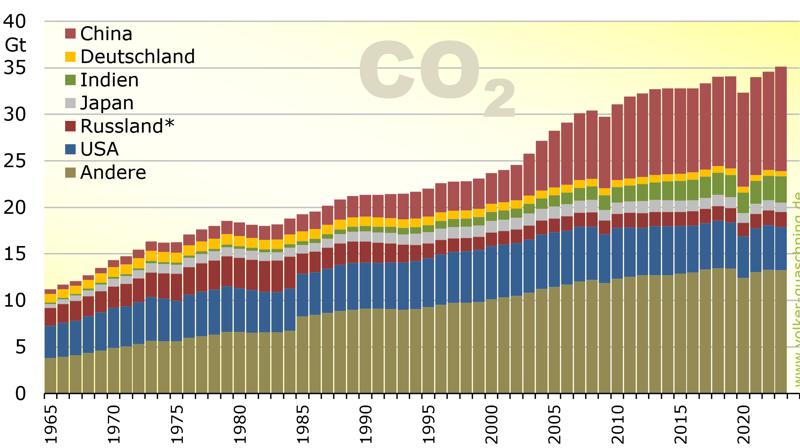
Who Benefits from the Energy Transition?Could this lead Mayor Andy Haugk and the town council in Hohenmölsen to focus not on "green district heating" but on preventing heating costs from rising further? Current prices using lignite include CO2 charges, taxes, and provisions for the restoration of the open-pit mine. Even without a degree, it is obvious that the current energy source is cheaper than what has been ideologically mandated.Hohenmölsen as an Expensive Place?Does it make sense to let the cost of living rise in Hohenmölsen due to rising energy costs when the alternative to "green district heating" still offers lower prices? Mayor Haugk hopes Hohenmölsen will become a "commuter belt" for Leipzig. But such movers will also calculate and consider where energy costs are cheaper. If Hohenmölsen becomes an expensive area, migration from the big city will not occur.Meeting Political Requirements – at Citizens’ ExpenseWe can assume that Mayor Andy Haugk will continue to meet top-down requirements. After all, it sounds impressive to announce that 66 million euros are being invested in Hohenmölsen. The town council members will probably hardly question this, even though they are themselves affected by rising prices.City and Citizens Could Apply PressureOf course, town council members could make themselves unpopular at the state and federal level by demanding a reversal of this "energy transition." They could join forces with other cities and towns to apply more pressure to keep heat affordable.Residents of Hohenmölsen could also apply pressure by insisting at upcoming council meetings that the mayor and council take action. They could ask questions and push for the top priority to be keeping living costs from rising—including keeping heating costs low. But do the people of Hohenmölsen want that? Do they have the courage? Citizen Profit: ZeroReferring to the question that Sebastian Striegel (Greens) asked in 2021 of the then-re-elected Minister President Haseloff, I asked the mayor what he does so that Hohenmölsen citizens benefit from the "energy transition." The answer was evasive. There is no real profit for each citizen.The "energy transition" makes life more expensive and destroys wealth by taking money out of people’s pockets. It does not save the climate, assuming the narrative that human CO2 actually causes climate change is even true. The 97 percent natural CO2 is not the problem. The graphic above shows that other countries value prosperity more than CO2 reduction. The "climate change" threat is clearly not considered significant. You can find my questions and the answers in the above video and the transcript below: Michael Thurm: I looked at this new green district heating concept presented here in December, and I read that the kilowatt-hour prices, currently about 15 cents, are supposed to rise to over 20 cents due to green district heating, which is supposed to cost around 50 million in subsidies. So the question is: Are there other concepts in the works to bring heating prices down again instead of continuing to rise? It was once said that the energy transition should cost as much as an ice cream scoop. No one can eat that much ice cream anymore. Andy Haugk (Mayor of Hohenmölsen): I know this will probably not be a satisfying answer because it’s like looking into a crystal ball. If you look at this concept, which is published on the council information system, you’ll see that all available heat sources were first examined – the question is always, where does the heat come from? The study area was enormous – from geothermal, lake thermal energy, industrial waste heat, to wastewater treatment plant heat, etc. All of this was examined. What is now included in the new heating supply concept is what remains. That is what is currently – I emphasize: currently – available for Hohenmölsen’s district heating network, and a timeline up to 2045 has been established. The year 2045 marks the point when complete defossilization should be completed, as required by law. There is a transformation path mandated by federal law specifying CO₂ shares in heat for each year. This is accounted for, and therefore the forecast you mentioned in numbers must be seen along the timeline. It doesn’t mean next week or the week after, but develops over time. And this 20-year timeline naturally leads to cost increases for any energy source. The projected heat prices are purely estimates, and similar projections must be done for other energy sources or private heat pumps. There will always be increase factors. The subsidies you mentioned are correct – Hohenmölsen receives them to prevent prices from rising too much. If these plants were built without subsidies, prices would be much higher. Heat would then not be affordable. Thus, this coal exit, accompanied by structural change funds, keeps prices under moderate inflation. In all calculations and in selecting the transition path, a control mechanism ensures Hohenmölsen citizens don’t face unaffordable district heating or prices above the market for other energy sources. In Hohenmölsen, there’s always a comparison: what if everyone produced their own energy? That comparison must hold. Therefore, district heating prices remain marketable relative to individual solutions. The result today: prices are marketable. But it is a forecast. No one can see 10 or 20 years into the future. The gas share is included – no one knows how gas prices will develop. Today’s gas users cannot predict their heating costs in 10 years. Oil users cannot predict oil prices in 5 years. Electricity users cannot predict electricity prices. So assumptions are always needed to calculate projections. Assumptions can change and must be revisited. This is how anyone reasonably evaluating such projects would proceed. A cautious business approach was used here. Michael Thurm: I have a small follow-up. When Reiner Haseloff was re-elected in 2021, the Green MP Striegel asked what he would do to ensure residents of Saxony-Anhalt benefit from the energy transition. I’d like to ask that here. Andy Haugk: He isn’t here today. Michael Thurm: No, but you, Mr. Mayor: what do you do so Hohenmölsen residents benefit from the energy transition? Andy Haugk: I’m not sure if that falls under our assigned tasks. But as an energy region, we contribute significantly to the state’s energy supply. Not as a city, because we own no wind turbines or power plants. So maybe the question is in the wrong place. But we are particularly affected. Later we’ll discuss a PV project. The city enables the energy transition by creating conditions for such plants. That’s a municipal task: planning and zoning rights. There are also statutory feed-in tariffs, which bring revenue for the city, used in the budget to support things like daycare fees. This is an example of how residents indirectly benefit from PV and wind installations. As a mining region, one-third of our municipal area is still directly affected by mining. The budget benefits because tax revenues fund other municipal expenditures. Without income from wind, PV, and existing industries, the city’s finances would not work. For example, daycare costs: total costs minus state and district subsidies leave a large share funded by parents and the general budget. Previously, at least 50% had to come from the city budget. Now we fund about 70% from the budget. Where does this money come from? As mentioned, from general tax revenues, key allocations, and special subsidies from projects, linking back to your question. Author: AI-Translation - Michael Thurm | |

|
| Other articles: |
 | 35 Years Since the Fall of the Wall: Evening Discussion – The Peaceful Revolution in Weißenfels – Between Remembrance and Criticism (Demo in Dessau)In recent days, the anniversary of the Peaceful Revolution that marked the beginning of the end of the GDR was commemorated. On November 9, 2024, a demonstration took place in Dess... zum Artikel |
 | Death Threat After Demo on 08/26/2024 – Interview with Colette Bornkamm-RinkAt the end of a demonstration by government critics in Aschersleben, a serious incident occurred when an Albanian man threatened one of the participants with death. Among the topic... zum Artikel |
 | Democratic Initiative Demands Death Penalty – Threat or Provocation?Death penalty for negotiating with the AfD and for referendums punishable by law? A dubious "Democratic Initiative" is causing a stir with radical slogans and dangerous ideas – a... zum Artikel |


|
Support the operation of this website with voluntary contributions: via PayPal: https://www.paypal.me/evovi/12 or via bank transfer IBAN: IE55SUMU99036510275719 BIC: SUMUIE22XXX Account holder: Michael Thurm Shorts / Reels / Kurz-Clips Imprint / Disclaimer |