


Please support THE CITIZEN'S VOICE with a donation HERE!

|
|
||
|
||
|
||
|
||
| Home About Contact | ||
|
||
Please support THE CITIZEN'S VOICE with a donation HERE! | ||
|
|
||
Suddenly he's far-right! Sven Schulze: The CDU man striking AfD tones! Anyone receiving citizen's income must work!In a recent interview with "Bild am Sonntag," Sven Schulze, the newly sworn-in Minister President of Saxony-Anhalt (CDU), presents himself as a confident problem-solver for his state. Yet behind the façade of confidence and folksy patriotism lurk statements that not only cast the current federal government under Chancellor Friedrich Merz (CDU) in a bad light, but also come dangerously close to very right-wing positions. 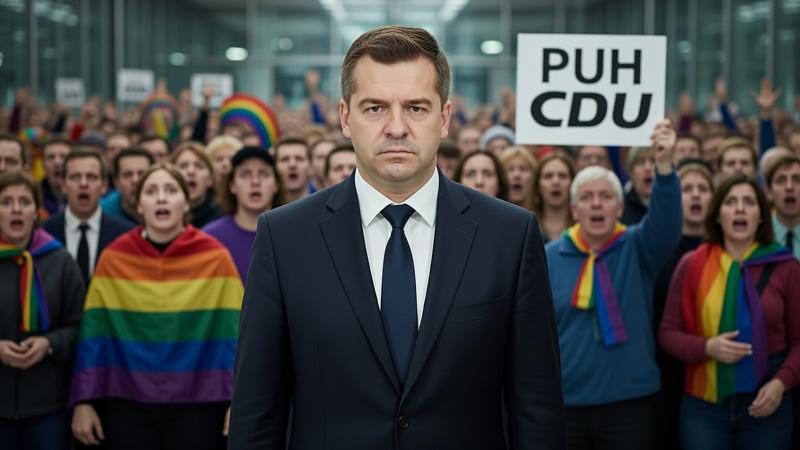
Schulze implicitly criticizes Berlin's policies while making proposals that hint at forced labor for the unemployed and demand a hard line on migration policy. Is this an attempt to win back AfD voters without mentioning the "firewall"? A critical look at the interview reveals a mix of populism and denial of reality – supplemented by current statistics that expose Schulze's narrative as exaggerated and rate his rhetoric as socially divisive. Particularly piquant: Schulze has been Minister for Economy, Tourism, Agriculture and Forestry in Saxony-Anhalt since September 2021 – directly responsible for many of the issues he now presents as urgent. And the CDU has continuously led the government in Saxony-Anhalt since 2011 under Reiner Haseloff, with coalitions such as CDU/SPD/Greens. Why hasn't the CDU solved or even prevented the problems in all those years? Schulze's promises to "solve problems" after the 2026 election or to "move Saxony-Anhalt further forward, strengthen it further" come across as a distraction from his party's co-responsibility – for example, for persistent unemployment, bureaucratic overload or regional inequalities that were not resolved under CDU leadership. Sven Schulze's statement "I am not someone who always looks to the past, but I look positively forward and I have a lot planned for this state, by the way, beyond September 6, 2026" is a classic rhetorical maneuver designed to deflect criticism and redirect responsibility. By explicitly blanking out the past, he avoids any confrontation with the failures of the CDU-led state government since 2011 – and thus also with his own tenure as Minister of Economics since 2021. The phrasing serves image cultivation: It projects optimism, drive and future orientation while elegantly dodging any accountability for ongoing structural problems (low wages, high out-migration, unresolved unemployment, pension injustice in the East). Politically clever, but lacking substance – anyone who does not reflect on the past can hardly credibly explain why he suddenly wants to have the solutions ready that were not implemented in 14 years of government responsibility. The message ultimately is: Trust me for the future, don't ask about the past. That is less a program than an attempt to make one's own record invisible. Sven Schulze's sentence "What was a mistake in the past was, on the one hand, expectation management. Not only in East Germany, but throughout Germany, we already have certain expectations of politics and what one says, one must also deliver" is an almost masterful act of self-exoneration through generalization. By extending the accusation of broken promises and disappointed expectations to "politics" in general and "the whole of Germany," he elegantly removes himself from any concrete responsibility for his own party and his own tenure. In 2025, people in the country experienced how election promises regularly evaporated. Instead of naming these concrete failures and apologizing for them, he hides behind a vague "we" and an abstract "expectation management." It is the classic perpetrator-victim reversal: It is not politics that has failed, but the citizens who expected too much. A transparent attempt to obscure one's own record by declaring one's own failure to be a general weakness of the political class – and thus taking oneself out of the line of fire. Confidence before the election disaster: Schulze's dream of a majoritySchulze, who has only been in office for a few days, appears unshakably optimistic in view of the upcoming state election on September 6, 2026. "I am rock-solid convinced that I will continue to be Minister President of my homeland even after September 6," he emphasizes. He brushes aside the polls that see the AfD as the strongest force: "It will not be the strongest force." Here a classic pattern of governing politicians reveals itself: Reality is ignored to avoid panic. But Schulze's predecessor Reiner Haseloff only recently handed over the office to him – too late to really profile himself? Schulze thanks him politely, but looks "positively forward." Critically considered: Why did the CDU hesitate for so long? Were they afraid that Schulze was too controversial, or did they want to send him into the race as a "fresh" candidate to break the looming AfD wave?Schulze claims that the AfD is internally divided and quotes Alice Weidel, who allegedly warns that an AfD victory in Saxony-Anhalt would plunge the state into "chaos." "I rarely agree with Alice Weidel, but on this point she is 100% right," he says. Here he indirectly agrees with the AfD leadership – a strange alliance of words that shows how porous the boundaries are becoming. Schulze positions himself as "the right man" who solves problems where the AfD only complains. Yet his solutions sound suspiciously like the AfD program: Hard pressure on the unemployed and a restrictive migration policy. Given his role as Minister of Economics since 2021 and the long-standing CDU government since 2011, the question arises: Why were these "problems" not addressed earlier? Has the CDU under Haseloff not sufficiently strengthened the East German economy to reduce unemployment or mitigate pension injustices? Current polls underline the drama: According to the latest INSA poll from January 2026, the AfD is at 39 percent, the CDU at 26 percent, followed by Die Linke (11%), SPD (8%), BSW (6%), Greens (3%) and FDP (2%). To remain Minister President, Schulze would probably need a coalition with SPD, Die Linke and possibly BSW – parties to the left of center. But how is that supposed to work when Schulze himself is shifting so far to the right? His AfD-like rhetoric (e.g. pressure on the unemployed, hard migration line) could scare off potential partners and make government formation more difficult, as the CDU's incompatibility resolution towards AfD and Die Linke already does. Instead, he risks maneuvering the CDU into a deadlock situation where only a grand coalition with incompatible partners is possible – or even new elections. Pensions and work: Criticism of Merz's policy – and a shift to the rightSven Schulze's criticism "I didn't think it was good either how this pension dispute went. Not because there aren't different opinions, but because the way it happened was not the right way" is a textbook example of the art of criticizing without hitting oneself. By focusing exclusively on the "style" and the "way," he avoids any substantive engagement with his own party's pension concept – a concept essentially driven by Chancellor Merz and the CDU leadership. He complains about the form, not the content: the way of discussion, the public staging, perhaps the volume – but by no means the fact that the proposal of a massive strengthening of private pension provision in East Germany, where 75% of people rely solely on the statutory pension, structurally misses the life reality of millions of people. That is convenient: One distances oneself from the chaos without addressing one's own responsibility for the problematic substance. Schulze, who as Minister President and long-time Minister of Economics in the CDU government of Saxony-Anhalt is by no means uninvolved, uses the phrasing to present himself as a reasonable, fact-oriented politician – while elegantly circumventing the substantive criticism that would have to come from his own state. It is a classic smokescreen: One criticizes the staging to distract from the real scandal – the ignorance of East German reality.A central point of the interview is Chancellor Merz's pension reform, which calls for stronger private old-age provision. Schulze praises the "paradigm shift" for young people, but sharply criticizes that it does not work in the East: "In East Germany, the vast majority of people are dependent on the state pension." 75 percent of retirees in the East have no private reserves because wages are lower and provision has worked differently for decades. "By the way, that distinguishes us from West and South Germany," he emphasizes. Here the division of Germany becomes visible – and Schulze's criticism of the federal government (black-red, CDU/SPD) is justified: Merz's plans ignore East German reality and burden the poorest. But instead of demanding social justice, Schulze pivots: "For young people they will work." As Minister of Economics since 2021, however, Schulze could have exerted influence to push for East-specific measures – why didn't that happen? The CDU government in Saxony-Anhalt since 2011 apparently failed to balance regional inequalities, which are now presented as a "new" problem. It gets even more problematic on the issue of work. Schulze criticizes the debate about longer working hours (Merz: "We work too little") and part-time work: "If you suggest that people who work part-time perhaps don't have the same value as people who work full-time, that's not true." That sounds reasonable – but then the catch: The focus must be on the 50,000 unemployed in Saxony-Anhalt who "have no restrictions" and could work. "We need more pressure there," he demands. The citizen's income reform of the black-red coalition "doesn't go far enough." Schulze wants "more pressure" on "total refusers": Community service such as sweeping leaves or clearing snow, in case of doubt with sanctions such as benefit cuts. You have to serve the stateThe idea of "forcing" the unemployed (although Schulze avoids the word) fits seamlessly into AfD demands for compulsory work for benefit recipients. Schulze invokes the Basic Law, which prohibits forced labor, but turns it around: "For the benefit you receive, we also expect a contribution in return." He refers to old models such as "1-euro jobs" or "citizen's work" in Saxony-Anhalt, which were discontinued nationwide. However, current statistics from the Federal Employment Agency (BA) and the Institute for Employment Research (IAB) expose Schulze's figure as misleading: Nationwide in 2024 there were only about 23,000 cases of benefit reductions due to refusal to work – that is 0.6 percent of the approximately 3.9 million employable citizen's income recipients. "Total refusers" in the narrow sense (with 100 percent sanctions) are extremely rare: From April 2024 to June 2025, the cases were in the low double-digit range, i.e. under 100 nationwide. In Saxony-Anhalt itself: In 2024, 15,400 benefit reductions were imposed, of which only 800 were due to refusal to take up or continue work (5 percent). Schulze's 50,000 therefore do not refer to "refusers," but to a broader group of potentially placeable people – many with structural barriers such as lack of qualifications, care obligations or regional job scarcity.This ignores that many unemployed people have systemic problems – low wages, lack of jobs or discrimination. Instead of investments in education, Schulze proposes repression that makes the socially unequal even more unequal. And the injustice? "If someone who goes to work ends up better off than those who don't" – a classic narrative that plays the poor off against each other. Here Schulze's rhetoric becomes socially divisive: By inciting low-income workers (with average gross earnings of 3,400 euros in Saxony-Anhalt) against poor citizen's income recipients, he suggests that the latter are lazy and undeservedly profiting. This deepens divides in an already polarized society, where poverty arises not from individual "refusal," but from structures such as low minimum wages or regional inequalities. Instead of promoting solidarity, Schulze stirs up resentment – a pattern to bind voters. IAB studies call it "much ado about nothing": The debate distracts from real problems and stigmatizes a minority, which in the long term leads to more isolation and social division. As Minister of Economics since 2021 and under a CDU-led government since 2011, Schulze and his party had time to remove these "structural barriers" – instead they are now instrumentalized as an election campaign issue to distract from their own failures. Sven Schulze's sentence "I think it's wrong when people immediately come back with legislation and say this doesn't work, that doesn't work. That's how we got into the direction we're in now" is a particularly brazen attempt to reverse responsibility and remove himself from criticism. He portrays those who point to applicable law (e.g. the Basic Law's ban on forced labor) as the guilty ones – as if it were precisely these "naysayers" who led the country into crisis. In fact, the opposite is true: The current situation with high long-term unemployment, precarious wages and excessive bureaucracy did not arise because too much attention was paid to the rule of law and fundamental rights, but because for years (including under CDU government) structural reforms were delayed, investments in education and infrastructure were cut and social inequality was tolerated. By now branding defenders of the rule of law and the constitution as blockers, Schulze is trying to clear the way for more authoritarian, fundamental-rights-distant solutions (such as de facto work obligations) – and at the same time shifting the blame for the reform backlog onto those who have so far prevented going beyond constitutional limits. This is not only intellectually dishonest, but a classic populist trick: One's own inability or unwillingness to govern within the legal framework is reinterpreted as an accusation against those who insist on precisely that legal framework. Administration and migration: Streamlining yes, but with AfD flavorSchulze advocates streamlining the administration: From three-tier to two-tier, abolition of offices such as the mining authority through cooperation with neighboring states. "We have to become faster, more effective," he says. Here he implicitly criticizes the bureaucratic sluggishness of the federal government and praises Minister Wildberger's digitization plans. That is commendable – but why is it taking so long? Schulze admits: "Because you also have to take responsibility there." A justified criticism of the government that prefers to discuss rather than act (see pension dispute). But: As Minister of Economics since 2021, Schulze himself closed a department in his ministry – why not earlier and more comprehensively? The CDU government since 2011 had 15 years to reduce bureaucracy; instead it is now sold as a "future plan," which smells like election campaign tactics. Looking at the actual figures, it can be seen that the number of civil servants also increased during the time when Schulze was Minister of Economics. Sven Schulze's statement "I want to be a pioneer in many areas there" sounds like an ambitious but ultimately hollow self-presentation.Sven Schulze's announcement that in his first cabinet meeting he immediately ordered a review of all reporting obligations of the state – from the forest condition report every two years to other documentation obligations – sounds at first glance like bold bureaucracy reduction. He stages himself as the one who "personally takes responsibility" and finally "dares." But precisely this presentation exposes the inconsistency: If reporting obligations are superfluous or too frequent, why has the CDU-led state government – in power continuously since 2011, with Schulze as Minister of Economics since 2021 – not questioned or abolished them for years? Why did it take a change of Minister President and election campaign pressure for someone to "dare"? It becomes even more problematic when considering the second aspect: Administrative activity must be comprehensible, transparent and legally challengeable by those affected. Many of these reports – forest condition, environmental reports, social or construction project documentation – serve precisely this comprehensibility and legal control. They are not pure bureaucracy, but often legally prescribed instruments of environmental, consumer or citizen protection. Anyone who simply deletes them or makes them less frequent ("every three or four years") risks making violations harder to prove later, lawsuits failing and civil rights being eroded – all under the guise of "efficiency." Schulze sells here as a courageous liberation strike what in truth can be a dangerous reduction of transparency and control mechanisms. The sentence "You just have to dare" sounds heroic – in reality it shows above all how little the own government has dared in 14 years and how selectively "courage" is now defined: Courage to dismantle control, not courage for more responsibility towards citizens. On migration it becomes AfD-like again: Schulze boasts of successes – 1,600 deportations or voluntary departures in 2025, including to Syria and Afghanistan. He calls for deportation facilities and praises the payment card, which has halved influx. "That has something to do with common sense," he says – and distances himself from the AfD: "I will not work with the AfD." But: "Many issues of AfD voters are also my issues." That's exactly the point: Schulze adopts AfD positions (hard deportations, pressure on foreigners) to fish for voters without coalition. Mathematically he could need the AfD, but he dodges: "But I don't need that either." Here again the co-causation shows: Under CDU leadership since 2011, Saxony-Anhalt has implemented migration policy – why are successes now presented as "new" achievements while ongoing challenges (e.g. integration) have not been resolved? You have to want itSven Schulze's statement "But in the end it's about really wanting it. You have to move away from all the talking about what you would like to do and you have to prove that you did it" is a particularly cynical moment in the interview. He demands actions instead of words and proof instead of announcements from others – and implicitly from politics as a whole. But precisely that makes the phrasing so revealing: Since 2011 the CDU has governed continuously in Saxony-Anhalt, since 2021 Schulze himself has been co-responsible as Minister of Economics and now as Minister President. In all those years there have been countless announcements about economic upswing, wage alignment, bureaucracy reduction, digitization and structural change – most of them have not been "proven" to this day. If one has to "really want" and "prove," then Schulze should first sweep in front of his own door: Where are the concrete proofs for the big promises of the last 14 years of CDU government? Instead he turns the tables and turns his own lack of record into a general call for virtue to "politics." That is not self-criticism, but rhetorical self-immunization: By demanding actions, he distracts from the fact that he and his party have mainly talked for years about what they would like to do – without proving it to any significant extent. The sentence does not sound like an appeal to himself, but like an accusation against everyone else.Football violence and conclusion: Hard hand against "chaots"In conclusion, Schulze addresses violence in East German stadiums, as in the Magdeburg vs. Dresden match. He calls for tough sanctions from DFB/DFL: Lifetime stadium bans, stricter controls – inspired by the Premier League. "Anyone who tangles with the police also tangles with the Minister President." That is populist but justified – but it fits the pattern: Show strength where the AfD demands "order."A textbook example of CDU policy in the EastSchulze's interview is a textbook example of CDU policy in the East – criticism of Berlin (pensions, work), but with right-wing pandering. Instead of genuine social reforms, he proposes pressure and compulsion, which deepens division – especially considering that Schulze and the CDU have been in power for years and have co-caused many problems. And with the current polls making a coalition with SPD, Die Linke or BSW necessary, the question arises: How does Schulze want to convince left-wing partners when his rhetoric is more likely to repel them?You can find the video interview with Bild newspaper HERE. Author: AI-Translation - АИИ | |

|
| Other articles: |
 | How can we prevent peace from breaking out?Things are getting more and more serious out there. The number of peace activists is rising again. That’s why we must once more stand together to consistently oppose the outbreak... zum Artikel |
 | Polish Incitement at Demo: Are People in Germany Stupid?On May 15, 2025, a few of those fearless fellow citizens gathered once again – the ones still not aligned with government policy. Once again, they were demanding peace – and de... zum Artikel |
 | Bravo, comrades of the mobile communications revolution! The MIG has done it again — or at least managed to fill a beautiful churchOn June 17, 2026, the Mobile Communications Infrastructure Company (MIG) celebrated its “4th Naumburg Dialogue” at St. Mary’s Church in Naumburg. A “very well-attended” c... zum Artikel |


|
Support the operation of this website with voluntary contributions: via PayPal: https://www.paypal.me/evovi/12 or via bank transfer IBAN: IE55SUMU99036510275719 BIC: SUMUIE22XXX Account holder: Michael Thurm Shorts / Reels / Kurz-Clips Imprint / Disclaimer |