


Please support THE CITIZEN'S VOICE with a donation HERE!

|
|
||
|
||
|
||
|
||
| Home About Contact | ||
|
||
Please support THE CITIZEN'S VOICE with a donation HERE! | ||
|
|
||
The Subjects Celebrate High Fuel Prices – and Applaud the GougersWhile a liter of diesel is approaching the €3 mark and gasoline is also reaching record highs, loyal government supporters on Facebook are busily defending the situation. 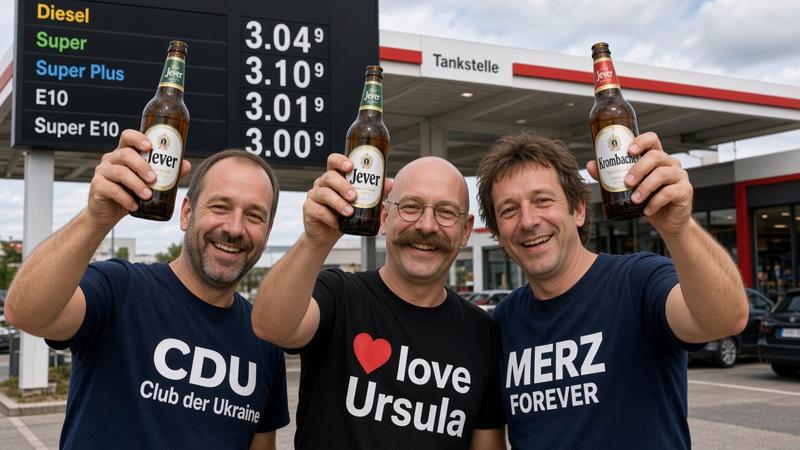
Maik Wohler sets the example: It is not politics that is to blame, but Putin, Trump, and the oil companies. The taxes? They're fixed, after all! Citizens are simply supposed to keep paying obediently and blame the AfD. Welcome to the logic of subjects who even cheer on their own exploitation. Fixed Taxes – and the Myth of the Innocent StateWohler is partly right: The energy tax on E10 is around 65 cents, and on diesel 47 cents, plus the CO₂ levy. These amounts do not rise with the price of crude oil. When the price increases by 50 cents per liter, only around 8 cents of that increase actually goes to VAT. The rest goes to corporations and intermediaries. So far, so correct.What he leaves out: Politicians could lower, suspend, or even abolish this fixed burden at any time. Corona proved that regulations and laws can be changed overnight when the political will exists. The Infection Protection Act was amended dozens of times, and containment regulations were adjusted on a weekly basis. When fuel prices are bringing transport, food, and industry to their knees, that will is missing. Apparently, the well-being of citizens is not particularly high on the government's list of priorities. The CDU-SPD federal government under Friedrich Merz (CDU) is currently planning a temporary reduction of the energy tax by 14 cents per liter starting October 1, 2026 – including the VAT effect, around 17 cents in “relief,” at a “total cost” of approximately €2.5 billion. A genuine VAT reduction from 19 to 7 percent was considered and rejected: EU law would stand in the way, and it “would be expensive.” This is where the wording exposes itself. Collecting less money is not a “gift” to citizens, but merely a reduction of a compulsory levy. Politics and the media talk as if the state were giving people something when it takes less from them. Classic bullshit that goes unnoticed by subjects who only think as far as the end of their own noses. Wars, Sanctions, and Selective OutrageThe Iran war (a US-Israeli attack since the end of February 2026) and the closure of the Strait of Hormuz are driving up oil prices. That is indisputable. Yet the German and European response remains remarkably restrained. No sanctions against the USA or Israel, no comparable outrage as in the case of the Ukraine war. Peace efforts? Barely audible. At the same time, sanctions against Russia were imposed and continuously tightened by Brussels and Berlin. These sanctions, which have negative effects on Germany and Europe, were not imposed by Putin, but by German and European policymakers. Gas and energy prices exploded because of political decisions that cut off cheap sources of energy.Following drone attacks (Houthis/Iraqi militias) on the East-West Pipeline, Saudi Aramco has temporarily halted or severely restricted deliveries to European refineries. European customers will no longer receive forward-contract deliveries in October. This is driving prices up even further. This is clearly the responsibility of those who support geopolitical escalations or at least fail to criticize them. The EV Comparison and the Electricity IllusionWohler's joke about the queues at gas stations and the supposedly faster charging of electric cars is cheap. Even if large numbers of people switched to electric vehicles tomorrow: At night and during periods of low wind and solar generation, the electricity would come from coal- and gas-fired power plants. Wind and solar cannot cover that. Electricity prices would rise – and with them the cost of everything else. The comparison is not merely flawed; it is a distraction from reality.End-consumer electricity prices of more than one euro have already been reported because of temporary acute electricity shortages. Wind and solar therefore by no means save the day, because fossil fuels have to be used during periods of low wind and solar generation. A rapidly increasing number of electric cars would exacerbate precisely this problem. Meanwhile in Russia and the Czech RepublicIn Russia, a liter of fuel currently costs around 77 cents. Does Putin care more about “his people” than the much-loved German and European leaders care about “their people”? At least he makes sure that energy remains affordable in his own country. In 2026, the Czech Republic reduced the excise tax on diesel (temporarily down to the EU minimum) and capped margins. The measure has partially expired, but the price difference remains noticeable: Germans living near the border drive across to refuel because diesel is available there for less than two euros. While Berlin calculates, hesitates, and explains that it would be expensive, its neighbors take action.Why the Subjects Defend the Government Even While They BleedThis is where it gets philosophical and bitter. High fuel prices work their way into every price: transport costs, food, industry. Many companies will not survive. Yet these fellow citizens defend the political actors responsible.It is the classic mechanism of subservience. The government becomes a projection surface for one's identity. Criticism of it feels like self-criticism – and that is uncomfortable. It is easier to invoke an external enemy (Putin, Trump, the AfD, corporations) than to admit that one's own leadership could act and simply chooses not to. The COVID years trained people to believe: The state knows best, restrictions are “for protection,” and anyone who doubts them is being selfish. Cognitive dissonance also plays a psychological role: Those who have followed a particular political line for years may find it difficult to confront reality. High prices are then reinterpreted as a “necessary evil of the geopolitical struggle for values.” The fact that these same values suddenly become flexible when it comes to allies is conveniently ignored. The media and political class provide the narratives, the subjects repeat them – and feel morally superior while doing so. The result is paradoxical: People who are also bleeding at the gas pump and in the supermarket defend the very structure that is taking money out of their own pockets. They indirectly celebrate the high prices by dismissing every criticism as populist. The corporations rake in the money, the state takes its share as well (including through VAT on high prices), the citizens bear the burden – and the subjects still applaud. The 17-cent reduction starting in October would be a drop in the ocean. A price cap is being discussed. Both measures come late and remain temporary. Genuine relief – permanent tax reductions, real peace diplomacy, a departure from ideological energy policy – would require politicians to put the well-being of citizens above their own retention of power and moral self-glorification. There is little evidence of that. The subjects will continue to defend their beloved leaders. When the next price shock comes, they will once again look for the bad guys outside. They will pay the bill themselves. The Taxation of Electric Cars Is Coming for SureMany countries already tax electric cars. It is only a matter of time before the leaders so beloved by the subjects also tax the electricity that electric cars need for charging. At the latest when the de facto phase-out of combustion engines takes effect and citizens have no real alternative to electric cars, politicians will also turn today's electric-car enthusiasts into a source of revenue for the state coffers. You don't have to be a prophet to imagine that the decline in current and future tax revenues from combustion engines, gasoline, and diesel will of course be offset by new and increasing taxes on electric cars and charging electricity. This could and certainly will include electricity generated by one's own home solar system. But thinking that far beyond the end of their own noses is not something government-loyal subjects usually do.Maik Wohler's Post from September 15, 2026The fixed tax amounts on fuel prices do not change. No matter how far fuel prices rise. They were the same before the Iran war as they are now. Thus, the increase in prices since the beginning of the Iran war can indeed be attributed to that war. 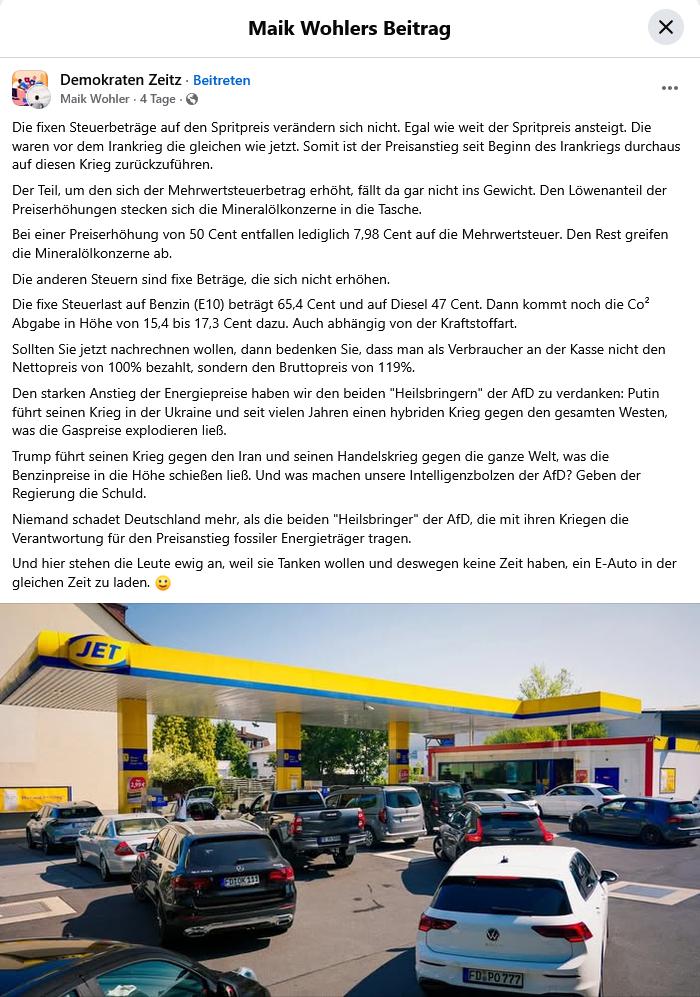 Author: AI-Translation - АИИ | |

|
| Other articles: |
 | €1.5 trillion for Ukraine over the next 10 years – finally no more having to think about vacation planningYou know the drill: the most beautiful days of the year have to be planned – the vacation. But now you don’t have to worry about that anymore.... zum Artikel |
 | No New Landfill Construction in the Heart of the "Tuscany of the North"Open Letter: No New Landfill Construction in the Heart of the "Tuscany of the North," in the Middle of the Wine-Growing Region on the Saale and Unstrut!... zum Artikel |
 | Censorship Still Exists - Democracy Is a Dangerous Organization or GroupWhen the Federal Administrative Court lifts a ban, it’s a normal procedure in a functioning constitutional state. But if that ban concerns the Compact Magazine – a medium one d... zum Artikel |


|
Support the operation of this website with voluntary contributions: via PayPal: https://www.paypal.me/evovi/12 or via bank transfer IBAN: IE55SUMU99036510275719 BIC: SUMUIE22XXX Account holder: Michael Thurm Shorts / Reels / Kurz-Clips Imprint / Disclaimer |