


Please support THE CITIZEN'S VOICE with a donation HERE!

|
|
||
|
||
|
||
|
||
| Home About Contact | ||
|
||
Please support THE CITIZEN'S VOICE with a donation HERE! | ||
|
|
||
Guest Article: Sven Schulze and the Great Memory Hole of Saxony-AnhaltA political miracle has occurred in Saxony-Anhalt. A minister who had been sitting in the cabinet since 2021 was promoted to Minister-President at the beginning of 2026. He then appeared in the public eye almost as fresh as if he had previously observed state politics only from a distance. His previous responsibilities, however, were the economy, tourism, agriculture, and forestry. His political record apparently seems unusable for the election campaign and too unspectacular for the political opposition. 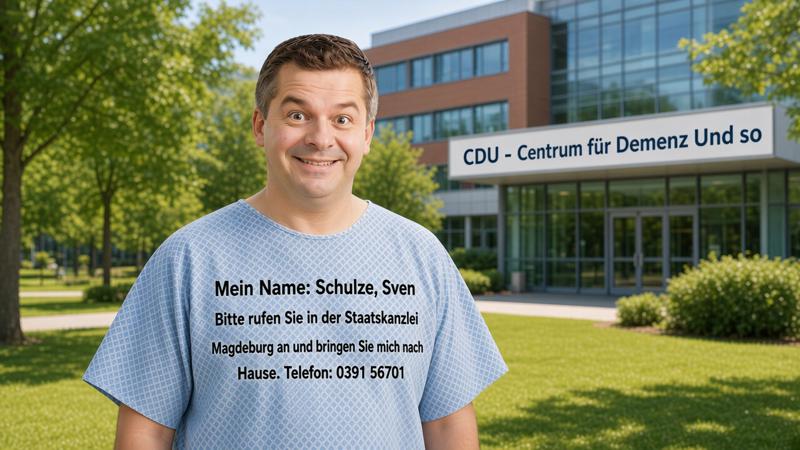
The Political New Car with Four Years on the OdometerOn January 28, 2026, Saxony-Anhalt got a new Minister-President. Sven Schulze replaced Reiner Haseloff and was immediately presented as a generational change. A younger man, a new face, fresh momentum for the State Chancellery. One could almost have thought that Schulze had merely happened to pass the state parliament on his way from Quedlinburg to Magdeburg and had spontaneously been elected head of government there.In fact, he had been a member of the state government since September 2021. Not as Minister for Stamp Collecting or Ceremonial Ribbon-Cutting, but as Minister for Economic Affairs, Tourism, Agriculture and Forestry. Four major policy areas under which a state can develop — or fail to. Yet with the move to the State Chancellery, a political whitewashing program apparently began. The long-serving cabinet member became the new beacon of hope. Responsibility became experience. The previous record in government became a legacy that somehow someone else had left behind. Intel: From Silicon Dream to Very Large FieldThe biggest promise of his time as minister was Intel. Two state-of-the-art chip factories were supposed to be built near Magdeburg. Billions in investment, thousands of jobs, and Saxony-Anhalt's entry into the technological premier league were on offer. All that was missing, really, were self-driving government cars and a new name for the state: Silicon Anhalt.Schulze was among the project's most determined political advocates. The fact that the company was supposed to receive up to ten billion euros in government subsidies did little to dampen the optimism about the economy. Critical economists who asked about the rationale, risks, and alternatives were treated more like annoying background music to the grand investment opera. In September 2024, Intel initially put the project on hold. In February 2025, Schulze still said that the chapter was not over. In July 2025, Intel ended it for good. The company had not received a single cent of the planned subsidies, and the cancellation was primarily due to its global corporate crisis. But the political staging, the concentration of hopes and planning on a single major investor, and the years-long presentation of an uncertain corporate decision as the state's future are very much part of Schulze's record as a minister. What remains is a huge prepared industrial site and the hope that other future technologies will eventually settle there. Even Sioux, a Dutch high-tech company announced in connection with the Intel project, later withdrew from its plans to establish operations there. The site is now waiting in a political Sleeping Beauty state, waiting for the prince who will awaken the maiden with a kiss. When the Economist Gets in the Way of the Ceremonial SpeechIt was particularly inconvenient that the Leibniz Institute for Economic Research Halle, of all institutions, raised doubts about the billion-euro subsidy policy. IWH President Reint Gropp considered subsidizing individual large corporations economically questionable.One might assume that a minister for economic affairs would welcome academic objections as the basis for an open debate. Schulze, however, preferred a more robust form of confrontation. He publicly distanced himself from the institute and its president. Only after criticism did a clarifying meeting take place. It was a remarkable division of roles. The economic research institute was getting in the way with economic research, while politicians were already busy dividing up the bear's hide before it had been caught. Meyer Burger: Less Social Spending, Then Fewer JobsThe solar industry, too, provided an opportunity for a grand economic-policy performance. The manufacturer Meyer Burger operated a solar-cell production facility in Thalheim near Bitterfeld-Wolfen. When the company demanded better subsidy conditions in 2023 and threatened to relocate to the United States, Schulze showed understanding.In this context, he formulated a sentence that could be regarded as an involuntary summary of his political priorities: “We have to spend more on the economy and less on social programs.” That was bold. After all, not every politician is so open about whom they intend to look to first for spare change when a company comes asking for subsidies. It did little good. In 2025, the German Meyer Burger companies filed for insolvency. Production in Thalheim was shut down, and hundreds of jobs were lost. The state also faced a risk from guarantees worth millions of euros. There Are Successes, They Just Don't Fit the HaloTo be fair, Schulze's tenure did not consist exclusively of factories that were never built or were shut down again. Daimler Truck's spare-parts logistics center in Halberstadt is a major investment that was actually realized. Other companies invested in logistics, pharmaceuticals, and food production.Precisely for that reason, a normal assessment would be possible: weighing real successes against costly illusions and industrial setbacks on the other side. Instead, the simpler narrative is chosen during the election campaign. All of this seemed to have been erased by the move to the State Chancellery. This method is practical. A minister for economic affairs can thus take credit for investments, but never responsibility for a misguided strategy. He is, in a sense, the political fund manager who manages only the profits, while the losses, unfortunately, belong to the market. The Opposition Discovers the Principle of Political Grace PeriodWhat is truly astonishing, however, is not that the CDU presents its candidate as an ideally unburdened fresh start. Parties do that sort of thing. What is astonishing is how rarely his political biography and his specific record as a minister are systematically brought up by his opponents.The question practically asks itself. If Saxony-Anhalt is facing major economic, demographic, or infrastructure problems after five years, can the responsible minister for economic affairs suddenly run as an uninvolved problem-solver? If the previous government needs a change of course, why is a member of its innermost leadership circle being treated as the embodiment of that change? Instead, Schulze is primarily talked about as the man who is supposed to stop the AfD. That is convenient for both major rivals. The CDU does not have to talk about its own record, while the AfD can stage the election campaign as a grand duel. The other parties comment on the spectacle and then wonder why they have been given only supporting roles in it. And so a political baptism without holy water takes place. Sven Schulze emerges from the Haseloff cabinet and is suddenly free of its past. Apparently, the minister was someone else with the same name. Failed investment policies, the prioritization of major investors, the handling of criticism, and the unresolved structural problems appear like a pale shadow from the past. Perhaps this could be a task for a smaller force in the state parliament. dieBasis campaigns with the slogan: “The motion counts — not the sender.” The same should apply to political records. It should not be the new office, the grand firewall, or the election-campaign role that determines the assessment, but what someone previously proposed, supported, promised, and took responsibility for. Saxony-Anhalt does not need an immaculate Minister-President. Such a person exists only on election posters anyway. It needs a parliament that remembers — and preferably for longer than until the next press conference. This article was written by Peter Scheller, a member of dieBasis, and reflects his political positions. It was published by the editorial team as a guest article. Author: AI-Translation - Peter Scheller (dieBasis) | |

|
| Other articles: |
 | How the Reichsbürger Coup Might Have UnfoldedThe "Kingdom of Germany" was recently banned. Long legal proceedings are underway against the "Rollator Coup Plotters." But how serious was the actual danger – and how would the ... zum Artikel |
 | The "Cuddle Coalition" on Trial: An Analysis of Eva von Angern's Speech of September 16, 2021, and Its Relevance Five Years LaterOn September 16, 2021, Eva von Angern (Die Linke) delivered a critical speech in the Saxony-Anhalt state parliament against the coalition agreement of the newly formed "Germany Coa... zum Artikel |
 | The Whining District Administrator: Götz Ulrich’s Lament Over the 2026 District Levy – Talking, Talking, Talking, but No Pressure UpwardsOn March 30, 2026, agenda item 17 was on the program at the Burgenlandkreis district council: the deliberation on setting the 2026 district levy.... zum Artikel |


|
Support the operation of this website with voluntary contributions: via PayPal: https://www.paypal.me/evovi/12 or via bank transfer IBAN: IE55SUMU99036510275719 BIC: SUMUIE22XXX Account holder: Michael Thurm Shorts / Reels / Kurz-Clips Imprint / Disclaimer |