


Please support THE CITIZEN'S VOICE with a donation HERE!

|
|
||
|
||
|
||
|
||
| Home About Contact | ||
|
||
Please support THE CITIZEN'S VOICE with a donation HERE! | ||
|
|
||
Guest Article: Why dieBasis Is Gaining Momentum in Saxony-AnhaltMany voters neither want to return to the old party system nor vote for the AfD as a protest. dieBasis is seeking to fill this political gap with issue-based majorities, a rejection of enforced political camps, and the aim of involving citizens in important decisions even between elections. 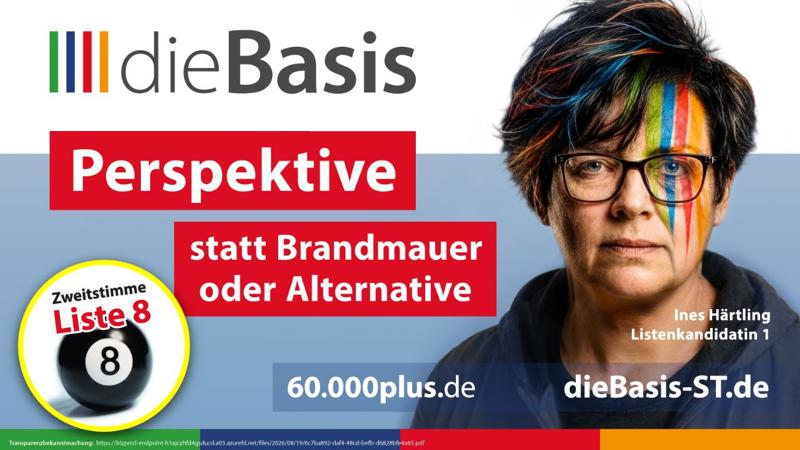
An Open Flank in the Party SystemSaxony-Anhalt is heading toward a state election in which many things are becoming more polarized while, at the same time, surprisingly little is changing. The established parties defend alliances, divisions, and familiar roles. The AfD is gaining support from dissatisfaction with this system. But what about those citizens who find themselves in neither of the two poles?They have lost confidence in the CDU, SPD, Greens, FDP, or Left Party, but are equally unwilling to give their vote to the AfD. Some vote for smaller parties, some stay at home, and many vote tactically against something rather than out of conviction for something. dieBasis sees its opportunity in this politically homeless middle. “Gaining momentum” is initially not a claim about percentage points. It is a description of a political possibility. The more the election is reduced to a choice between an established camp and the AfD, the more room there is for a force that rejects this false dichotomy. dieBasis does not want to form the next camp, but to change the symmetry of parliamentary decision-making. The Motion Matters, Not Who Submitted ItThe core of this approach can be summed up in one sentence. The motion matters, not who submitted it. A proposal should be judged on whether it is lawful, financially viable, and beneficial to the people of Saxony-Anhalt. Not on which party puts it forward.In doing so, dieBasis is challenging a political practice in which motions sometimes fail simply because they come from the supposedly wrong side. Parliaments are not stages for rituals of moral belonging, but places for deliberation and decision-making. Anyone who rejects a good proposal merely to deny a political opponent a success is putting party tactics above the common good. Issue-based cooperation, however, does not mean agreeing at any price. Every motion must be scrutinized against the constitution, fundamental rights, its consequences, and its benefits for the state. A bad proposal does not become better because it comes from an accepted party. And a good proposal does not become worse because its author is politically unwelcome. What Rejecting the “Firewall” Means—and What It Does NotParticularly contentious is the position on the so-called “firewall.” dieBasis rejects blanket exclusion in which the origin of a motion becomes more important than its content. This is not a coalition commitment to the AfD, nor does it mean adopting its positions. Rather, it is a demand that parliamentary decisions once again be publicly justified.The line is drawn where human dignity, fundamental rights, or the free democratic constitutional order are attacked. Opposition to such proposals is not merely legitimate, but necessary. Yet democratic resilience must not be confused with prohibitions on thinking or scrutiny. Anyone convinced that they have the better arguments should present them in parliament and submit to the judgment of the public. This model is more demanding than the firewall because it requires elected representatives to make their own judgments. It does not relieve them through automatic party-line discipline. That is precisely where its democratic appeal lies. Responsibility is not outsourced to parliamentary group leaders, coalition agreements, or media outrage. Cooperation Instead of Permanent ElectioneeringSaxony-Anhalt has concrete problems, namely an aging population, a thinning-out of infrastructure, staff shortages in schools and public administrations, strained medical services, and major disparities between urban and rural areas. These issues will not be solved by parties labeling their opponents as effectively as possible.dieBasis therefore advocates changing, issue-based majorities. On one issue, the better proposal may come from the left; on the next, from the political center; and on a third, from a smaller parliamentary group. What should matter is whether a solution serves citizens and moves the state forward. Cooperation does not replace criticism or opposition. It focuses both on the issue at hand. For a smaller parliamentary group, this is not a minor role. It can introduce motions, compel hearings, make decisions transparent, and enable majorities where the major camps block one another. Its influence would lie less in the number of seats it holds than in its ability to free substantive issues from the logic of fixed alliances. Democracy Must Not End on Election NightThe second crucial point extends beyond parliament. Anyone who calls on citizens to vote only every five years and then turns them back into spectators should not be surprised by their political alienation. The state election on September 6, 2026 will decide who represents the people. But it will not answer every political question that arises during the following legislative term.dieBasis therefore links its parliamentary ambitions with regular citizen participation. On important projects, people in the state should be informed, heard, and—where legally possible—directly involved. This includes lowering the hurdles for popular initiatives and referendums, providing fair information about votes, ensuring transparent decision-making processes, and fostering a political culture in which citizens’ decisions are not regarded as a disruption, but as a normal part of democracy. Direct participation is no substitute for expertise. Rather, it forces politicians to make knowledge accessible, explain alternatives clearly, and justify their decisions. Those who take citizens seriously do not have to put every detailed question to a public vote. But on far-reaching decisions that set the course for the future, citizens should be more than an audience standing on the sidelines. This article was written by Peter Scheller, a member of dieBasis, and reflects his political views. It was published by the editorial team as a guest article. Author: AI-Translation - Peter Scheller (dieBasis) | |

|
| Other articles: |
 | Ghostly Apparition at Zeitz CastleA night watchman observes a light gliding through the windows of Zeitz Castle, accompanied by a shadowy outline.... zum Artikel |
 | Solar Trap: Why the New Subsidy Policy Turns Solar Systems into a Financial Risk!The looming abolition of subsidies for solar systems and the drastic cut of the feed-in tariff to zero could turn your solar power plants into a financial disaster. With falling el... zum Artikel |
 | Small Group, Important Message: Palestinian Woman at Peace Demonstration in Weißenfels on July 15, 2024The Failure of NATO as a "Peace Alliance" and the True Costs of Global Conflicts, Moving Words from a Young Palestinian Woman Reporting on the Stateless Existence and Often Forgott... zum Artikel |


|
Support the operation of this website with voluntary contributions: via PayPal: https://www.paypal.me/evovi/12 or via bank transfer IBAN: IE55SUMU99036510275719 BIC: SUMUIE22XXX Account holder: Michael Thurm Shorts / Reels / Kurz-Clips Imprint / Disclaimer |