


Please support THE CITIZEN'S VOICE with a donation HERE!

|
|
||
|
||
|
||
|
||
| Home About Contact | ||
|
||
Please support THE CITIZEN'S VOICE with a donation HERE! | ||
|
|
||
Shock Ahead of the State Election – Members of Parliament Suddenly Expected to Think for Themselves!Just a few weeks before the state election in Saxony-Anhalt, a political idea is making the rounds that could seriously disrupt parliamentary business. In future, members of parliament might actually be expected to judge motions based on what they contain rather than on who submitted them. 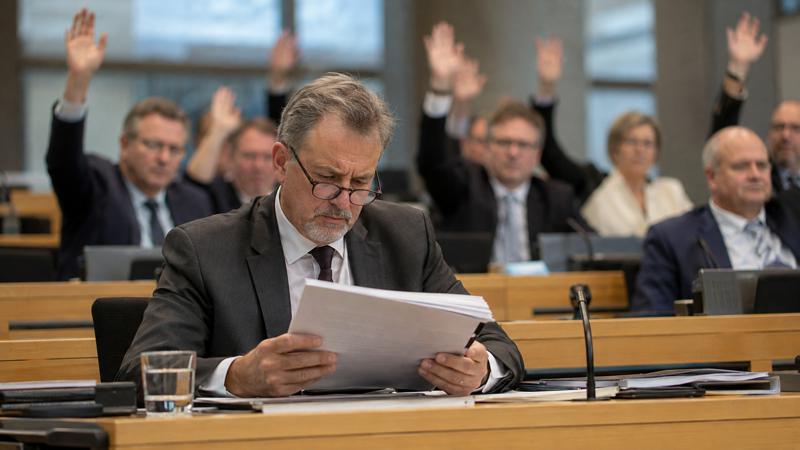
Just imagine it. One parliamentary group submits a sensible motion, and members of another group could simply vote in favor of it. Just like that, without first checking whether the sender is sitting on the right side of the parliamentary garden fence. And it gets even worse. A bad motion put forward by one's own political friends could actually be rejected – simply because the motion is bad or would harm the citizens of Saxony-Anhalt. Where would that leave us? The Motion Matters, Not Who Submitted ItThis remarkably dangerous idea comes, of all places, from dieBasis Saxony-Anhalt. On its campaign website for the state election, the party explains that it does not want to form either “the next camp” or “the next coalition.” Instead, the state parliament should decide motion by motion and issue by issue. Proposals from other parties should also be supported if they solve problems faced by the people of Saxony-Anhalt.That sounds harmless at first, but it isn't. Because what would become of our tried-and-tested parliamentary orientation system if the content of a motion suddenly became more important than the party logo in the top right-hand corner? Members of parliament might actually have to start reading proposals and weighing arguments. They might even have to explain to their voters why they supported a proposal even though it came from the “wrong” side. Politics Could Become Unnecessarily ComplicatedAnd then dieBasis even drags out the Constitution of Saxony-Anhalt. Particularly devious is the fact that supporters of this idea could actually invoke the constitution of the state of Saxony-Anhalt. It really does say that members of parliament are representatives of the whole people. They are not bound by orders or instructions and are subject only to their conscience.Apparently, that passage dates from a time when nobody had yet anticipated just how convenient coalition meetings, parliamentary group agreements and carefully maintained political camps would one day become. Because let's imagine the alternative. The member of parliament votes in favor of good legislative initiatives and motions from the “Others,” while rejecting bad ones from their “Own.” The member simply follows their conscience. That would be a loss of parliamentary control. Before long, someone might even claim that politics has something to do with solving concrete problems. Can You Really Examine Every Motion?At this point, the experienced parliamentarian might object: “It all sounds very nice. But surely nobody can deal with every law and every motion themselves.”Can they really not? In the state parliament of Saxony-Anhalt, an average of around 25 laws are passed and approximately 75 motions are decided on each year. That's roughly 100 substantive decisions a year, or two per week. For full-time members of parliament, that might just about be manageable. Of course, not everyone has to examine everything down to the last detail. Even a small parliamentary group can divide the work up by subject area. One person can specialize in economics and finance, another in education, health or local government. Then, before a vote, all that would really be needed are a few fairly simple questions: What is supposed to change? Who benefits from it? What will it cost? Will new obligations or new bureaucracy be created? And above all: Is the proposal good for Saxony-Anhalt? After that, something could happen that seems almost exotic in parliamentary business. Members of parliament would actually have to read the motions. And What Are Committees For, Anyway?And when things get more complicated, that's what committees are for. Experts can be heard, specialists consulted, arguments exchanged and – imagine that – members can even form their own opinions. After all, why does the state parliament have eleven standing committees?dieBasis is entering the election with a remarkably modest ambition. It does not claim that it will subsequently be able to govern Saxony-Anhalt on its own. Instead, its “60,000+” campaign assumes that even a small parliamentary group could make a difference in parliament by submitting its own motions and supporting sensible proposals from others. The roughly 60,000 votes mentioned are explicitly the party's own estimate based on the expected number of valid second votes (https://diebasis-st.de/wahlen/unterstuetzung/) Author: AI-Translation - Peter Scheller | |

|
| Other articles: |
 | Hotspot Neustadt - Is the Police Helplessly Watching? - Are the Residents Overreacting? - Is Neustadt Dangerous?Can the police manage the growing chaos in Neustadt when their patrols hardly make a difference? How much longer can the frustrated residents endure the constant noise, violence, a... zum Artikel |
 | If the Hell-Summer in Germany Isn’t Enough for Climate Change HysteriaI had to chuckle again recently. A climate change doomsayer from Burgenlandkreis tried once more to spread fear of the climate apocalypse.... zum Artikel |
 | Attack by the Anti-Democracy and Non-Transparency Movement in the Burgenlandkreis District Council Successfully RepelledYes, they still exist – or rather continue to exist – the Anti-Democracy and Non-Transparency Movement in Burgenlandkreis. However, I was able to successfully fend off an attac... zum Artikel |


|
Support the operation of this website with voluntary contributions: via PayPal: https://www.paypal.me/evovi/12 or via bank transfer IBAN: IE55SUMU99036510275719 BIC: SUMUIE22XXX Account holder: Michael Thurm Shorts / Reels / Kurz-Clips Imprint / Disclaimer |