


Please support THE CITIZEN'S VOICE with a donation HERE!

|
|
||
|
||
|
||
|
||
| Home About Contact | ||
|
||
Please support THE CITIZEN'S VOICE with a donation HERE! | ||
|
|
||
Politics on a Park Bench – Mayor Martin Papke (CDU) in Conversation with a MotherAll I had wanted was to watch the children play. A few hours to switch off, forget everyday life for a moment, and watch the ball roll through the sand again and again. Instead, Mayor Martin Papke suddenly sat down on the bench beside me. 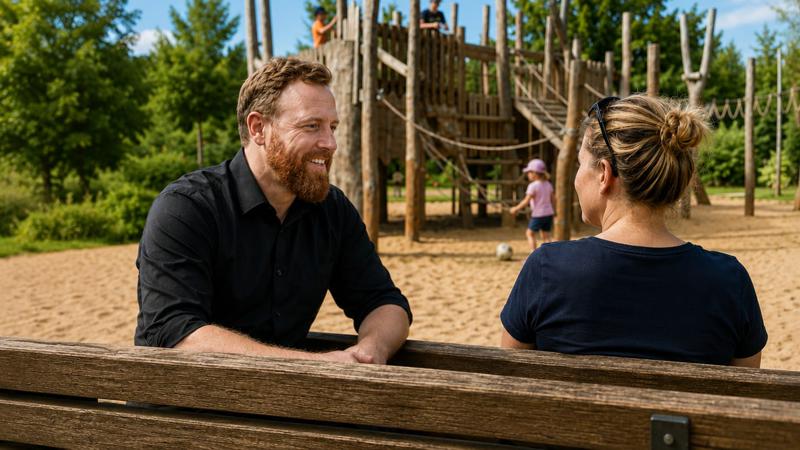
I certainly hadn't expected to meet him that afternoon. All I had wanted was to watch the children play. A few hours to switch off, forget everyday life for a moment, and watch the ball roll through the sand again and again. Instead, Mayor Martin Papke suddenly sat down on the bench beside me. As a private citizen. He had taken the afternoon off. While his wife chatted with other mothers at the playground, he kept an eye on their two children. No press event, no photographer, no cameras—just family time. Neither of us probably suspected that it would turn into a political conversation. What began with a brief "Hello" ended up becoming a 35-minute discussion about elementary schools, the swimming pool, the castle, the new St. Elisabeth daycare center, playgrounds, and how political decisions are made and explained. Perhaps Martin Papke spoke so openly precisely because, at that moment, he never imagined this conversation would later become an article. I'm certainly not going to hold that against him—quite the opposite. It was refreshing to speak not with the mayor standing behind a lectern, but with a person who took the time to explain his perspective. It quickly became clear that many decisions at City Hall are driven less by conviction than by financial, legal, or organizational constraints. That's something one can understand. Even so, one central question stayed with me afterward: not whether politicians have to make difficult decisions—that goes without saying. Rather, whether those decisions always keep in mind who they are actually being made for. Are the interests of the citizens consistently taken into account? Is it explained transparently enough why some projects receive priority while others remain on hold for years? And are people truly being brought along on that journey? The Castle – A Decision with Two SidesNaturally, we also talked about our castle. I explained my concern that, while the castle may ultimately be restored, it could become less and less accessible to the people of Weißenfels. After all, it is one of our city's defining landmarks. Martin Papke explained his perspective in a very understandable way. A restoration financed solely by municipal funds would hardly have been affordable. By securing the Office for Agriculture, Land Consolidation and Forestry as a long-term tenant, the city had found an occupant who would not only bring life back into the building but also make the restoration financially possible in the first place.I can understand that argument. Better a castle that is preserved and in use than one that slowly falls into ruin. Even so, I am left wondering how much of the castle will ultimately remain for the public. After all, a landmark is defined not only by its beautiful façade but also by the extent to which people can identify with it. St. Elisabeth Daycare CenterThe new St. Elisabeth daycare center was also part of our conversation. As the mayor himself admitted, he is not exactly enthusiastic about the chosen location either. In the end, however, the solution had to be financially viable and make the best use of the available land. One thing should not be forgotten: the need for action did not arise yesterday. For years—if not decades—the existing daycare center has been operating beyond its limits. Parents repeatedly drew attention to the situation and urged the city council to act. You don't have to like every location. But it is fair to acknowledge that action could no longer be postponed.The Swimming Pool – Sometimes It's Time to Draw a LineSurprisingly, we found ourselves in complete agreement on the subject of the municipal swimming pool. I told Martin Papke explicitly that I welcomed the decision to abandon the plan for a complete renovation. Difficult as that decision may have been, there comes a point when you have to admit that a concept simply no longer meets today's needs. A swimming pool with six lanes and six starting blocks may be sufficient for school swimming lessons and a local swim club. Economically, however, that alone is unlikely to make it sustainable.A modern swimming pool has to attract families, offer recreational activities, and appeal to people who simply want to swim a few laps or spend an enjoyable afternoon with their children. Only then can it remain economically viable in the long run. Sometimes it is more responsible to draw a line than to keep pouring money into a solution that no longer meets the demands of tomorrow. The Small Things Make the DifferenceAfter that, our conversation became much more down-to-earth. I brought up the condition of our playgrounds. As an example, I mentioned the playground in Kämmereihölzchen. Today, only a single bench remains there—and even that has been deliberately vandalized. The climbing frame and the merry-go-round still serve their purpose, but they are no longer modern or particularly inviting. At the same time, Kugelberg still doesn't have a playground at all. Martin Papke is well aware of these issues. That became obvious very quickly. In essence, however, he explained that a mayor cannot publicly accompany every single small issue. That was the point where I found myself disagreeing. Why not?Of course, not every new park bench requires a press release. But why do citizens regularly hear about the major projects—the library, the Gloria cinema, or other multi-million-euro investments—while the small things that shape everyday life are hardly ever discussed? Families often care much more about when the playground in their own neighborhood will be renovated than about the next glossy visualization of a prestige project. Transparency should not begin only where millions are being invested. Criticism Is Part of DemocracyNaturally, we also talked about social media. Martin Papke described how much time comments, questions, and clarifications now consume. I can certainly understand that point. After all, running a city administration does not mean spending all day replying to Facebook comments. Nevertheless, I believe it would be the wrong approach to largely withdraw from these discussions or to disable comment sections altogether.Yes, there is trolling. Yes, some comments are simply unnecessary. But among them are also legitimate concerns, constructive criticism, and valuable ideas from local residents. Criticism is not automatically an attack. More often than not, it clearly shows where people see problems. And those are precisely the places worth paying attention to. Funding Alone Is Not EnoughOne point Martin Papke emphasized during our conversation was that, over the past several years, he had secured substantial funding from both the federal and state governments for Weißenfels—money that had previously gone unused in some cases and now makes numerous projects possible. I believe him.Unfortunately, this aspect is often overlooked in public debate. Instead, discussions tend to focus on what isn't working or on everything people would still like to see happen. At the same time, it is equally fair to say that funding alone does not make for good local government. Ultimately, those investments have to benefit the people. One Question Remained UnansweredAs we said goodbye and I later walked home, I realized what I should actually have asked him about: the pug wearing a pointed nightcap. To this day, I still don't understand why the monument is supposed to leave its long-standing location on Leipziger Straße and be moved to the market square.Perhaps there are good reasons for it. Perhaps Martin Papke could have explained them to me. Perhaps I would even have understood the decision better afterward. That is probably the most important lesson from that afternoon. I went home understanding much more than I had before—but not everything. And perhaps that is exactly what politics is supposed to do. Not convince every citizen of every decision, but make decisions transparent enough that people can understand them—even if they still disagree. Because being close to the people is not demonstrated by a mayor happening to sit on the same park bench. It is demonstrated by people feeling that their questions are taken seriously. And in that respect, this afternoon was a good beginning. Author: AI-Translation - Karla Kolumna | |

|
| Other articles: |
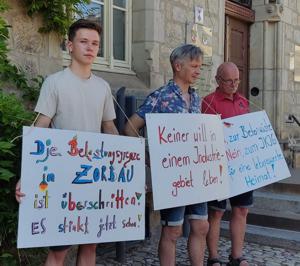 | Deception and Concealment: The True Face of the Structural Change Millions!On June 26, 2024, critics of the IKIG (Intermunicipal Industrial Area) demonstrated in front of the town hall in Lützen.... zum Artikel |
 | Fantastic: Even your freedom restrictions are already definedIsn't it wonderful how carefully and foresightedly our judiciary defined your freedom restrictions years ago?... zum Artikel |
 | If the Hell-Summer in Germany Isn’t Enough for Climate Change HysteriaI had to chuckle again recently. A climate change doomsayer from Burgenlandkreis tried once more to spread fear of the climate apocalypse.... zum Artikel |


|
Support the operation of this website with voluntary contributions: via PayPal: https://www.paypal.me/evovi/12 or via bank transfer IBAN: IE55SUMU99036510275719 BIC: SUMUIE22XXX Account holder: Michael Thurm Shorts / Reels / Kurz-Clips Imprint / Disclaimer |